


PRSE 2026 live: Ampacet exhibits PCR material portfolio for PPWR compliance


Key takeaways
- Ampacet showcases its portfolio of PCR materials and advanced technologies at PRSE 2026, focusing on compliance with EU PPWR.
- Technologies such as OdorClear, AA Scavenger, and Rec-NIR-Black are said to enhance recyclability, improve product quality, and meet sustainability goals for packaging.
- Ampacet emphasizes recyclability by design, with solutions for the beauty and personal care sectors addressing premium aesthetics and eco-compliance.
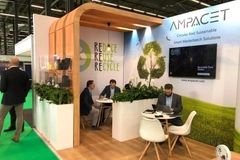 Image credit: Ampacet.
Ampacet is exhibiting its comprehensive portfolio of polymers, with a focus on post-consumer recycled (PCR) materials, at the ongoing Plastics Recycling Show Europe (PRSE) in Amsterdam, Netherlands (May 5–6).
The global masterbatch company is highlighting its advanced scavenging and stabilization technologies that are said to address key challenges associated with recycled materials and ensure compliance with European regulations.
It is also presenting its Halolite and Halofree flame-retardant technologies, which use low-halogen or halogen-free formulations free from substances of very high concern to support compliance with safety standards.
“The Packaging and Packaging Waste Regulation (PPWR) is a cornerstone of EU policy, which places binding requirements on packaging recyclability, recycled content, waste prevention, and eco-design, moving beyond voluntary targets to mandatory compliance,” François Thibeau, strategic business manager for Flexibles, E&E, and Sustainability at Ampacet, tells Packaging Insights.

“Meanwhile, the Circular Economy Package and European Plastic Strategy set ambitious targets for recyclability and recycling rates, for example, a minimum 50% plastic packaging recycling by 2025 and 55% by 2030, which is influencing packaging decisions.”
“National schemes like France’s Citeo eco-modulation system aim to incentivize recyclable packaging and penalize non-recyclable formats.”
PCR content & recyclability
At PRSE, Ampacet is presenting its portfolio of masterbatch technologies designed to improve the quality, aesthetics, and recyclability of plastics while supporting higher PCR incorporation rates.
The OdorClear range is among the solutions presented at the show. The range includes a series of odor-absorbing masterbatches intended to neutralize unwanted smells in PCR resins, enabling higher recycled content in packaging applications without affecting consumer experience.
The company is also highlighting its AA Scavenger technology for PET and recycled PET bottles, which is designed to reduce acetaldehyde levels by up to 80% to help preserve taste and product quality.
Furthermore, the company is displaying ThermProtect, a stabilization solution developed to minimize thermal degradation and yellowing in recycled polymers such as PET and PE, alongside desiccant masterbatches that absorb moisture in post-consumer resins.
Ampacet is emphasizing packaging design solutions intended to improve recyclability. Its Rec-NIR-Black masterbatch can replace traditional carbon black formulations, allowing black plastic packaging to be detected and sorted through near-infrared (NIR) technology.
Thibeau says black packaging remains highly valued in beauty and personal care for its premium appearance, pointing out that traditional carbon black formulations have historically limited recyclability.
“This creates a conflict between premium aesthetics, functional requirements, and environmental responsibility,” he explains. “With the PPWR moving toward mandatory recyclability and recycled content requirements, brands can no longer rely on subjective or ambiguous sustainability claims. Packaging must be demonstrably compliant.”
Thibeau notes that Ampacet’s Rec-NIR-Black technology is designed to reduce this tension by combining recyclability with premium aesthetics.
“Premium” recycled material
Ampacet is also presenting its Gastop-Flex technology platform, which enhances gas barrier properties in polyolefin packaging while reducing EVOH content below the 5% RecyClass threshold to support recyclable barrier packaging structures.
Additional technologies include LaserMark and LaserMarkFlex laser-marking solutions for ink-free marking, as well as nucleating agents designed to improve the stiffness and mechanical performance of PP while supporting downgauging.
Ampacet’s ReVive portfolio is also being showcased at the event. ReVive 311E and ReVive 324 are compatibilizers intended to homogenize mixed polymer streams such as PE, PP, polyamide, and ethylene vinyl alcohol to improve mechanical properties and support upcycling into higher-value applications.
Meanwhile, ReVive 614 is designed to restore impact strength to “near-virgin levels” while maintaining recyclability and supporting higher PCR content.
“If brands want to future-proof their packaging portfolios, they should prioritize recyclability by design, compliance with mandatory regulatory standards, material innovation, and certification,” says Thibeau.
He observes that beauty and personal care brands in particular are increasingly moving away from “theoretically recyclable” packaging components by redesigning pumps with fewer mixed materials, aligning label and bottle materials, reducing ink coverage, and adopting wash-off adhesives and laser-marking technologies.
Thibeau adds that sustainability claims are facing greater scrutiny from regulators and consumers, with brands expected to provide clear evidence around recyclability and PCR content claims.
“Consumers still expect sustainable plastic packaging to feel premium, hygienic, and easy to use. The challenge for brands is balancing those expectations with compliance and circularity goals.”