


Greiner Packaging CEO talks circularity, partnerships & sustainable profitability


Key takeaways
- Greiner Packaging’s circular economy strategy focuses on reducing materials, reusing, and recycling for sustainable, future-proof packaging.
- The packaging company collaborates with brands like air up and Henkel to develop innovative, sustainable solutions.
- It uses digital tools and automation to increase efficiency, reduce waste, and maintain profitability.
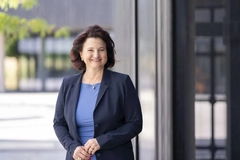
Beatrix Praeceptor, CEO at Greiner Packaging, tells us how the packaging manufacturer turns circular economy principles into a competitive advantage, focusing on sustainability, innovation, and customer partnerships. We sit down with Praeceptor to hear more about the company’s business strategy and its plans for 2026.
How are you turning circular economy principles from a compliance driver into a competitive advantage?
Praeceptor: The circular economy is not only about compliance. It is a strategic lever and a key differentiator in the market. We focus on the principles of “Reduce, Reuse, Recycle.” We reduce materials that are not necessary for packaging to function properly and minimize the use of virgin materials by implementing recyclates and making products more sustainable.

We produce reusable packaging, such as drinking bottles, cups, and meal boxes, to avoid single-use plastics. At the same time, we design our products according to design-for-recycling principles, ensuring they can be reintegrated into the material cycle as effectively as possible and help close the loop (for example, K3 r100 and washable inks).
With the upcoming EU Packaging and Packaging Waste Regulation setting ambitious recyclability and reuse requirements, we see our early investments paying off. By being fully prepared for these changes, we give our customers confidence that their packaging solutions will remain compliant and future-proof, allowing them to focus on their core business.
At the same time, we are going beyond regulatory requirements by investing in recycling infrastructure, material innovation, and partnerships with start-ups through Greiner Innoventures. This enables us to develop new circular business models and create packaging solutions that are not only sustainable but also deliver real market differentiation. In short, we are turning circularity into a competitive advantage, for our customers and for ourselves.
When you stepped into the CEO role, what were your strategic priorities for Greiner Packaging, and how have those evolved?
Praeceptor: When I assumed the CEO role in May 2023, my priorities were clear: accelerate sustainable product development, drive organizational transformation, and strengthen global competitiveness. Over the past year, these priorities have evolved to reflect market realities.
We aligned our recycling strategy with new EU packaging regulations, streamlined our organization, and expanded our footprint in North America, where we’ve achieved above-average growth. In Europe, we responded to increasing price sensitivity with innovative, cost-efficient solutions.
Can you share an example of how customer partnerships have shaped product development or recyclability advances under your leadership?
Praeceptor: A good example is air up. This cooperation went far beyond production: together, we redeveloped key components of the innovative drinking system to enhance functionality and quality.
The straw and closure were completely re-engineered to make the bottle more robust and fully leakproof, while production was relocated to Austria to shorten supply chains and reduce CO2 emissions. In addition, the surface finish was improved by integrating the color masterbatch directly into the bottle instead of applying a lacquered coating. Even the outer packaging was redesigned to use fully recycled cardboard.
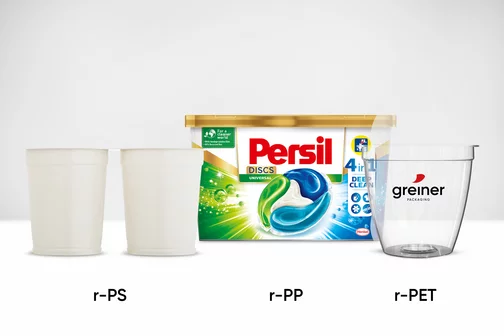 Product examples of Greiner Packaging's recycled materials range.With Henkel, our long-standing partnership resulted in toilet-rim cages made from 30% post-consumer recycled material and 70% renewable feedstock PP, combining functionality and aesthetics with an improved environmental footprint.
In cooperation with Orthomol, we developed tailor-made high-tech production lines for its bottles and enabled the use of 30% recycled PET, ensuring strict hygiene and quality standards are met while improving circularity.
And in Switzerland, starting this year, we will produce K3 cups with recycled polystyrene content at our Diepoldsau site. This initiative, realized together with partners such as ELSA and Emmi, will reduce CO2 emissions and demonstrate how local collaboration can help to improve the sustainability of packaging.
Across all these projects, one principle remains consistent: true innovation and progress in creating more sustainable products are only possible through close, trust-based partnerships with our customers. We cannot develop a product without their active involvement. We can provide design and production capability, but they need to test it on their production and filling lines, carry out migration and product safety checks, conduct storage trials, and validate market suitability.
This is why partnership matters: it requires a customer who is motivated to adopt improved and sustainable product solutions early, engages proactively in testing and validation, and completes all necessary checks thoroughly. Only with this level of collaboration can we ensure that the solutions are viable, safe, and ready for the market.
How is Greiner Packaging maintaining profitability while meeting higher environmental expectations?
Praeceptor: Greiner Packaging faces the same mounting pressures as the broader packaging industry. Rising raw material and energy costs, stricter regulations, and increasing consumer expectations for sustainable products all add complexity to our operations. Sustainable packaging solutions are often more expensive to produce, and virgin materials remain cheaper and easier to source than recycled alternatives. At the same time, we need to ensure that our products meet high standards for quality, safety, and performance while supporting circular economy goals.
However, maintaining profitability while meeting increasing sustainability demands is not a contradiction for us, but our operating principle. We address these challenges through cost discipline, technological excellence, and targeted investments. Despite volatile market conditions, we achieved a 3.6% revenue increase in 2024, proving that sustainable growth is possible.
A key driver of this success is our focus on automation and digitalization. By investing in state-of-the-art technologies and data-driven process optimization, we increase production efficiency, reduce energy consumption and material waste, and ensure consistent quality. We also generate solar energy at several of our sites, reducing energy costs while further advancing our sustainability objectives. This allows us to operate more competitively while continuing to meet the highest environmental and regulatory standards.
Through innovation, efficiency, and close collaboration with our customers, we are building a resilient, future-oriented business model where economic success and environmental responsibility go hand in hand.
How is Greiner Packaging integrating digital tools to improve efficiency, traceability, or recycling performance?
Praeceptor: Greiner Packaging uses digital tools not only to continuously improve our business operations but also to make our packaging more sustainable and easier to manage throughout its lifecycle. Data analytics and process monitoring help optimize production, reduce material waste, and ensure consistent quality.
On the product side, smart packaging solutions like the digital product passport provide clear information on material composition, recyclability, and origin, giving customers and recyclers better transparency.
We explore a variety of digital approaches to find the most effective solutions, for example, HolyGrail 2.0, which uses digital watermarking to improve sorting and enable high-quality recycling of complex packaging. RFID chips in reusable packaging are another tool we can use to track usage, ensure proper collection, and support cleaning and reuse cycles.
By combining these tools, we make our packaging more traceable, more recyclable, and better aligned with circular economy goals.
What will define success for Greiner Packaging in the upcoming years?
Praeceptor: Success means combining innovation with responsibility. We see strong growth potential in North America, in recycled and bio-based materials, and in digitalized business models. Expanding circular economy initiatives and forging new partnerships for sustainable solutions will be key. Our ambition is to remain a packaging leader and become a pioneer in sustainable technologies.