





Christmas packaging trends: Recyclability, minimalist design and supply chain agility drive innovation

Key takeaways
- Packaging companies explore eco-friendly materials and plastic alternatives for festive packaging.
- Innovative designs blend sustainability with luxury, offering unique seasonal solutions.
- DS Smith, Pure Trade, and Hunter Luxury discuss supply chain optimization and recyclability efforts for the holiday season.

As the holiday season kicks off, packaging manufacturers are creating products that blend the magic of Christmas with sustainability and functionality, ensuring festive appeal, recyclability, and effective product protection during transport.
Packaging Insights sits down with DS Smith, Pure Trade, and Hunter Luxury to discuss the latest innovations in Christmas packaging, exploring the demand for paper-based solutions, as well as the balance between aesthetics and functionality in seasonal personal care and snack packaging.
Anne Curtis, business unit lead for e-commerce at DS Smith, tells us: “We are seeing a build-up to the Christmas peak, and a clear ‘path to ship’ in our own containers alongside the lightweighting of hybrid and flexible packaging for lightweight products. Likely this trend is led by current and imminent legislation around packaging, and by consumer thinking and preferences for sustainable options.”
Holiday demand
Curtis explains that the majority of Christmas packaging is often planned well in advance by manufacturers. At DS Smith, that means implementing its Design and Innovation team to align customer objectives with its Circular Design Metrics (CDM) and Value Chain Analysis.
“All of this is in support of full supply chain optimization. The pioneering CDM tool enables us to rate and compare the circularity of packaging designs across eight different indicators, ranging from carbon footprint, reuse, supply chain optimization, recyclability, and material utilization, to recycled content.”
The Value Chain Analysis also enables DS Smith to ensure that the packaging creation process for the holiday season is streamlined by identifying inefficiencies and optimizing opportunities for enhanced value creation.
Meanwhile, luxury packaging provider Hunter Luxury stresses the importance of agility in the supply chain around the season.
Paul Hamilton, head of sales and marketing at Hunter Luxury, tells us: “Seasonal lead times and demand uncertainty mean suppliers should be agile and efficient. There are times when we need to be creative in order to solve problems.”
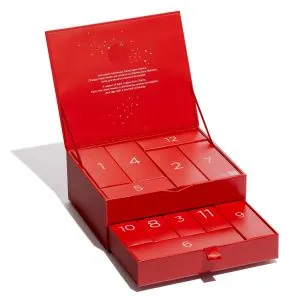 Pure Trade's advent calendar for Clarins is recyclable and made from responsible sourced forests.Hamilton explains Hunter Luxury has “contingencies for contingencies” around the holiday season to ensure that its customers can trust it to deliver the product to the agreed specification. But, he adds, it is vital to ensure that the product specification is realistic.
Designing for recyclability
At the heart of festive packaging this year is innovation that reduces reliance on plastic and increases product recyclability. Hamilton says that balancing functionality with recyclability requires a “clear vision” and collaborative relationship between client and supplier.
He notes: “This helps us to pin down the personality of the brand and its products, giving us a solid foundation to work from when making creative decisions around materials and production techniques.”
“Our beauty advent calendars for Next used high-quality printed designs that were strategically spot varnished and foiled. The designs carried a strong visual impact and made smart use of traditional premiumization techniques but did so while being fully recyclable or reusable if required.”
The calendar features recyclable rigid box elements, with the boxes designed as durable keepsakes for vanity or storage uses. Hamilton also notes an increase in packaging that doubles as a keepsake, giving consumers the option to use packaging as well as product.
Designing for recyclability and functionality continues with Pure Trade’s advent calendar for Clarins and Lancôme, made from FSC-certified paper and cardboard.
A Pure Trade spokesperson tells us: “Designed with sustainability in mind, both calendars are made entirely from FSC-certified cardboard and coated paper from responsibly managed forests. Fully recyclable, they can also enjoy a second life as elegant jewelry boxes.”
Creative techniques
 Hunter Luxury's beauty advent calendars for Next used high-quality printed designs that were then spot varnished and foiled.A main feature of Christmas packaging is the use of decorative designs that evoke a sense of luxury, uniqueness, and the spirit of gift-giving. To achieve this, packaging techniques can include printing, embossing, hot stamping, and varnishing.
DS Smith’s Curtis, says: “We offer advanced printing solutions, from Flexographic to High Quality Print, litho-laminating, and digital — using the most appropriate papers to ensure that our packaging products are delivered to consumers in their end destination as expected.”
“We provide flexible options around our digital printing expertise, and we invest in new technologies to ensure that these are market leading. We offer a digital print format that has proven successful. We can also apply laser line processes where required and produce small quantities or scale upward using the appropriate technology.”
Furthermore, the Pure Trade spokesperson highlights that its advent calendar for Lancôme was achieved through “perfectly aligned hot stamping, reflecting Maison’s exacting standards of precision.”
Moreover, Pure Trade’s calendar for Clarins was made in Europe through semi-automated production.
The spokesperson adds: “The boxes embody technical precision, featuring a cardboard drawer-stop system. The coated paper, printed in Clarins’ signature red, is adorned with a subtle, shimmering ‘Christmas ornament’ motif created through hot stamping and selective varnish.”
Minimal, not simple, design
 Pure Trade's advent calendar for Lancôme used hot stamping, reflecting Maison’s standards of precision, according to the spokesperson.This year, Hunter Luxury equipped skin care brand ESPA with the packaging for its limited-edition Christmas collection. The cardboard and velour range features an advent calendar, rigid gift boxes and accompanying FBB cartons, a premium vanity case, cosmetic bags, and retail store bags.
The advent calendar is made from a rigid format wrapped in dyed-to-Pantone paper with an embossed fine-line texture and chiseled foil numbering. The advent calendar compartments reveal 25 drawers, each holding a gift.
Hamilton says: “There’s definitely a trend toward minimalism without losing any of the impact or the ‘wow’ factor that consumers expect from Christmas packaging.”
He explains that the trend is fueled by consumer expectations around sustainability and convenience. “‘Minimalist’ doesn’t necessarily mean ‘simplistic’, it means designs have to be efficient, and every creative decision has to be justified.”
Hamilton adds that digital printing and hybrid approach can offer brands customizable Christmas designs.
“Digital printing is the key that has unlocked countless new possibilities for personalization. It makes limited or seasonal projects much more economical to produce, and we have built relationships with a number of printers who can deliver these short-run projects without compromising quality.”
He adds that regionalized or store-specific packaging can be made using traditional print for the main design, while digital inkjet printing can be used to provide overprinting for personalized elements.
Protected holiday deliveries
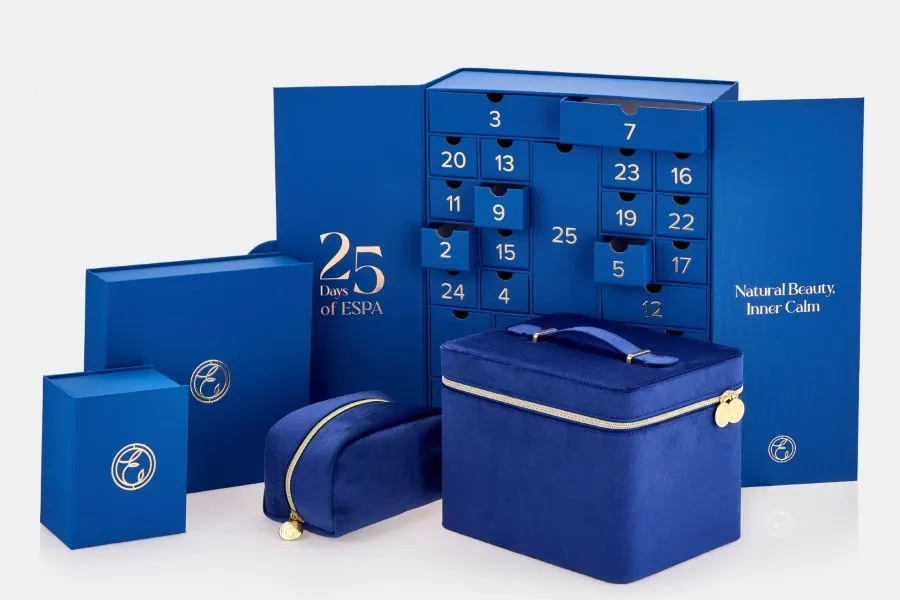 Hunter Luxury's Christmas collection for ESPA. Hamilton Explains there is a trend toward minimalization design that also features festive decorations.For DS Smith, it is crucial that packaging during the holiday season is protective and sturdy, particularly for e-commerce products.
“Our packaging solutions for e-commerce are tested using our DISCS system, our smart in-house testing, and patented process. This is industry-leading, and we work from the premise that packaging needs to survive as many as fifty different touchpoints,” says Curtis.
“In addition, we apply International Safe Transit Association testing in our laboratories to ensure our packaging is transported safely and provides protection to minimize any product damage during transit. Ultimately, the consumer can therefore enjoy their unboxing experiences and receive their products safely.”