


Zero Waste Day 2026: Avery Dennison spotlights smart packaging to reduce food waste


Key takeaways
- Avery Dennison highlights how poor inventory control is driving record meat waste, with 72% of industry leaders citing it as a key challenge.
- Connected packaging technologies (RFID, NFC, IoT) enable real-time tracking of freshness, location, and expiry.
- Combining smart packaging with data-driven inventory management and cross-value chain collaboration is said to be critical to reducing food waste at scale.

Avery Dennison is marking the UN’s International Day of Zero Waste (March 30) with a report revealing how limited inventory control is contributing to “record levels” of meat loss.
We catch up with a company spokesperson to find out how connected packaging can help tackle food waste.
“Packaging innovation is at the heart of the solution to food waste, but it is most effective when combined with better forecasting and stronger supply chain management,” a spokesperson at Avery Dennison tells Packaging Insights.
“Food waste is a complex, multi-stage challenge, and increasing visibility of where waste happens is essential to understanding where value is being lost and where action is needed.”

According to the new research conducted for Avery Dennison’s Making the Invisible Visible report, 72% of F&B industry leaders say managing meat-related waste is their single biggest operational challenge, with 74% saying inflation is making it harder to forecast meat demand.
The spokesperson shares that the issue can be tackled by introducing a digital identity to every food item to help pinpoint losses. “The most effective response is not to choose between packaging and operations, but to connect them.”
Shelf life-extending packaging
Avery Dennison describes packaging as central to food inventory control, as it helps protect product quality and extend shelf life. These factors are particularly important in perishable categories where even small delays or temperature changes can lead to spoilage.
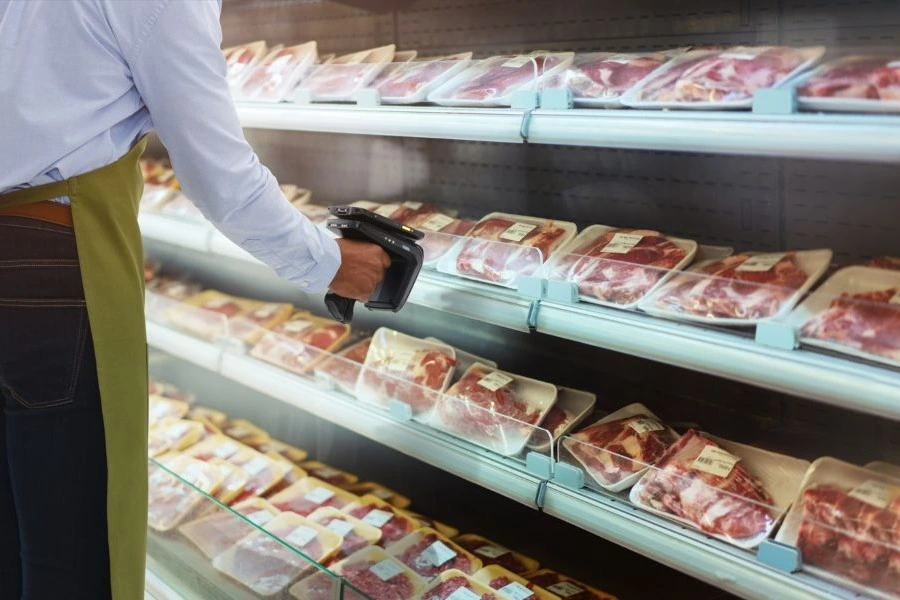
“Connected packaging technologies such as RFID, NFC, QR codes, and ambient IoT provide item-level visibility into where products are, what condition they are in, and when they are approaching expiry, replacing guesswork with actionable, real-time insight,” the spokesperson adds.
“Freshness-extending labels, resealable formats, and other shelf life-extending packaging technologies are key to preserving quality, extending usability, and reducing the likelihood that food is discarded before it can be sold or consumed.”
 Vidre+ is a freshness-extending labeling solution developed by Fresh Inset and supported by Avery Dennison (Image credit: Avery Dennison).The spokesperson highlights Vidre+, a freshness-extending labeling solution developed by Fresh Inset and supported by Avery Dennison and designed to slow the ripening of produce and extend freshness by turning an “everyday label” into an “active packaging tool.”
“Results include spinach maintaining good to excellent quality for up to 10 days and raspberries maintaining good eating quality for up to 20 days.”
Resealable packaging is another important format, particularly for products where waste happens after opening, according to Avery Dennison. By helping consumers maintain freshness once packs are opened, resealable and reclosure packaging can reduce waste after purchase while also supporting new consumption occasions.
More broadly, packaging redesigns, intelligent labeling, and shelf life extension technologies stand out among the most effective interventions businesses have implemented.
Taken together, packaging formats that extend freshness, improve resealability, or add intelligence to the pack stand out as some of the most effective interventions for reducing waste.
Ensuring data utilization
The Avery Dennison spokesperson asserts that connected packaging requires an ecosystem, not just an intelligent label. “It starts with item-level technologies that allow each product to carry a digital identity.”
“These technologies make it possible to monitor location, temperature, humidity, and expiry data throughout the product journey, giving businesses much greater visibility into where waste is occurring and why.”
In practice, data needs to feed into core workflows such as stock rotation, expiry management, markdowns, forecasting, and inventory optimization.
“The biggest reductions in waste come when businesses use packaging innovation to preserve freshness and combine that with stronger inventory management and coordination across the supply chain. The real opportunity lies in using that data to improve decision-making and reduce waste at scale,” the spokesperson adds.
Sensing and data-capture capability, the connected product cloud, and applications are among the factors that Avery Dennison says can bring information together and turn it into usable insight for brands and consumers.
“Together, these form an end-to-end ecosystem in which data from individual products can be used to identify issues earlier and act before spoilage occurs.”
Value chain collaboration
Connected packaging also depends on collaboration across the value chain, according to the Avery Dennison spokesperson. If suppliers, logistics providers, and retailers are working to different standards or with fragmented data, visibility remains limited.
A recent study conducted in the US found that while connected packaging with biosensors and IoT can help reduce food waste by monitoring freshness and spoilage, integration into existing supply chains faces challenges such as high infrastructure costs and regulatory hurdles.
“The infrastructure required is technical and operational: physical identifiers on pack, systems to capture and use the data, connected product cloud infrastructure and applications to manage it, and shared standards that allow businesses to act on that data in real time,” the spokesperson continues.
“That is what turns connected packaging from a technology concept into a practical waste-reduction tool.”