
Barrier coating innovators balance performance, recyclability & PFAS-free packaging


Key takeaways
- The packaging industry is working to balance strong barrier performance with recyclability and compostability.
- Companies are developing PFAS-free, water-based, and mineral or bio-based coatings to replace plastic laminates.
- Full plastic replacement isn’t universal yet, but scalable fiber-based solutions are rapidly advancing.

A major challenge in modern packaging is combining high-barrier performance with recyclability. We sit down with experts at BASF, Flint Group, and Qwarzo to discuss the trade-offs manufacturers face when protecting against moisture, oxygen, and grease, while meeting recyclability goals.
We also explore how the industry can develop smart plastic substitutions that are feasible and scalable.
“BASF tackles the performance challenge holistically, providing packaging solutions with partners along the value chain instead of only focusing on the resin produced by BASF,” Dr. Michael Bernhard Schick, Global Marketing Biopolymers, Paper & Flexible Barrier Packaging at BASF, tells Packaging Insights.
BASF’s biopolymer ecovio offers various high-barrier solutions for FMCGs like food packaging.
Historically, achieving high-barrier performance against water, oils, and grease required the use of materials that compromised recyclability and compostability.
Today, this trade-off can be overcome, Luca Panzeri, chief technology officer and founder at Qwarzo, tells us.
“Qwarzo is a concrete example: it enables paper to gain resistance to water, oil, temperature, oxygen, and vapor without altering its recyclability or compostability.”
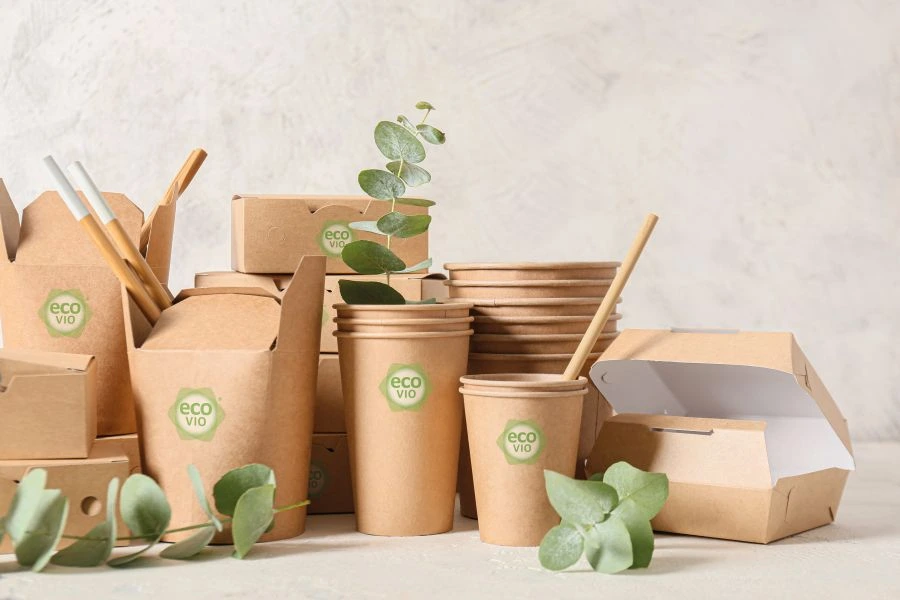 BASF’s biopolymer ecovio can be applied to high-barrier food packaging (Image credit: BASF).“This is possible because Qwarzo is mineral-based. It is free from plastic and intentionally added PFAS and invisible, odorless, and tasteless; and patented,” highlights Panzeri.
Beyond laboratory validation, he says that “true technological maturity” is demonstrated through real-world implementation.
“Adopted by Starbucks EMEA, our technology contributed to the launch of a compostable paper cup that is now distributed across their regional stores. Millions of cups are produced and used every day with Qwarzo — a tangible demonstration that mineral-based coatings are not experimental, but industrially mature, scalable, and embedded in global supply chains.”
Competing with multilayer plastic
Alessio Crivellari, product manager for Paper & Board EU at Flint Group, tells Packaging Insights that historically, polyboard (PE-coated paperboard) was used for barrier coatings as it delivers strong functional performance at low cost.
“However, it occupies a sustainability ‘grey zone.’ Polyboard is neither fully paper nor fully plastic, and therefore poses challenges for recycling systems. As a result, brand owners and converters are increasingly moving toward monomaterial, fiber-based solutions that can be recycled within standard paper recovery streams.”
Recyclability and monomaterial objectives favor thin, water-based coatings that remain compatible with fiber recycling streams over conventional multilayer plastic solutions, according to Crivellari.
He adds that these materials often deliver lower overall barrier performance than traditional multilayer plastics.
But Crivellari says the gap is closing quickly. “For many short shelf life or lower sensitivity foodservice applications, such as fast-food wrappers, bakery bags, and corrugated transit packaging, innovative water-based coatings, such as DecaCode Barrier variants, now provide good-to-excellent grease and water repellence alongside sufficient moisture barrier for typical use cases. This supports meaningful plastic reduction in these segments.”
“In some cases, recyclable monoplastic laminate solutions may still be appropriate where suitable recycling infrastructure exists.”
“Overall, water-based barrier coatings have made substantial progress, but universal replacement across all high-barrier categories is not yet fully achieved.” Monomaterial demands have led to water-based coatings compatible with fiber recycling streams (Image credit: Flint Group).
Renewable coating innovation
Recently, BASF introduced ecovio grades for FMCG packaging, which are said to be based on renewable sources. In addition, they are certified home compostable and do not create any persistent microplastics, according to Schick.
“They offer excellent barrier properties for greasy and liquid packaging. For manufacturing, converters can use existing machines for conventional plastics: BASF developed these ecovio grades for any kind of packaging processing technology like extrusion (paper) coating or film lamination processes,” he notes.
Meanwhile, chemical company Qwarzo develops alternatives to plastic coatings and traditional barrier solutions.
“We are currently applying our mineral coating across various paper and cardboard products, including cutlery, vending and takeaway cups, plates, and cardboard fish boxes designed to replace expanded polystyrene packaging. This allows us to operate across multiple packaging segments while supporting the transition away from plastic-based solutions,” says Panzeri.
Furthermore, Flint Group’s latest barrier coating innovations are focused on helping converters to transition from plastic to fiber-based materials through lightweighting and material substitution.
“Through our DecaCode Barrier portfolio, we have developed water-based coatings designed to protect paper and board packaging against water, water vapour, oil, and grease,” says Crivellari.
“All of these innovations are PFAS-free and designed with regulatory readiness in mind, reflecting the growing demand for compliant, future-proof packaging materials.”
Replacing PFAS
Schick says BASF’s ecovio is “perfectly in line” with tightening regulations on PFAS as it does not contain any “forever chemicals.”
“Ecovio is food-contact approved in many countries as all our ecovio grades are certified compostable, support organic recycling, and do not create persistent microplastics.”
He says that together with partners along the paper packaging value chain, BASF recently demonstrated that paper packaging coated with ecovio is suitable for mechanical paper recycling on an industrial scale.
Meanwhile, Panzeri says the tightening of global regulations is driving a structural shift in the packaging industry as companies must adapt to a new paradigm based on legislation that restricts or bans certain materials, particularly in single-use plastic packaging.
“This scenario is redefining the role of coatings and functional barriers, which today represent a key solution for replacing plastic and PFAS while remaining fully compliant with regulatory requirements.”
“Qwarzo does not compromise the end-of-life properties of a material. Paper coated with Qwarzo maintains its recyclability and compostability, allowing converters and brands to meet current regulatory requirements while preserving material circularity.”
Can paper replace plastic laminates?
Schick says that with its ecovio grades for paper coating, BASF offers solutions which are “well-proven” and do not compromise shelf life.
“Ecovio supports customers and brings additional value like multiple end-of-life options: It is certified industrial and home compostable, so that soiled paper packaging can be composted at home or in industrial facilities without creating persistent microplastics.”
 Mineral and next-gen coatings have reached a level of maturity that allows plastic replacement, says Panzeri (Image credit: Qwarzo).For Qwarzo, paper has become a central material in packaging innovation. “However, compared to plastic, paper has intrinsic limitations in terms of barrier performance if not properly functionalized,” says Panzeri.
“However, current mineral and next-generation coatings have reached a level of maturity that allows plastic replacement in a growing number of real-world applications — particularly in food packaging.”
Panzeri adds that replacing plastic liners in paper cups is an example of this progress. “When solutions are already implemented at industrial scale — serving millions of units daily — it demonstrates that barrier coatings can meet not only technical performance criteria, but also processability, scalability, and economic feasibility.”
“The key is not absolute substitution in every case, but smart substitution where performance, sustainability, and circularity can be balanced without compromising product integrity.”
Flint Group’s Crivellari says: “The focus has clearly shifted from maximum barrier performance at any cost to functional performance compatible with circularity, which is driving some of the most exciting formulation work in the industry right now.”
Rethinking barriers
Panzeri says that the future of sustainable packaging will be defined not only by new material standards, but by companies’ ability to rethink their approach, mindset, and design philosophy.
He asserts that a simple material switch, without broader changes in mindset and product design, is insufficient to unlock the full potential of innovative technologies.
“Solutions like Qwarzo demonstrate that functionalized paper can deliver the same barrier performance as traditional plastics, making it a viable alternative across packaging applications. We believe that functionalized fiber-based packaging will become the new standard, combining sustainability, circularity, and industrial scalability.”
“When material, design, and user experience are reimagined together, it becomes possible to develop truly sustainable alternatives capable of replacing plastic while delivering the same functional experience to the consumer — through entirely different materials and technological platforms.”
Crivellari says Flint Group expects the next generation of sustainable packaging to be shaped by continued advances in water-based and bio-based coating platforms.
“Formulations built on renewable feedstocks and designed for compatibility with existing recycling infrastructure will become the standard, not the exception.”
“The packaging industry is at an important junction, where regulatory pressure, brand sustainability commitments, and consumer expectations are putting real momentum behind fiber-based packaging solutions. For converters, the question is no longer whether it’s time to make this transition, but how to do so without compromising on the performance their customers depend on,” says Crivellari.