


Australia’s plastic recycling sector at “tipping point,” industry calls for reforms

Key takeaways
- Industry groups warn that without government action, Australia’s plastic recycling rates could drop to 32% by 2030.
- ACOR and APCO urge the government to implement a mandated EPR scheme to protect local recycling capabilities.
- Despite the cost increase of packaging reform, the impact on consumers would be minimal, according to an industry analysis.
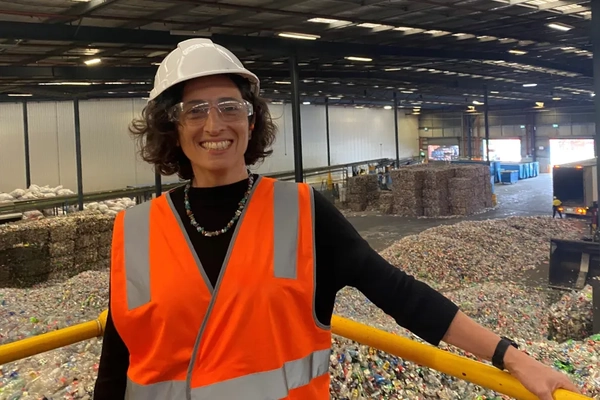
A recent letter from the Australian recycling and packaging industry insists the current government “urgently” introduces packaging reforms or “risks the collapse” of Australia’s plastic recycling sector.
The Australian Council of Recycling (ACOR) and the Australian Packaging Covenant Organisation (APCO) have called on the government to protect the country’s recycling industry following a commissioned report by Rennie Advisory.
The report found that without regulatory reform, Australian plastic recycling rates could fall to just 32% within the next five years, leading to facility closures, job losses, and stalled investment in the circular economy.
Packaging Insights speaks with Suzanne Toumbourou, CEO at ACOR, about Australia’s circular economy amid growing imports of virgin plastic.
What prompted ACOR and APCO to release this letter now?
 Global oversupply of cheap resin, mainly from Asia, makes it difficult for Australian recyclers to compete, says Toumbourou.Toumbourou: Australia’s plastic recycling sector has reached a tipping point. Without urgent action, we risk losing the local capability we’ve built. Rennie Advisory’s report provides the government and industry with a clear, evidence-based roadmap for reform, supporting Australia’s National Packaging Reform through a mandated EPR scheme, to drive immediate action this term and prevent facility closures and loss of sovereign recycling capability.
Why is Australia’s plastic recycling sector at the “risk” of “collapse”?
Toumbourou: Recycling is a remanufacturing supply chain, encompassing collection, processing, and markets for the recycled product. Without demand for recycled material, the system is not viable. Currently, only around 53% of Australia’s recycling capacity is being used (below commercially viable levels), and recycled plastic costs up to 50% more than imported virgin material.
Without policy intervention, utilization could fall to just 32% by 2030, putting investment, facilities, and jobs at risk. The experience in Europe and the US shows that similar pressures have already forced major recycling plants to close. If no action is taken, Australia could face the same outcome, losing both jobs and sovereign recycling capability.
What is causing the low demand for Australian recycled plastic?
Toumbourou: The lack of demand is driven by both price and policy. Global oversupply of cheap resin, mainly from Asia, makes it difficult for Australian recyclers to compete. Producing recycled plastic locally is more expensive due to higher labor, energy, logistics, and regulatory compliance costs.
Without mechanisms to prioritize local recycled content, businesses naturally opt for the cheaper imported alternative, which often has an unfair advantage due to lower costs and differing regulatory requirements.
What immediate actions do ACOR and APCO want the government to take?
Toumbourou: First, the government should commit this term to Australia’s National Packaging Reform with a mandated EPR scheme. Second, procurement policies and EPR incentives should be used to favor Australian recycled content, so local recyclers have a market for their products.
What impact would the packaging reform have on costs for consumers and businesses?
Toumbourou: The report’s modeling shows that Australian households spend around AU$246 (US$157.44) per week on groceries, with packaging materials accounting for approximately 2.5% of that, or AU$6.14 (US$3.93). Introducing an EPR scheme would only affect a small fraction of this cost, with products in plastic packaging potentially seeing an increase of around 0.1%.
This is minimal compared with the broader environmental and waste management costs currently borne by society.