



Avery Dennison positions smart packaging and traceability as key to cut food waste


Key takeaways
- Food waste is driven by limited supply chain visibility, with 61% of businesses lacking insight into where losses occur, according to a new report from Avery Dennison.
- Smart packaging, RFID-enabled labels, and digital identity are highlighted as tools to extend shelf life.
- Innovations such as freshness-extending labels and item-level tracking in high-risk categories like meat could help retailers cut costs.
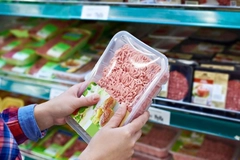
A new Avery Dennison report has found digital identity solutions in F&B packaging allow retailers to improve product traceability and cut food waste. The findings highlight smart packaging, traceability, and labeling as crucial to extending shelf life.
Packaging Insights discusses the report with Pascale Wautelet, vice president of global R&D and sustainability at Avery Dennison Materials Group.
“Packaging plays a critical role by enabling enhanced tracking and traceability. At the same time, materials science can improve freshness and extend shelf life,” she tells us.
Connected packaging can tackle food waste by maintaining freshness and improving visibility across the supply chain.
“Sixty-one percent of businesses across the globe still lack full visibility into where food waste occurs. The lack of visibility compounds food waste challenges, with costs in the supply chain equivalent to 33% of revenues.”

Labels that reduce waste
Wautelet argues that enhanced product tracking and traceability can help brands and retailers better manage stock rotation, expiry dates, and optimize markdowns and promotions to keep products fresher for longer.
 Pascale Wautelet, vice president of global R&D and sustainability at Avery Dennison Materials Group.“In Chipotle’s pilot, RFID was used across 200 locations to help trace ingredients at its distribution center and improve inventory accuracy. The system can read hundreds of tagged items in seconds, enabling quick action on freshness and food safety concerns, but also supporting better operational decisions that reduce spoilage and avoid overproduction.”
Connected packaging and intelligent labeling can help close the loop by linking consumers directly to product and recycling information and turning every label into a tool for transparency and more intelligent consumption, she shares.
“Freshness depends on making better decisions as products move through the chain. Enhanced tracking and connected packaging can help teams identify what needs selling first and apply more targeted interventions before quality declines.”
“Freshness protection also requires a holistic approach across the value chain. The most effective innovations include materials designed to improve freshness, and shelf life extension technologies such as barrier materials and compounds that slow ripening.”
Wautelet highlights the Fresh Inset Vidre+ freshness-extending labeling technology, which uses timed release of 1-MCP to temporarily block ethylene receptors, slowing ripening to extend freshness and quality.
“It is designed to integrate into existing packaging and equipment without needing operational redesign. That matters commercially as well as environmentally, because for exporters, every additional day of shelf life can mean the difference between profit and loss, and for retailers, Vidre+ can reduce markdowns and minimize waste from rejected items.”
Meat packaging technology
The Avery Dennison report cites meat as the most waste-intensive category. Wautelet adds that new economic modeling predicts that meat waste will cost the food industry US$94 billion in 2026, nearly a fifth of the total economic cost of food waste in the retail supply chain.
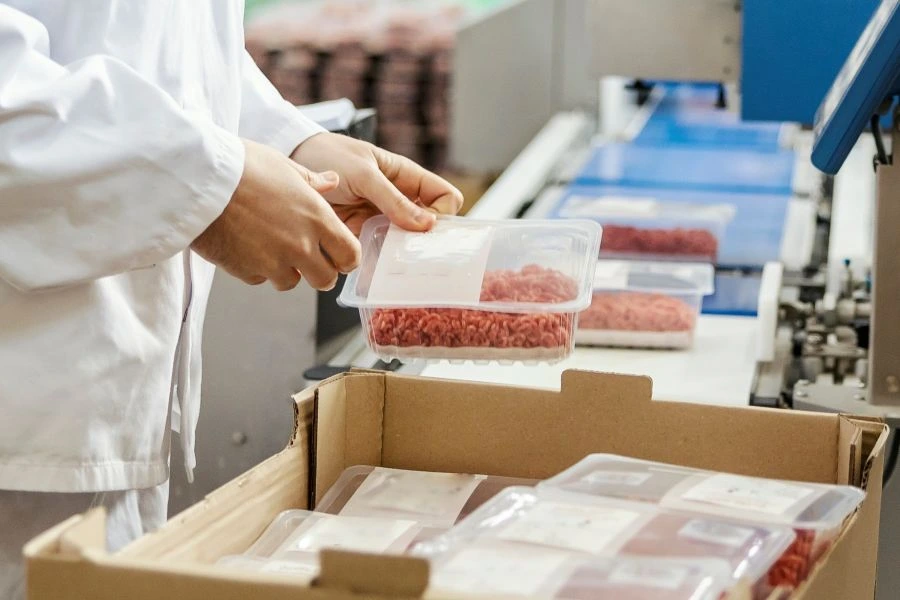 Automated item-level identification for meat products helps retailers to manage one of the highest-value items.“That’s why innovation is so important, particularly in areas that have historically been hardest to solve, like high-moisture, cold environments such as meat, where traditional tracking technology hasn’t always worked reliably.”
Walmart recently teamed with Avery Dennison to create and test a “first-of-its-kind” sensor technology that provides RFID-enabled labels to the meat industry.
“By using RFID solutions across meat, Walmart associates can track inventory faster and more accurately, helping keep products stocked and ready when customers want them. With digital use-by dates available, associates can rotate products more efficiently and make smarter markdown decisions, helping cut down on unsold food,” Wautelet explains.
She says that by introducing automated item-level identification for meat products, Avery Dennison has directly helped retailers to manage one of the highest-value items in store.
“It’s also important to think beyond packaging as just a protective layer. Connected packaging technologies like RFID, NFC, QR codes, and ambient IoT can provide end-to-end visibility of individual items, helping pinpoint where loss happens and enabling more targeted actions to prevent it.”
“Packaging fundamentally has a role in influencing consumer behavior. When shoppers understand where a product comes from and how much shelf life it has left, they are more confident buying it. Clearer packaging information can help reassure quality and safety, reducing unnecessary waste and supporting better purchasing decisions.”
Addressing barriers
One of the biggest barriers to food waste prevention, according to Wautelet, is that it has historically been treated as an “accepted cost,” rather than a business-critical operational issue.
 Economic modeling shows food waste costs across the supply chain can be equivalent to 33% of total revenue.“But the economic modeling shows that on average, food waste costs across the supply chain can be equivalent to 33% of total revenue, meaning improving performance and reducing loss should be viewed as a commercial priority.”
A second barrier she highlights is that retailers often deal with waste drivers that sit inside everyday operations, like inventory management and overstocking.
“This can make it harder to identify where packaging and labeling innovation will deliver the biggest return unless it’s paired with clear measurement and operational alignment.”
“At the same time, solving food waste can’t sit on the shoulders of retailers alone. Reducing waste requires a more value-chain approach, from upstream packaging design and responsible sourcing, through to shared data, visibility, and execution at store-level.”
Retailers are described as important drivers of change because they are closest to the point where waste becomes visible and where intervention happens fastest, adds Wautelet. However, progress depends on collaboration across suppliers, packaging partners, and logistics providers.
“Retailers also don’t want to improve performance in ways that undermine recyclability goals. Packaging, therefore, has to be designed for circularity as well as functionality. For example, Avery Dennison’s CleanFlake adhesive system is designed to enable complete separation of labels and RFID tags from PET containers during recycling, supporting improved recycled PET yield while maintaining label performance.”
Wautelet points out that food waste is rarely caused by one single failure point. “Perishables face pressure at every stage of the supply chain, and packaging constraints are consistently cited as one of the key friction points across categories like meat, produce, and baked goods.”
“That’s why meaningful progress tends to come from combining packaging innovation with better visibility and decision-making.”