



Empack 2026 review: Rising oil prices, global regulations & AI dominate industry innovation


Key takeaways
- Innovations addressing global regulations like SUPD, PPWR, and GS1 took center stage at Empack 2026 in Gorinchem.
- AI, automation, and bioplastic solutions are transforming packaging with a focus on sustainability and reducing reliance on fossil fuels.
- Key industry players discuss the intersection of technology and regulatory challenges.
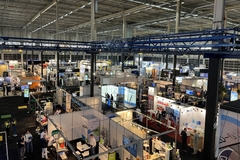
Innovations responding to pressures from global regulations and rising fossil fuel prices took center stage at this year’s Empack, held last week in Gorinchem, Netherlands.
Meanwhile, the shift toward AI and automation in factories was also at the forefront of manufacturers’ priorities, highlighting the challenge of balancing technological innovation with secure handling and practical, real-world application.
Exhibitors’ solutions to regulations like the EU’s Packaging and Packaging Waste Regulation (PPWR) and Single-Use Plastic Directive (SUPD), as well as Global Standard One (GS1) and workplace health and safety requirements, ranged from monomaterial and bio-based innovations to automated robotics and advanced packaging tracking tools.
Packaging Insights spoke to Markem Imaje, Smart Robotics, and Xampla to examine the array of global regulations shaping the packaging industry amidst increasingly volatile supply chains.
“Every three or four years, there’s some kind of global issue or disaster that means fossil fuel prices rise through the roof,” said Sam Walker, head of business development at Xampla.
At the show, Xampla presented its Morro Coating, a pea protein-based barrier coating that features in Huhtamaki’s range of corrugated takeaway boxes. The companies recently expanded their solution in a partnership with Just Eat.
“People are now starting to cotton on to the fact that they will never have a truly sustainable and secure supply chain until they start looking at alternative materials that are less volatile from external pressures,” added Walker.
The case for bio-based
Walker said that Xampla’s Morro Coating is an example of an industry solution that directly corresponds to PPWR, SUPD, and EPR demands.
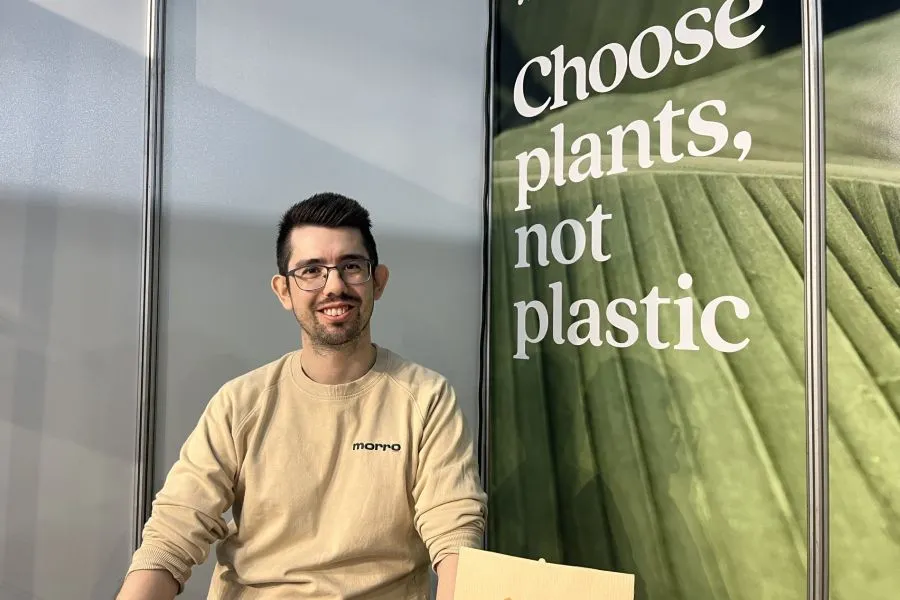 Consumers increasingly see that sustainable, secure supply chains need less volatile options, like bio-based materials, said Xampla’s Sam Walker.He added: “We have a real benefit in that we are exempt from SUPD. We’re in the lowest fees for EPR regulations in the UK, Europe, and also for the SB 54 in the US. It’s clear that the definition of plastic is standard across the world. Because of that, we’re now falling into the lowest category costs for material types — which is what everyone wants.”
Walker also noted that the “real barrier” within bio-based packaging materials has been the tension between performance and “better” sustainability.
“The takeaway box with Huhtamaki is one of the first packaging solutions to come to market, where there isn’t that compromise. It’s still high performing, and that’s been the gap in the market that the Morro Coating validates what natural polymers can do.”
Bioplastic solutions are on the rise as consumers and manufacturers seek to reduce reliance on fossil fuel-based virgin plastics. However, their market adoption poses challenges, including fair regulation, greenwashing claims, and the assumption that bioplastics do not perform as well as conventional plastics.
“There are fossil fuel plastic derivatives that are called bio-based, because they’re using a different feedstock, but it’s still the same kind of plastic. We’re trying to work and promote natural polymers, because those materials already exist in nature, and we’re taking natural solutions and applying them to areas where we need a better solution than fossil fuel plastic.”
Walker highlighted that it can be “tough to get this message across” because the market is filled with misinformation. He highlights that Xampla aims to educate consumers on its natural polymers.
Harmonized data collection
GS1 is a global organization that aims to set global standards for product identification, data capture, and data sharing. Stephen Tagg, global application manager for software at Markem Imaje, explained that, even though GS1 is not a regulation, there is “a lot of talk about how it is going to impact and change packaging.”
GS1 standards largely affect packaging labeling, including barcodes and serialization numbers for product tracking. Tagg emphasized that Markem Imaje’s software capabilities are suitable for packaging data collection and are able to comply with GS1 demands.
He added: “The next is the EU’s Digital Product Passport regulation, which is coming in a couple of years. It’s going to be batteries first, then textiles and toys. It’s going to be about giving the consumer more information, but also looking at a packaging’s end-of-life.”
Making automation a reality
Of concern to Tagg is the disjunction between companies’ goals for automation in factories and reality.
 Markem Imaje’s Stephen Tagg highlighted the gap between companies’ factory automation and connectivity goals and reality.“What we’ve seen in the industry to date is a slow digitization of packaging, from message, design, inspection, integration, to enterprise resource planning,” he noted.
“But for all the talk about Industry 4.0 and IoT, I can go to 20 factories, and only half of them have a network. There’s a big difference between reality and what we see on LinkedIn and in the media.”
One of the reasons that companies are adopting connected processes and automation, Tagg explained, is that it’s easy to standardize at the business level.
“But once you start getting down to the guts of the factory where you’re making a product, sticking it in a box, or on a pallet, there’s different equipment, different ages of equipment — connectivity is a lot more complicated.”
He predicts that in the next five years, investment in connected factories, automation, and AI inspection will increase, with technological innovations driving the shift.
Reducing human error
Tagg also remarked that Markem Imaje has noticed an increased interest in automation in Asian and African markets, which are beginning to “embrace automation and smart inspection,” due to a lack of trained operators and reduced manual errors.
“There are common conversations about bringing data down to the packaging world, moving away from people typing things into machines, manual errors are around 30% of all problems around packaging and coding mistakes.”
 Automation appeals to packaging manufacturers because of workplace safety laws on weight limits, said Smart Robotics co-CEO Heico Sandee.Heico Sandee, co-CEO at Smart Robotics, told Packaging Insights at Empack 2026 that automation is also appealing to packaging manufacturers due to workplace safety laws.
“Regulations are helping us quite a bit, because workers are not allowed to lift too many kilograms continuously. That’s why robots are a perfect solution. We are also increasing the payload capabilities of robots. Nowadays, we can lift up to 25 kg already with robots.
“With collaborative robots, without using fencing and software, it’s super important to have safe robots. And that’s also why Smart Robotics conforms with all regulatory constraints.”
Sandee also identified the lack of skilled operators as a challenge for automation adoption, but tackles it through intuitive user interfaces.
“One challenge that some of our customers are looking at is: how do you control a robot? Because they don’t have trained robot operators. We overcome this by making the system simple. On the robot interface, it only shows one button at a time, like a start or stop button.”
“If a handler needs to reconfigure the palletizer for a different setup, it guides the user with clear instructions and visuals. In the end, with a robot for our system, we don’t need any instructions to operate it.”