



PepsiCo, Siemens & Nvidia boost packaging efficiency with AI and digital twin tech


Key takeaways
- PepsiCo is collaborating with Siemens and Nvidia to scale AI-powered digital twin technology across packaging and bottling operations.
- The partnership combines Siemens’ Digital Twin Composer with Nvidia’s Omniverse and computer vision tools to optimize packaging line performance.
- Early pilots in the US show potential to reduce waste, improve throughput, accelerate changeovers, and enhance supply chain resilience.
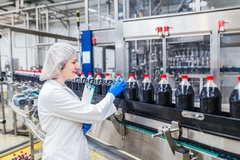
PepsiCo has rolled out a multi-year, “industry-first” collaboration with Siemens and Nvidia to advance the use of digital twin technology and AI to improve the speed and efficiency of packaging and bottling lines.
Early pilots aiming to transform PepsiCo’s plant and warehousing facilities are already underway in the US.
To find out more about the collaboration, Packaging Insights speaks to John Nixon, vice president for Infrastructure, Life Sciences, Consumer Products, and Retail at Siemens Digital Industries Software, as well as Tarik Hammadou, director of Supply Chain Developer Relations at Nvidia.
“The collaboration shows what’s possible when manufacturers, technology partners, and Original Equipment Manufacturers (OEM), work together rather than in silos. Packaging innovation accelerates when everyone sees the same digital truth,” Nixon tells us.

Identifying bottlenecks
Digital twin technology creates a digital model of a physical object. The collaboration aims to combine 2D and 3D digital twin data from Siemens’ real-time photorealistic virtual scene, supported by Nvidia’s Omniverse libraries.
 John Nixon of the Siemens Digital Industries Software (Image credit: Siemens).Nixon adds: “Packaging operations are entering an era where digital twins aren’t just engineering tools — they’re operational systems. They help reduce waste, optimize sustainability metrics, reduce changeover and turnaround pain, and improve agility. Our Digital Twin Composer is part of a much larger movement toward data-driven packaging and a more resilient supply chain.”
Meanwhile, Hammadou explains: “AI helps identify bottlenecks on packaging lines by continuously analyzing high-frequency operational data — machine cycle times, micro-stoppages, quality rejects, and more — to distinguish true system constraints from symptoms.”
He says that unlike traditional methods, AI models learn normal behavior patterns and detect deviations in real time, revealing whether throughput loss is caused by a specific machine, human interaction, or a different hurdle.
“By correlating events across the entire line, AI can predict when and where a bottleneck will shift and recommend corrective actions.”
The Digital Twin Composer
Siemens says it is digitally transforming the manufacturing facilities of PepciCo using physics-based digital twins and AI, with the Digital Twin Composer as a cornerstone solution.
Nixon argues: “The Digital Twin Composer gives packaging and bottling teams something they’ve never really had before: a fast, intuitive way to turn complex packaging lines into living, dynamic digital twins.”
“What we’ve seen in our real-world work with PepsiCo is that packaging becomes far more predictable when you can model and visualize entire line behaviors — everything from filler dynamics and labeler interactions to downstream accumulation.”
He explains that packaging operations are full of micro dependencies. “Half a second delay at a capper can ripple all the way to palletizing. Composer brings those interactions into one environment so operators, OEMs, and engineers can rapidly understand performance, test ideas, and improve flow — before touching physical equipment. It turns packaging into a ‘designable’ system, not a fixed constraint.”
AI for digital twinning
 Tarik Hammadou, director of Supply Chain Developer Relations at Nvidia (Image credit: Tarik Hammadou, ResearchGate).Nvidia’s Computer vision is an AI tool that analyzes digital images and videos, working in synergy with Siemens’ Digital Twin Composer.
Hammadou says: “Computer vision plays a critical role in packaging and palletizing simulations by providing the perception layer that connects physical reality to digital twins and AI decision systems.”
“Vision models detect, track, and classify products, cases, pallets, and human actions in real time — capturing dimensions, orientation, stability, defects, and handling variability that traditional sensor data cannot fully represent.”
In palletizing, Computer vision allows simulations to evaluate mixed-SKU stacking, load stability, misalignment risk, and collision scenarios, while continuously learning from real-world observations to refine the virtual model.
He adds that, as a result, simulations become living systems capable of predicting failures, optimizing layouts and robot motions, and safely testing throughput and quality improvements before deployment on the production floor.
Improved speed and efficiency
The partnership aims to boost the speed and efficiency of packaging and bottling lines. Nixon adds that the partners design for “high-speed, high variability, and high SKU complexity.”
“PepsiCo runs extremely fast, highly agile packaging operations. In the work Siemens has done with PepsiCo, we’ve used Digital Twin Composer to simulate high-speed bottle handling, case packing cycles, stretch of conveyor networks, and the impacts of shifting SKUs and formats.”
“The combination of Siemens’ capabilities and Nvidia’s accelerated computing allows teams to simulate and validate format changes well before lines are reconfigured.”
Ease of adoption
Discussing the conversion of existing packaging equipment into digital twins, Nixon says Siemens’ Composer is designed for today’s “retrofit reality — the industry’s biggest current challenge,” while also supporting greenfield scaling as a future opportunity.
“Most packaging lines are a mix of legacy machines, OEM-specific systems, and custom controls. Digital Twin Composer lets teams start from whatever fidelity they have: computer-aided design where available, point clouds where computer-aided design doesn’t exist, and domain-specific simulation templates for common equipment types.”
 The digital twin and AI solutions by Siemens and Nvidia are easy to integrate in PepsiCo’s packaging lines.For PepsiCo, Siemens built “usable, decision-ready models quickly using existing engineering data plus on-site scans.”
“The message to the industry is simple: you don’t need a perfect dataset to start. You need willingness, collaboration, and a platform built for highly complex brownfield environments. That’s where Composer stands out.”
Hammadou adds that AI agents can improve line balancing (ensuring each aspect of a packaging line is properly matched) and throughput in packaging plants.
“This improvement can be achieved by continuously sensing real-time machine, labor, and material data, identifying true bottlenecks, and dynamically rebalancing speeds, tasks, and buffers across the line.”
“Instead of relying on static engineering assumptions or periodic ‘overall equipment efficiency’ reviews, agents anticipate disruptions, harmonize equipment speeds based on SKU behavior, reduce micro-stoppages, and optimize changeovers and labor allocation before throughput is impacted.”
Coordinated across equipment, operations, quality, and maintenance, these agents optimize the system as a whole, balancing throughput, quality, safety, and wear, asserts Hammadou.
“The result is higher sustained output, faster recovery from variability, and measurable throughput gains without additional capital investment.”