

Tomra Recycling expands AI capabilities with PolyPerception’s platform


Key takeaways
- Tomra Recycling has introduced an AI-native platform from PolyPerception and acquired a 51% majority stake in the company.
- The platform features a natural language interface, allowing operators to interact with plant data.
- Three deep learning applications have also been launched for Tomra's GainNext technology.
Tomra Recycling has introduced an AI-native platform from PolyPerception and three new deep learning applications for its GainNext technology. The launch coincides with Tomra’s expanded investment in PolyPerception, reaching a 51% majority stake. The company says this move enables further collaboration between real-time data and physical sorting action.
PolyPerception’s AI‑agent platform is an upgrade from its Waste Analyzer, an AI‑powered waste analytics solution that strengthens sorting performance through end‑to‑end material tracking. One of the breakthroughs is the natural language interface. Operators can now “chat” with their plant data in plain language, asking questions to the platform.
Lars Enge, executive vice president and head of Tomra Recycling, says: “AI has always been part of Tomra’s DNA, but we are now entering a new phase. With our acquisition of a majority stake in PolyPerception, we are moving beyond AI as a sorting tool to AI as a central intelligence for the recycling plant.”

“By combining our advanced sorting systems and digital solutions with PolyPerception’s AI platform, we are creating an end-to-end solution that doesn’t just optimize machines but redefines how plants operate.”
Advancing sorting operations
The platform is also said to feature “writing” capabilities, allowing it to act like an agent within the plant. The companies say that rather than just observing material streams, the technology can draft custom quality reports and set operational alerts in seconds.
The technology is engineered to provide full transparency by enabling recyclers to integrate plant data into their existing management systems. This allows managers to query waste statistics or purity levels via their dashboards without needing to log into a separate system.
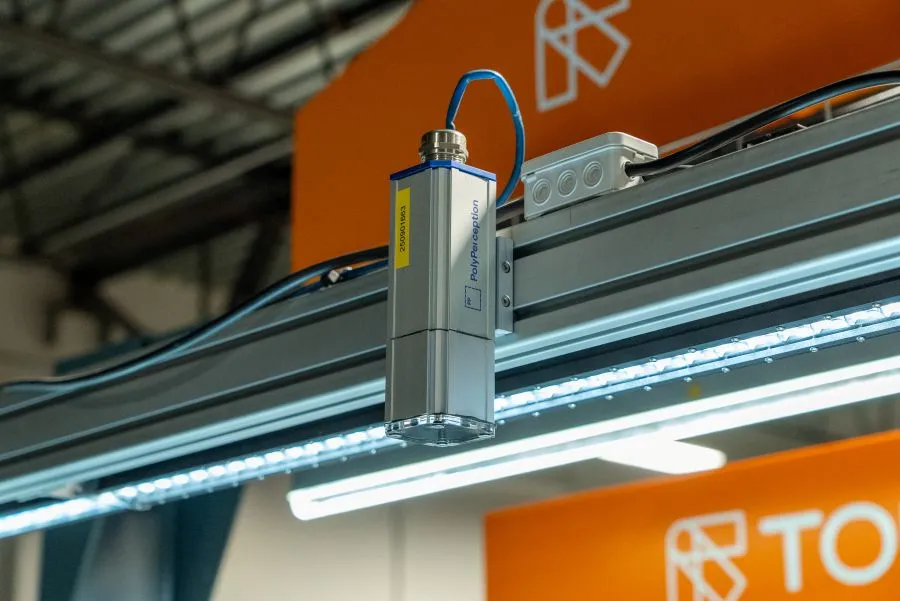 The platform provides two search methods to assist plants respond to changing material streams.Nicolas Braem, CEO and co-founder at PolyPerception, says: “With the introduction of our new agent-based platform, recycling plants now gain a new cognitive layer. Data is no longer just reported — it is interpreted, explained, and transformed into relevant insights in a few seconds.”
“Operators can interact naturally with their plant, ask questions, explore material behavior, and receive clear, actionable answers in real time.”
Expanding GainNext ecosystem
Tomra has also unveiled three new deep learning applications for its GainNext ecosystem. The first application addresses the growing demand for food-grade PET trays as it becomes an increasingly important feedstock alongside bottles.
According to the company, the system can distinguish between takeaway or supermarket trays and consumer or medical packaging based on shape and use. The solution is said to be able to achieve purity levels over 95%, demonstrating that PET tray sorting can be a viable business case.
In the metals sector, Tomra has launched a high-precision application for “copper meatballs”, supporting a steel market that is starting its journey towards decarbonization.
The third addition is a high-throughput solution for used beverage can (UBC) aluminum recovery from packaging streams. The GainNext UBC application is developed to provide up to 33 times more throughput than manual sorting, delivering 98% purity or higher. The system is said to provide a more efficient, automated path for aluminum can-to-can recycling by detecting and ejecting non-UBC materials.