


UK pEPR: Industry reacts to stricter PackUK Year 2 Illustrative Fees

Key takeaways
- PackUK says its Year 2 fees will be based on packaging recyclability to encourage sustainable design.
- FPA and Ecosurety raise concerns over clarity on costs, material market values, and recyclability.
- Industry fears the fee system may not align with actual recycling outcomes or encourage innovation.?

PackUK has published the Year 2 Illustrative Fees for the country’s packaging EPR (pEPR). We discuss the new document with Ecosurety, the organization responsible for compliance, and the UK’s Foodservice Packaging Association (FPA).
According to PackUK, from Year 2 (April 1, 2026 – March 31, 2027), fees will be modulated “to drive a shift toward more environmentally sustainable packaging design,” with recyclability used as an indicator. “Packaging items are subject to higher or lower modulated fees based on recyclability assessments in line with the Recyclability Assessment Methodology (RAM).”
“The FPA strongly welcomes PackUK’s decision to publish these illustrative fees at the earliest possible opportunity. Early transparency is essential if EPR is to function as anything other than a retrospective tax,” Mike Revell, executive chair of the FPA, tells Packaging Insights.
However, he stresses the “clear need” for greater clarity regarding:
• How local authority net costs are calculated and allocated by material
• How recycled material market values are factored into future fee setting
• How the RAM classifications reflect actual recyclability in practice
• How enforcement against freeriders will be strengthened and demonstrated in outcomes, not assumptions.
“Without progress in these areas, there is a real risk that EPR will be seen by compliant producers as inequitable, unpredictable, and disconnected from real environmental performance.”
Ecosurety’s innovation and policy director, Robbie Staniforth, tells us: “While these fees are a step in the right direction, they are far from the finished article. It does, however, signify that the government is serious about punishing badly designed packaging.”
“The indicative fees will help companies begin to plan and adjust their budgets for potentially higher costs next year.”
Illustrative material fees
Revell says PackUK’s publication of its illustrative material base fees for 2026 is “a welcome and timely step.”
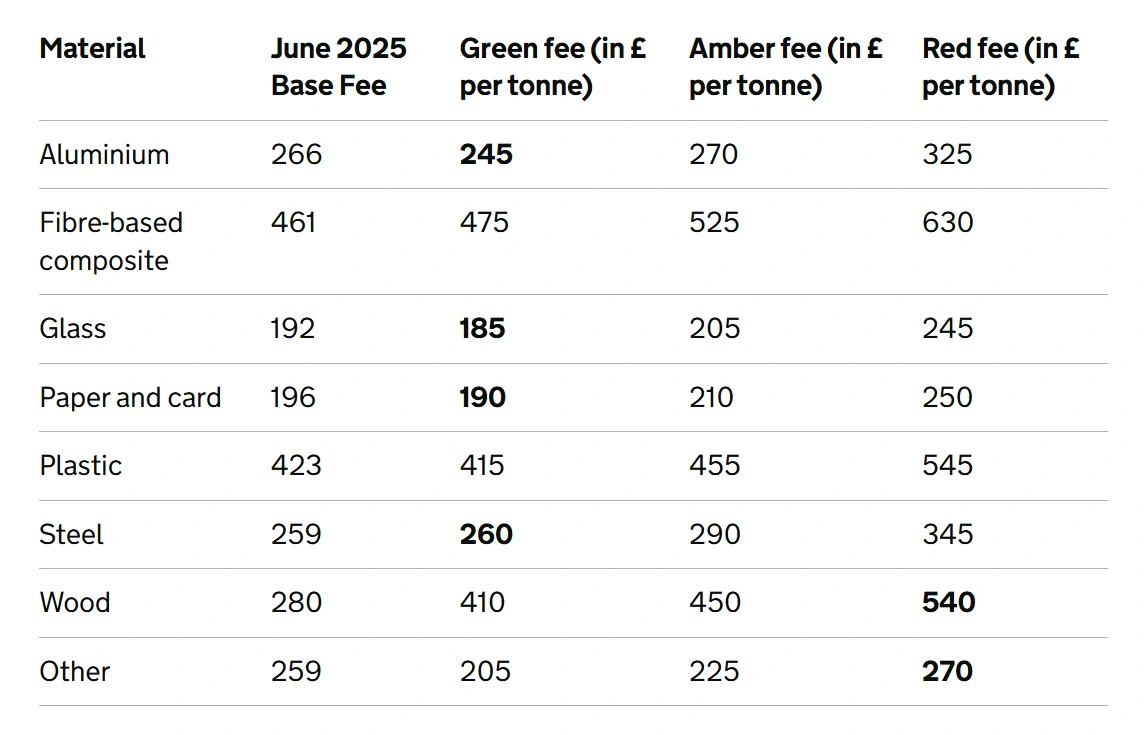 The current RAM proportions for each material and the induced average fee taking red, amber, and green into account (Graph credit: PackUK).While the figures are indicative and subject to change, he points out that early visibility is essential for obligated producers “who are already grappling with the practical and financial implications” of the pEPR.
“That said, our members’ initial reaction is more one of cautious concern than reassurance.”
He says it is not surprising that the overall structure of the 2026 illustrative fees “broadly mirrors 2025.” However, Revell expects updated packaging tonnage data, inflationary pressures, and higher local authority costs to push fees upward.
“Our members are troubled by the underlying assumptions used to calculate the figures. In particular, estimates of household packaging volumes appear to have been inflated by expectations around the Environment Agency’s freerider enforcement activity.”
“While the FPA supports robust enforcement, the reality that fewer additional producers were captured than anticipated means compliant businesses continue to shoulder a disproportionate share of the cost.”
Revell warns that this cost imbalance reinforces a longstanding frustration among obligated producers — that those who play by the rules are, in effect, subsidising businesses that either evade EPR entirely or under-report through questionable practices.
“Without effective and visible enforcement outcomes, fee increases risk eroding confidence in the system.”
Meanwhile, Staniforth argues that the packaging data from producers will get more accurate and granular over time, causing PackUK to become increasingly confident about the penalties they should deal out.
“We expect RAM to evolve in line with the roadmap published earlier in the year. The Technical Advisory Committee has its work cut out to improve the methodology in line with the government’s increasing penalties.”
He tells us that packaging producers are “already well advanced” with their plans to improve the packaging they place on the market, “based on the general EPR mood music over the last few years.”
“While the release of these figures is likely to reaffirm that their efforts will not be in vain, they will not necessarily expedite progress.”
“These illustrative fees are likely to be used by producers as one important input for budget setting for next year.”
Amber, red, and green
PackUK’s pEPR illustrative fees for Year 3 are modulated into amber, red, and green.
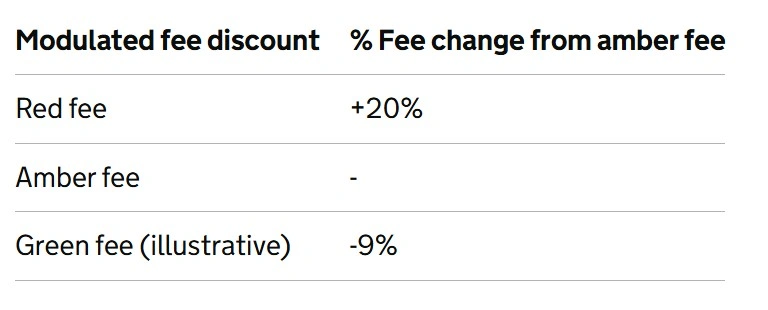 Packaging EPR for packaging modulation factors for Year 2 (Graph credit: PackUK).Amber fees are set at the base rate and were previously referred to as “base fees.” Red fees apply to materials that are less recyclable according to the RAM and are set at 1.2 times the amber fees in Year 2.
Green fees apply to materials that PackUK considers more recyclable. “The level of discount for green fees depends on the relative proportion of green, amber, and red materials reported in the Reporting Packaging Data service,” PackUK outlines.
Revell says the introduction of indicative red, amber, and green fees under the RAM raises concerns among FPA members, “particularly where fee differentials do not clearly align with real-world recycling outcomes.”
“In principle, EPR and modulated fees are intended to influence packaging design decisions. In practice, our members are sceptical that the current fee signals will drive meaningful change in packaging choices.”
“A key issue is the treatment of fiber-based composites. The application of the red (higher) fee to paper and board packaging containing more than 5% non-fiber content risks penalising formats that are widely recycled and perform well in established collection systems.”
He asserts that the threshold bears little relationship to actual recyclability or local authority net costs, which he says are supposed to underpin the fee structure.
“As a result, some packaging is likely to be charged at a higher rate than is justified by its end-of-life performance. This creates a risk that design decisions are influenced by blunt regulatory thresholds rather than genuine environmental outcomes, potentially discouraging innovation or the use of functional coatings and barriers that improve product protection and reduce food waste.”
Concerns about uncertainty
Uncertainty also remains a major concern for FPA members. While Revell says it is understood that the figures are illustrative, businesses are being asked to make commercial, investment, and design decisions now, against a backdrop of fees that may change significantly.
“The lack of clarity around how local authority costs may be affected by recycled material prices in 2026 only adds to this uncertainty.”
“Members are particularly concerned about volatility for materials with lower overall tonnages, such as wood, where relatively small changes in reported volumes could result in disproportionate swings in fees from one year to the next.”
This level of uncertainty can make budgeting difficult, while undermining confidence in long-term planning, Revell argues. He says this is especially true for SMEs with limited capacity to absorb unexpected cost increases.
“The FPA will continue to engage constructively with PackUK and Defra to help ensure the system delivers fair, evidence-based fees that genuinely support recycling outcomes and do not unfairly penalize responsible packaging producers.”