



AI robotics and vision systems boost flexibility and efficiency in food packaging

Key takeaways
- AI-enabled robotics are transforming meal assembly and high-mix production, with systems that adapt to changes in products, packaging formats, and customer demands.
- Oxipital AI’s real-time vision systems allow packaging in chaotic bulk, speeding up production processes.
- The smart solutions from Chef Robotics offer a shift toward flexible, lower-risk automation models.
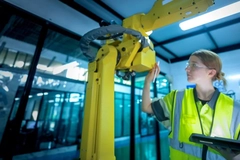
AI-powered robotics is reshaping food packaging processes and setting the stage for smarter, more adaptable automation solutions. The innovations in the sector are increasing flexibility, reducing labor costs, and boosting production efficiency.
Packaging Insights speaks to Oxipital AI and Chef Robotics to explore how smart solutions are overcoming challenges once considered too complex for the packaging industry to automate.
Rajat Bhageria, founder and CEO at Chef Robotics, tells us: “We’re seeing a big shift from traditional, fixed automation to physical AI, meaning AI-enabled robotics that can handle real-world variability.”
“Historically, packaging machinery has worked best when products are uniform, predictable, and run thousands of times. But today, manufacturers are dealing with more stock keeping units, more changeovers, and more variability, and that’s where AI-enabled systems are making an impact.”
Anthony Romeo, product marketing manager at Oxipital AI, suggests that AI has leveled the playing field in the packaging industry.
“What used to require years of training to learn how to use a complicated system can now be automated and simplified with AI. As it enables everything to be easier to use, tons of different AI-enabled products have popped up that are well trained to perform a specific task,” he says.
Vision-guided robotics
Oxipital AI centers its development efforts on vision-guided robotics for food packaging, an area, it says, where variability is constant. The company suggests that “unlike industrial components stamped to precise tolerances, food items differ in shape, texture, and weight from piece to piece.”
“In the packaging industry, a lot of visual inspection is done by humans. Most of the time, nothing is going wrong, and it’s tedious to observe when everything is going smoothly,” says Romeo.
“AI-driven vision systems have caught up to humans in terms of visual inspection and can inspect non-repetitive parts, but they have a never-ending attention span, which is something that humans lack.”
Romeo shares that Oxipital AI’s system has combined 2D and 3D vision, allowing it to calculate the dimensions of the product and the best piece of food for the desired weight in real time.
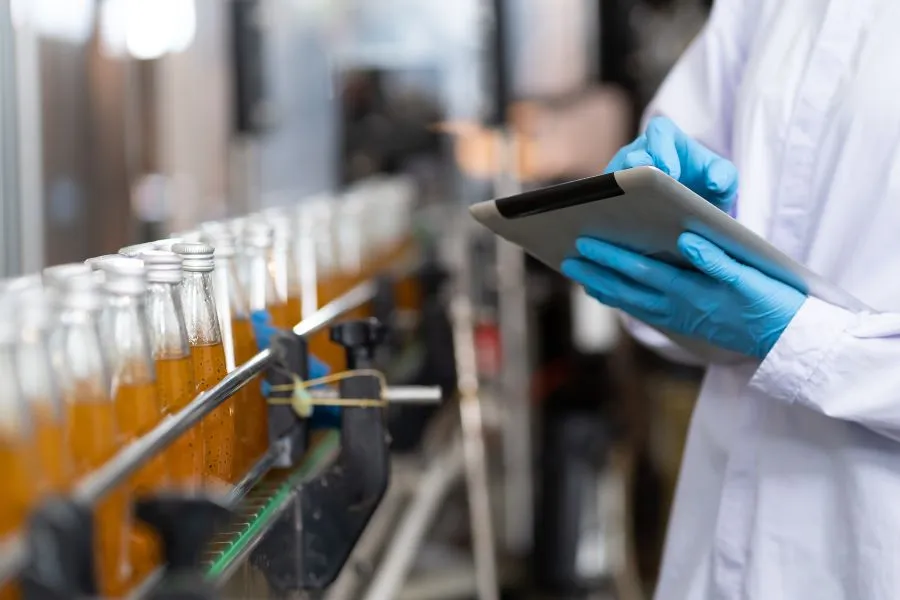 Smart solutions can pack products, and a final inspection can be performed by humans after packing.“Most vision systems image upstream, which gives the system time to calculate the pick coordinates to send to a robot to pack the product. If the robot picks something up and neighboring products move, the system is blind to this movement and can cause ghost picks or damage to the system,” he adds.
“We image directly in the robot pick area and calculate in real time. We can account for this movement, which ensures the system and product don’t get damaged.”
Influencing pack line design
According to Romeo, vision-guided robotics can change how manufacturers design packaging lines.
Vision applications used to require products to be singulated, justified, or indexed. “With new AI vision systems that can process in real time, products can be fed in a chaotic bulk. This can eliminate expensive singulation equipment and increase the overall speed of production,” he explains.
“There’s a general tendency to expect things to take very long and have long lead times. With Oxipital’s approach using synthetic data generation, we can develop solutions for customers in a matter of weeks instead of months.”
“This really changes the way manufacturers can think about timelines and how long something will take to generate return on investment.”
Replacing labor-intensive manufacturing
Chef Robotics focuses on meal assembly. In many facilities, hundreds of workers portion ingredients in cold rooms.
“Unlike a lot of other packaging steps, it involves handling ingredients that vary in shape, texture, and orientation. That variability is exactly what makes it difficult to automate with traditional machinery and what makes it such a strong fit for physical AI,” shares Bhageria.
“One of the biggest challenges manufacturers are facing right now is high-mix production and frequent changeovers. Consumers want more choice, more customization, and fresher products, which means plants are producing more stock-keeping units with smaller runs and faster changeovers.”
Bhageria also says that even small variations — an irregular compartment of a meal tray or inserts within a salad bowl that do not sit perfectly flat can disrupt traditional automation.
“We built Chef robots to overcome the problems. Our robots use computer vision and machine learning to adapt to the variability of real food. We also designed them to work in real production environments: they take up roughly the space of a person, support fast changeovers, and are easy to clean and move around between shifts.”
Improved flexibility
Bhageria highlights that the key trend happening in the space of AI-enabled systems in the packaging industry is its increased flexibility compared to traditional systems.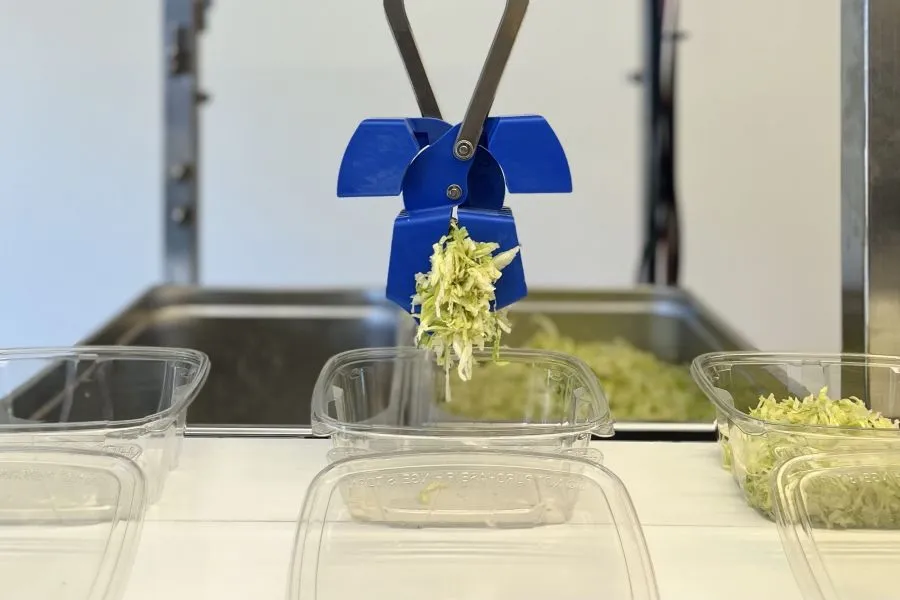 Chef Robotics’ solution overcomes the limitations of traditional automation, which depends on consistency (Image credit: Chef Robotics).
“With computer vision and AI, robots can adapt to changes in products and packaging formats in ways that traditional automation can’t. That flexibility opens the door for automation in places that used to be considered ‘too hard,’ especially in food. This flexibility enables smart automation to handle high-mix assembly.”
“We’re also seeing a shift in business models. Robotics-as-a-Service is increasingly replacing large up-front CapEx purchases. Think of it like a robot staffing agency. Instead of buying a big machine and hoping it delivers a return on investment, manufacturers can deploy automation in a lower-risk way and see results quickly.”
“In addition, instead of hiring their own internal robotics team to troubleshoot, companies like Chef take care of the end-to-end deployment and provide uptime.”
Mixed stock keeping unit palletizing, automated storage and retrieval systems, and autonomous mobile robots for picking are the areas that have advanced the most, according to Bhageria.
“Food packaging and meal assembly are other areas where AI-enabled systems are starting to make a real impact. For example, Chef Robotics has made over 90 million servings in production onsite at customer facilities across North America.”
The future of smart automation
Romeo and Bhageria agree that AI can be expected to push further into complex packaging and assembly tasks with neural networks.
Romeo argues:“Moving forward, as automation gets smarter, it will require fewer general and more specific solutions. The specific solutions used to take too long to develop and not be worth it, but with AI and smart automation, these solutions can be engineered more quickly than ever before.”
Bhageria notes that physical AI has evolved “dramatically” in the last few years. “We’ve moved from mostly deterministic, rules-based automation systems to systems powered by modern neural networks, large language models, and vision-language models that constantly learn from vast amounts of data. That shift is expanding what’s possible in real-world manufacturing.”
“In packaging, we expect AI-enabled systems to expand into more variable parts of packaging and assembly as the technology becomes more robust and more widely deployed.”
”We’re still far away from humanoid robots fully replacing workers on production lines. But what’s exciting is that we don’t need humanoids to make meaningful progress. AI-enabled robotics can already automate tasks that traditional automation couldn’t handle, especially in food manufacturing, and I’m excited to see what impact that will have over the next few years,” Bhageria concludes.