



Sykell CEO highlights digital solution for efficiency and compliance in reusable packaging


Key takeaways
- Sykell’s Circular ERP software is said to optimize the management of reusable packaging by addressing transparency challenges.
- The software aims to support circular economy companies in achieving regulatory compliance and scalability.
- Circular ERP is designed to help overcome the limitations of manual systems by integrating smart data.

Reusable solutions aimed at reducing packaging waste in the food, retail, and to-go sectors are gaining traction across Europe. However, providers frequently encounter challenges with return, cleaning, and inventory management, according to Sykell’s CEO, Davide Mazzanti.
To tackle these issues, Sykell has developed the Circular ERP software, which enables reusable solutions to be transferred into a transparent and scalable system. The software has been put into use in Germany, the UK, and Denmark.
Packaging Insights speaks to Mazzanti about how the platform can support circular economy companies to manage and control material cycles, while achieving regulatory compliance.
Why has scaling reusable solutions been slow in many parts of the world?

Mazzanti: Reusable packaging is not a new idea. What is new is the ambition to operate it at scale, and that requires shared infrastructure: return networks, cleaning facilities, and the digital backbone to connect them.
Building that infrastructure requires alignment between retailers, gastronomists, municipalities, system operators, brands, and other partners, and long-term commitment from governments and investors. That is hard, and most markets have not done it.
Germany is the clearest example of what becomes possible when the infrastructure exists. Decades of investment in DRS and logistics networks created the foundation. Based on that, Einfach Mehrweg, the standardized and scalable reusable ecosystem for plastic-based takeaway and food packaging, could be deployed across REWE supermarkets and over 6,000 locations nationwide.
Compare that to the UK or France. Both markets have a genuine interest in reuse and growing regulatory pressure. What they lack for now is the shared infrastructure that turns a promising pilot into a national system.
 Sykell has refined its solution to meet the needs of different types of operators it collaborates with.Governments that are serious about meeting the EU Packaging and Packaging Waste Regulation (PPWR) targets cannot treat infrastructure as someone else’s problem. Once that foundation exists, the market can do the rest. Without it, reuse will remain a collection of pilots, while single-use continues to scale effortlessly.
What features of Circular ERP make it an effective solution to the challenges in reusable packaging?
Mazzanti: Reusable packaging systems fail at scale for a consistent reason: their costs continue to grow with volumes, eroding the business case precisely when it should be getting stronger.
The root cause is almost always system transparency. Without knowing where assets are, how many are in circulation, and what stage of the cycle they are in, operators cannot optimize their system. Transparency is what breaks the cost-volume coupling, keeping costs stable as revenues grow and making the business case stronger, the larger the system gets.
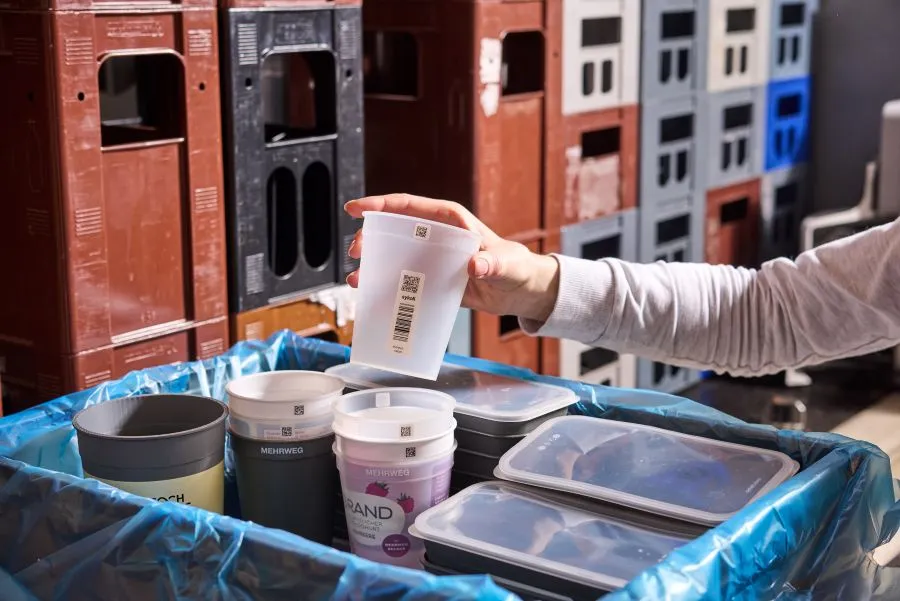
Circular ERP addresses the transparency challenge at the root. By serializing every asset with a QR code or RFID tag and tracing it across every partner in the system — from filling to retail or gastronomy to return to cleaning — the platform captures what is actually happening rather than what operators assume is happening.
At the cleaning facility, for example, which is the minimum viable data point in any reusable system, assets are automatically captured and sorted, triggering settlement toward the relevant collection points without manual intervention.
What this unlocks is not just efficiency, but confidence. Operators can see the current pool size in real time, track loss rates, measure cycle times, and automate deposit management across partners. The circular workflows that would otherwise require constant manual coordination run themselves. That is the difference between a reusable system positioned to scale and one that stalls.
How does Circular ERP incorporate smart solutions to optimize reusable packaging systems?
Mazzanti: Historic reusable packaging systems, for instance, in the beverage industry, have long been manually administered. While in logistics, pooling companies increasingly capture their pallets and crates digitally, this key step has not yet occurred in retail reusable systems.
Automated processes need to be established in order to gain acceptance. With the serialized codes on the containers, assets are captured and sorted at cleaning streets in order to facilitate automated settlement toward collection points.
Smart data can be collected at multiple points across the lifecycle: at filling lines, where codes become digital product passports; at consumer touchpoints, through gamified incentive systems; and at collection points, through direct data transfer from reverse vending machines.
The data captured allows full transparency on system performance, revealing how many times an asset has circulated, how long travel times are, what the loss rate is, and how big the pool is at any given moment.
In Glasgow, UK, and Copenhagen, Denmark, we work with the providers Reposit and New Loop. They have set up return points for reusable containers throughout the city. Circular ERP handles stock tracking, the processing of deposit settlements, and operational coordination between the partners, including cafés, retail outlets, and cleaning facilities..webp) The process involves collecting, marking the packaging with the collection point's Global Location Number, and returning the container.
The process involves collecting, marking the packaging with the collection point's Global Location Number, and returning the container.
How do you see the role of Circular ERP in supporting the EU's packaging regulations?
Mazzanti: The PPWR is opening the door to reuse at scale across Europe for the first time. The opportunities are real, but so are the risks. Many of the reusable systems being designed and invested in today may not achieve the scale required to meet PPWR targets if they are not built with data at their core from the start.
A reusable system without digital infrastructure is not a scalable system. It is a pilot that will struggle to grow beyond its initial footprint, no matter how well-designed the containers are or how dense the return network is.
Circular ERP is a key element of what a scalable reuse solution requires. It provides the operational backbone that turns a reusable packaging system into a manageable, measurable, and continuously improvable circular value chain. Without it, the PPWR targets remain aspirational. With it, they become achievable.
We’ve seen that the containers in a reusable packaging system, which contain important food-grade post-consumer recyclates, can be used to manufacture new containers. While single-use packaging faces a recyclate gap that the industry has not yet found a credible answer to, reusable packaging has no recycling problem.
How does Circular ERP aim to accelerate the adoption of reusable systems?
Mazzanti: Circular ERP is currently employed by eight reusable packaging system operators across Europe to automate circular workflows and drive efficiency in administering their systems.
We have a functioning reusable ecosystem and software that makes this system transparent, while also being able to integrate into other systems.
Reusable systems that once struggled to grow beyond their initial footprint are now scaling. And the ambition does not stop in Europe. In Q3 2026, Sykell will support its first project in Ottawa, Canada. This demonstrates that reusable systems are possible worldwide.