



Amazon partners with IIT Roorkee to pilot crop waste mailers

Key takeaways
- Amazon has partnered with IIT Roorkee to develop biodegradable paper mailers from agricultural residue.
- The project converts wheat straw and sugarcane bagasse into e-commerce packaging to cut plastic use.
- Research will move from lab-scale trials to industrial validation by mid to late 2027.
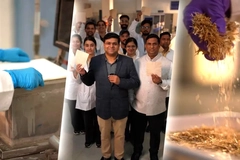
Amazon has partnered with the Indian Institute of Technology (IIT) Roorkee to develop biodegradable paper mailers from agricultural waste. The 15-month pilot research project will convert crop waste, such as wheat straw and sugarcane residue, from India into e-commerce packaging solutions.
The collaboration aims to reduce plastic packaging pollution and pressure on virgin wood pulp, the most commonly used material for paper mailers.
Abhinav Singh, vice president of operations at Amazon India, says: “At Amazon, we are building and managing India’s fastest, safest, and most reliable operations network, and we’re committed to making it more sustainable. As part of this effort, we’re partnering with IIT Roorkee to develop innovative packaging from crop residue.”
“India generates nearly 500 million tons of this waste annually, and by repurposing it into packaging, we can support a more circular economy while reducing reliance on conventional materials.”
From waste to mailer
The collaboration will begin as lab-scale development and testing for 15 months, after which Amazon will provide support for industrial trials, process validation, and commercial production by mid to late 2027.
Professor Kamal Kishore Pant, director of IIT Roorkee, says: “Sustainability is no longer a choice. It is an urgent national priority. This collaboration between IIT Roorkee and Amazon is a step toward realizing India’s vision of a circular economy and is aligned with government missions.”
At the Innovations in Paper and Packaging lab at the Department of Paper and Packaging Technology, IIT Roorkee, wheat, straw, and bagasse will be converted into pulp via an autoclave digester.
The pulp is then washed and screened to remove impurities and ensure consistent quality. Through drying and pressing, the pulp is turned into paper, suitable for e-commerce mailers.
“By transforming agricultural residues into biodegradable packaging materials, we are addressing the twin challenges of stubble burning and a reliance on virgin materials in India, while creating scalable solutions that can benefit industries, farmers, and society at large,” adds Pant.
Packaging Insights recently spoke with International Paper and Smurfit Westrock about the future of e-commerce packaging, which is expected to focus on efficiency and adaptation.
In other bio-based news, an advisory board of the US Department of Agriculture voted against adding synthetic compostable materials, such as those from biodegradable packaging, to the National List of Allowed and Prohibited Substances due to potential contamination with PFAS and microplastics.