


Europe hits record aluminum can recycling rate, industry urges scrap export ban


Key takeaways
- Europe reached a record 76.3% aluminum beverage can recycling rate in 2023, driven largely by expanding DRS.
- Countries adopting DRS, including Malta, Latvia, and Slovakia, saw rapid recycling gains, with some surpassing 90%.
- Industry groups call on the EU to restrict aluminum scrap exports to protect closed-loop “can-to-can” recycling and advance 100% circularity by 2050.
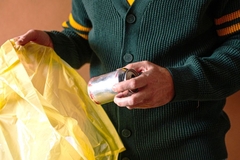
The overall recycling rate for aluminum beverage cans in the EU, UK, Switzerland, Norway, and Iceland reached a record high of 76.3% in 2023, according to a new report by European Aluminium and Metal Packaging Europe.
“The increase was primarily driven by the continued rollout and strong performance of well-designed DRSs,” Andy Doran, director of packaging group at European Aluminium, tells Packaging Insights.
“In 2023, two countries introduced DRS systems, and the two countries that introduced DRS during 2022 got fully up to speed. This led to significant improvements in collection rates, with recycling volumes increasing faster than the volumes placed on the market.”

Doran highlights that in 2023, beverage can volumes placed on the EU market grew by around 4%, while recycling tons increased by 7%. “This demonstrates that collection systems — especially DRS — are not only effective, but capable of keeping pace with market growth.”
“High-quality collection through DRS also supports closed-loop ‘can-to-can’ recycling, which is crucial for circularity.”
Doran further calls on EU bodies to regulate the aluminum scrap exports to third countries.
“To fully realize can-to-can circularity, Europe must ensure that valuable secondary raw materials remain in the European market.”
Success stories
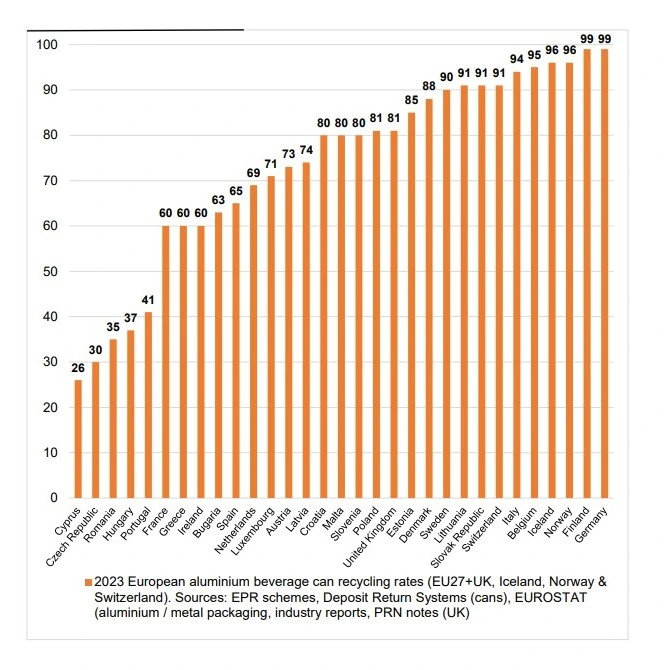 The 2023 aluminum beverage can recycling rates in the EU 27 plus UK, Iceland, Norway, and Switzerland (Graph credit: European Aluminium and Metal Packaging Europe).The new report finds that after adopting DRS in 2023, Malta increased aluminum beverage can recycling from 50% to 80%. Latvia and Slovakia introduced DRS in 2022, boosting their can recycling from 60% to 74% and from 58% to 91%, respectively.
“Slovakia provides a very clear example of what works. After introducing a well-designed DRS in 2022, it reached 58% recycling. The country then saw this recycling rate rise dramatically, reaching 91% in 2023,” says Doran.
“This was founded upon good preparation with an extensive infrastructure for consumer return plus communication campaigns in the general media and schools.”
He says the key lesson is that effective DRS, designed to be simple and convenient for consumers while ensuring high-quality material streams, can deliver “rapid and measurable” results.
Germany and Finland already achieved can recycling rates of 99%, and eight other European countries recorded rates above 90%.
“When consumers are given a clear financial incentive and easy return infrastructure, participation rates are extremely high. Other EU member states can replicate this success by implementing robust and harmonized DRS systems.”
Full circularity by 2050
European Aluminium and Metal Packaging Europe plan to increase Europe’s aluminum recycling rates by supporting the implementation of national collection infrastructure for DRS, aiming for 100% circularity by 2050.
“The industry is clearly on the right long-term path. The 2023 results show strong momentum, and the transition toward fully circular can-to-can recycling is accelerating, and we can already see the commitment of more countries to adopt DRS to support this objective,” says Doran.
“Reaching 100% circularity by 2050 is an ambitious objective, but it is technically achievable provided that the right framework conditions are in place.”
To achieve this target, Doran says DRS has to be implemented effectively across all EU member states, EU packaging legislation must be enforced consistently, and policies that ensure valuable scrap need to remain within Europe.
Keeping scrap in Europe
European Aluminium and Metal Packaging Europe emphasize that aluminum scrap exports impact Europe’s ability to achieve closed-loop recycling.
“Closed-loop recycling depends on keeping high-quality scrap available within Europe. When aluminum scrap is exported, it reduces the material available to European recyclers for producing new beverage cans,” adds Doran.
 Andy Doran, director of packaging group at European Aluminium (Image credit: European Aluminium).“That’s why European Aluminium welcomes the European Commission’s (EC) intention to develop an export measure to stem the record outflows of scrap from Europe. “
The 2023 data shows that the recycling system and European remelters and refiners are capable of managing growth. Recycling volumes increased faster than market volumes, which demonstrates that infrastructure and industry capacity are keeping pace, according to Doran.
“Continued growth will require ongoing investment in collection, sorting, and remelting capacity. Expanding and optimizing DRS will remain central to ensuring recyclers receive sufficient volumes of high-quality material to sustain closed-loop production.”
Calls for regulatory action
Doran says that rapid EC action is needed to impose export measures to stem the record outflows of scrap from Europe.
“This will help ensure that aluminum beverage cans purchased, consumed, and returned within European member states can then be reprocessed within the European circular economy.”
“With the right regulatory support and continued investment, the sector can move significantly closer to full circularity over the coming decades.”
Aluminum has permanent properties facilitating multiple recycling cycles. Doran argues this means industry partners need to continue the development of permanent high-quality collection schemes to reach even higher recycling levels.
“Manufacturers of flat-rolled aluminum have historically worked together with the can industry to improve cans’ carbon footprint through weight reduction and high recycled content for the can body alloy.”
“Looking to the future, there is an ongoing EU Sustainability Standardisation Agreement which is exploring recycling-friendly alloy options for can ends, which, if successful, will improve the overall recycled content potential for the whole can, paving the way toward cans being made from up to 100% recycled aluminum.”
Doran argues that maximizing the recycled content levels of the aluminum beverage can substantially lower carbon emissions and helps achieve sustainability goals, while taking advantage of the fact that recycled aluminum saves 95% of the energy needed to produce primary aluminum.
Recently, Eurostat revealed data that the EU’s per capita plastic packaging waste started declining in 2023 after a steady rise since 2013.