




Printing’s digital shift: Industry leaders examine data, design & connectivity

Key takeaways
- Digital printing has evolved from a niche technology to a core part of packaging, enabling faster production and greater personalization.
- Advances such as white ink printing and hybrid models are enhancing design quality while supporting data-driven applications like QR codes and traceability.
- The industry now faces challenges around scalability, workflow integration, and adoption across production systems.
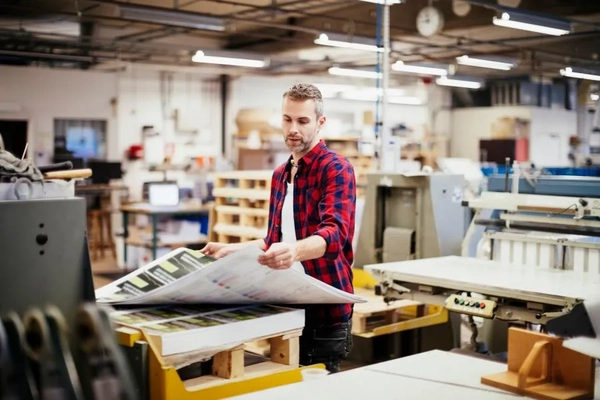
Digital printing trends continue to respond to regulatory pressure, demand brand personalization, and increasing data connectivity.
The printing technique involves copying a digital image directly onto a package without using traditional printing plates, which transfer ink from one surface to another.
Packaging Insights sits down with Bobst, Flint Group Digital Xeikon, Mondi, and Xaar to explore the industry’s transformation through digital printing, as well as the challenges the technology has yet to overcome.
Digital printing evolution
While digital printing is now common in the packaging industry, the technology is still developing, says Bernd Köbler, sales director at Mondi Ebersdorf. A “major example” is the expansion of six-color digital printing for corrugated packaging to include white ink.
“This reflects the growing demand for high-quality, multicolored printing on brown substrates, which underlines the ecological perception of paper packaging. At the same time, the use of white color on brown enables vivid, high-contrast designs that strengthen brand recognition while supporting sustainable and resource-efficient solutions.”
Köbler explains that digitally printed white opens new possibilities for brand identity on brown corrugated packaging. Moreover, he adds that halftone printing allows for smooth gradients and refined shading and chamfers that create three-dimensional visual effects.
“This results in brilliant, high-contrast print images and enables more distinctive, high-quality branding and packaging designs,” he adds.
Another trend noted by Patrick Graber, marketing director for PL Labels at Bobst, is the proliferation of serialization, QR codes, and other brand protection features in packaging.
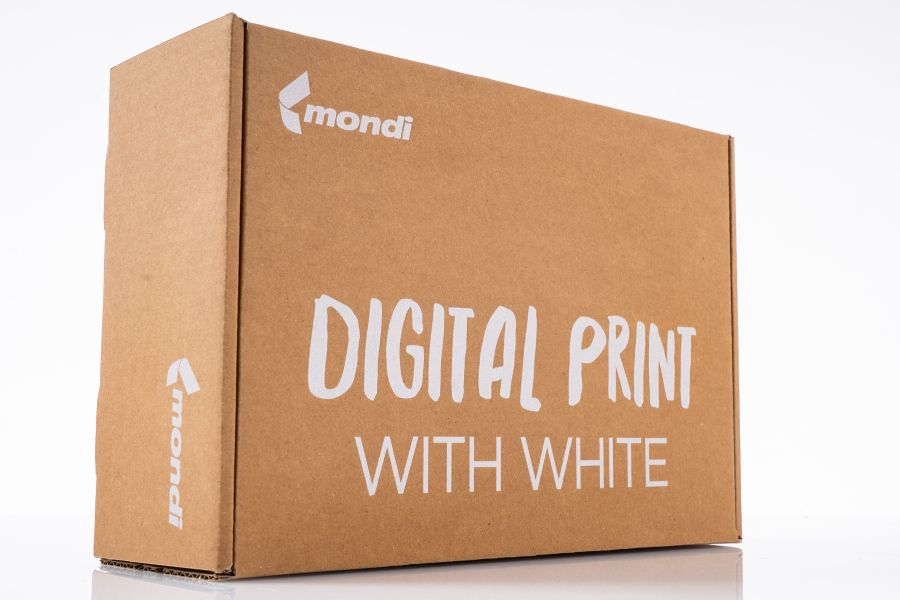 Köbler says digital white printing unlocks new branding options on brown corrugated packaging (Image credit: Mondi).“This is largely driven by different legislations, such as the EU’s Digital Product Passport, which expands the role of printing from decoration to data carrying. From a technology point of view, most manufacturers have added a hybrid product offering to their pure conventional or digital printing business model to help them balance cost, speed, and data complexity.”
He explains that a hybrid solution is not suitable for every application, but flexographic printing can deliver quality static designs while digital adds variable elements and other data layers on top.
Flint Group Digital Xeikon also observes a growth in digital printing applications tied to traceability, smart labels, track and trace, and compliance.
“Converters must navigate food safety, migration compliance, recyclability, and material compatibility while still delivering speed and flexibility. That is why technologies that reduce steps and simplify compliance are getting so much attention,” says Danny Mertens, marketing manager at Flint Group Digital Xeikon.
He adds: “A major trend is the convergence of digital print, workflow connectivity, and data. The market is no longer looking at a press as a standalone machine.”
“Converters want connected production environments where digital printing integrates with pre-press, finishing, data handling, inspection, and increasingly AI-enabled planning and automation.”
Adoption barriers
Mertens argues that digital printing has matured, adding that it can decrease printing time and is economically viable. Now, it faces a different kind of skepticism, one based on its ability to help, not hinder, system connectivity.
“The discussion has shifted from ‘Can it print?’ to ‘How do we run it profitably at scale, connect it seamlessly, and remove friction from the total workflow?’” he says.
“That also means the challenge is no longer just the press engine itself, but everything around it: data flow, scheduling, substrate behavior, finishing compatibility, operator simplicity, and overall plant efficiency.”
Neil Cook, head of Strategic Marketing at Xaar, also highlights that the challenge with digital printing is no longer if it delivers, but whether it can do it reliably and economically. He points to Xaar’s digital solutions, such as its High Laydown Technology, that handle highly pigmented, high viscosity inks on challenging substrates like corrugate at high speed.
“This, combined with greater use of variable data, has increased the importance of system-level design, where printheads, ink systems, and workflow integration are developed together to ensure consistent, production-grade performance,” says Cook.
Other challenges sit elsewhere, notes Graber, indicating that cost remains a key constraint, as in long printing runs, analog processes are more economical.
 Xaar’s digital solutions, including High Laydown Technology, enable printing with highly pigmented, high-viscosity inks on challenging substrates (Image credit: Xaar).He adds: “Application fit is therefore critical, with digital best suited to short-medium runs or long runs with multiple SKUs. Moreover, material limitations have shifted into regulatory complexity. Compliance around food safety, ink migration, and recyclability now plays a much bigger role than it did ten years ago.”
Operationally, the bottleneck has moved from machinery to skills and workflows. Managing data, integrating systems, and maintaining consistency across platforms requires expertise that is still in short supply.
On an operational basis, Graber tells us that the bottleneck has moved from machinery to skills and workflows, suggesting that expertise in managing data and integrating systems is in short supply.
“Perhaps most significantly, the key challenge today is adoption. The technology is proven, but integrating it into established production models and supply chains requires meaningful change from brands and converters alike,” says Graber.
The future of digital printing
Köbler explains that digital printing will continue to establish itself as an equal to conventional technologies like flexographic and offset printing, driven by its key advantages such as flexibility and speed to market.
He adds: “Within the Mondi Group, we see digital printing playing a key role alongside other printing technologies. As a leader in digital printing, we are working closely with our customers and partners to continuously evolve the technology and unlock its full potential.”
Bobst’s Graber highlights that digital printing will move into wider packaging formats such as flexible packaging, folding carton, corrugated board, and shrink sleeves.
“At the same time, next-generation inkjet presses will continue to close the gap with flexo in terms of speed, quality, and overall performance. However, this is not a one-sided race. Flexographic printing will also evolve, becoming more automated and efficient, improving its total cost of ownership and remaining highly competitive for long-run applications.”
Graber also identifies the concept of the connect factory as paramount to the future of digital printing, suggesting that automation will reduce reliance on manual operators while AI will support “everything from workflow optimization and predictive maintenance to color management and defect detection.”
In the next five years, Mertens expects there to be tighter links between digital print, AI, workflow connectivity, and data-led production planning.
“On the application side, growth will continue around smart labels, track and trace, compliant food-safe production, sustainable substrates, and on-demand manufacturing. At the same time, we believe the market will broaden commercially: more converters will adopt digital through flexible access models, not only through outright ownership.”
He concludes: “The market direction is clear: digital is becoming a structural part of the packaging workflow, not an add-on.”