

- Industry news
Industry news
- Category news
Category news
- Reports
- Key trends
- Multimedia
- Journal
- Events
- Suppliers
- Home
- Industry news
Industry news
- Category news
Category news
- Reports
- Key trends
- Multimedia
- Events
- Suppliers
We sit down with Sachin Desai, COO of ProAmpac, to discuss the company’s latest releases, and how collaboration with experts throughout the F&B system helps improve sustainability on the molecular level. We also talk about differences in the US and European markets.
We're live at Pack Expo.
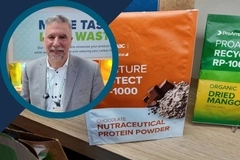
I'm joined by Seann Desai from Pro Ampak.
Hi there.
How are you doing?
What's new for Pro Ampak this year?
What's new for ProAE this year?
We're pretty excited to launch our MP 1000 product line.
It's a moisture scavenging film in partnership with Aptar.
It's brand new in the show.
We have a booth and some of the Aptar guys who are helping man the booth as , to talk about the products.
The way it works is that it will actively pull moisture out of the packaging, thereby negating the need for a dustskin package, or anything behind that.
Outside of that, we're expanding a recyclable, and sustainable platform as , this year at the show.
And so if you looked at the booth probably 5-6 years ago, we had a small sliver of recyclable.
This year, about 90% of the booth is recyclable and sustainable packaging solutions that we have here today.
And so we're pretty excited with all the customer meetings that we've had and just unprecedented amount of foot traffic that we've got and just a hell of a good looking booth.
This year, as with every year, the amount of traffic coming in that we're able to capitalize and all that.
Now what were the difficulties in getting all of this recycled material into your products and how did you achieve it?
Yeah, the, the difficulty comes down to the material science side of it, and we're fortunate to have 80 PhDs and engineers on staff and 7 university partnerships that we can leverage to go help us ideate and then innovate those solutions.
And then the other part of that is we're we're led a lot, we're led a lot by our customers and so a lot of these ideas are being born from our cust customers or they'll come in and ask, hey, how do we figure out the solution?
How do we get this to work.
Then our teams go to work with their teams and their packaging engineers, and as I look across the room, one of our largest customers is sitting right there and they got four of their packaging engineers talking to our guys ideating the next generation of products that they're going to be launching in 2025 and 2026, and so.
The difficulty behind it, it's working the material science behind it.
It's getting the polymer scientists and the food scientists to work together and figuring out what the next solution looks like at the molecular level.
And in terms of the packaging market in the US, how does it compare in your eyes to the market in Europe?
Yeah, there's a lot of similarities between the two.
What we're finding right now is that the last 18 months, depending on what market you were in, we saw the food markets begin to plateau disproportionate to what the other markets were doing.
So whereas we saw our industrial, medical, and pharmaceutical segments accelerate, we saw the food markets plateau, and we saw a lot of that happen within Europe as.
One of the main differences that we've seen is some of the turmoil that's going on in Eastern Europe are just not things that we're dealing with within the US, so some of the geopolitical issues that can impact in Europe, we're not seeing the same impacts that coming on here.
The other big thing that we're having to pay a lot of attention to is just general weather patterns within the US as those hurricanes are forming in the Gulf.
We are paying a close eye in terms of what's happening there, not only around resent availability, but to make sure that our customers stay in stock.
Different supply chain dynamics that are going on in Europe behind that, a lot more evenness and supply that we're able to control that's going on out there are probably the main things that we're discovering.
The other main thing that we're finding is that.
The push for sustainable packaging is equal in both regions, so we're seeing our European customers move at the same speed and intensity that our US based customers are moving at as.
And the benefit for us when something like that occurs, it allows the solutions that we develop either in in in the European region or the US region to start crossing the border a lot easier.
So as we're ideating and innovating in Europe, we're able to bring that technology here into the US.
Our wrap sandwich wedges are a great example of that.
As we're and innovating in the US with our polymer and modern material technology, we're able to deploy that out in Europe almost seamlessly because of that interplay that we're seeing and the aggressiveness of customers wanting to move that way.
It's interesting.
It's interesting that the speed of development looks the same when it's two different legislative environments.
It could be totally different customers and markets as , and that was not the case 10 years ago.
10 years ago, these regions were acting independently.
Some cared about sustainability, others did not.
And now what we're finding is that both regions are moving at the same speed when it comes to that and converting packaging from a conventional structure to a value add or a sustainable structure instead, right?
And then over the next 5 years, what do you expect to see?
So Pro Ampex's positioned in an interesting spot right now.
So 100% of everything that we supply as a sustainable alternate that's commercially available today, and what we see the next 5 years is all the products that are not in that sustainable alternate to move into that across the board.
And so that's gonna be probably the biggest general theme that we're seeing.
Is that as we exit this time period where it might have been slow for a handful of folks in the market, as the economy starts turning here over the next 5 years and the elections take place and people start finding their footing and stability starts resuming here geopolitically.
And and through the elections we hope that the sustainability conversation will re-accelerate to the pattern that it was before.
Brilliant.
Thank you so much.
Yeah, thank you.