


Dairy packagers embrace plastic reduction and smart labels for traceability


Key takeaways
- Dairy packaging is shifting toward sustainable materials like fiber-based solutions and recycled content, driven by regulations and consumer demand.
- Companies are pioneering monomaterial, lightweight, and active packaging to enhance recyclability and reduce plastic.
- The industry faces challenges in scaling these sustainable solutions while maintaining food safety, product freshness, and compliance with evolving regulations.

Material innovation and durable labeling are transforming dairy packaging. As sustainability regulations tighten, packagers are turning to recycled content and fiber-based solutions, while high-speed filling lines require labels that ensure security and clear traceability.
Packaging Insights speaks to Amcor Limited, Elopak, LEIBINGER, and SIG about their latest dairy packaging solutions, exploring various industry approaches to tackling plastic reduction and the emerging demand for active packaging options.
“The choices made now will define dairy packaging’s environmental credibility for years to come. What gives us confidence is the growing convergence between what regulators require and what the market wants,” says Uwe Schulze, executive vice president of product and development at Elopak.

“The solutions that reduce plastic, support longer freshness, and comply with evolving regulatory and market requirements are the same ones that brand owners are increasingly prioritizing. That alignment means this shift isn’t just compliance‑driven — it’s commercially inevitable.”
Paperization trend
For Elopak, the shift from plastic to fiber-based cartons is one of the biggest trends in dairy packaging. As with most packaging segments, the industry is shaped by sustainability regulations, material innovations, and consumer convenience.
Schulze says regulations have prompted brands to consider fiber-based dairy packaging formats.
“Cartons made from responsibly sourced paperboard offer a demonstrably lower carbon footprint compared to plastic packaging, and brands are increasingly able to prove that through independently verified LCA data, such as ‘Supporting evidence Environmental performance of beverage cartons.’”
Validating sustainability claims
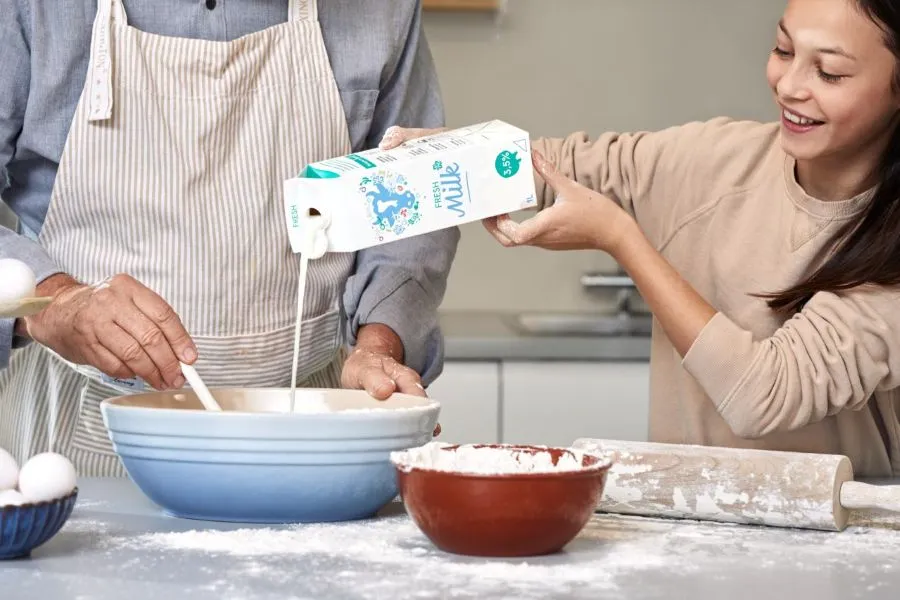 Elopak’s fiber-based cartons aim to reduce carbon footprint (Image credit: Elopak).Scientific validation is increasingly important for brands seeking consumer trust. “Substantiated Sustainability” was recently identified as one of Innova Market Insights’ Top Packaging Trends for 2026.
Regulators and consumers increasingly expect packaging sustainability claims to be scientifically validated, as the industry invests more in recyclable and reusable solutions, as well as bio-based alternatives.
“There are many ways and approaches that lead to more sustainable packaging solutions, but what ultimately counts is the proven benefit to the environment,” says Julia Trebels, global category and consumer insights manager at SIG.
“We’ve checked the environmental impact of our packaging solutions with several independent, ISO-certified, and critically reviewed LCAs. Thus, making sure that we understand the potential impacts of emissions and use of resources on ecosystems, natural resources, and human health.”
To reduce the carbon footprint of its cartons, SIG is increasing the proportion of low-carbon paperboard and eliminating carbon-intensive aluminum foil.
“Where we do still use aluminum, we source it from responsible sources certified to Aluminium Stewardship Initiative standards, which require suppliers to follow a strict emissions reduction roadmap,” says Trebels.
According to SIG, its Terra Alu-free + Full barrier is the “world’s first” full-barrier aseptic carton packaging material without an aluminum layer, boasting up to 81% paper content and targeting at least 90% by 2030, without cutting performance, quality, or shelf life.
Reworking plastic
Aside from paper-based cartons, continued development in the plastic dairy solutions involves monomaterial solutions to increase recyclability and lightweighting.
Katrina Burrett, product line director for Containers and Reusables at Amcor Global Rigids Packaging Solutions, tells Packaging Insights: “The shift into monomaterials is front and center when looking at the transition of the full packs (pot and lidding) to support recycle-readiness as well as regulatory alignment.”
.webp) SIG’s Terra Alu-free carton is the first aseptic packaging without aluminum (Image credit: SIG).“This is also driving continued lightweighting. There is a real move to thinner-walled pots, especially in the larger formats, to balance material reduction with the need to maintain fill line performance and consumer perception of quality.”
SIG’s Terra Alu-free carton is the first aseptic packaging without aluminum (Image credit: SIG).“This is also driving continued lightweighting. There is a real move to thinner-walled pots, especially in the larger formats, to balance material reduction with the need to maintain fill line performance and consumer perception of quality.”
For cheese products, Burrett highlights that there is a focus on consumer convenience and shelf life, creating demand for easy-open and close solutions, such as Amcor’s recycle-ready and monomaterial range, AmPrima.
Overcoming plastic challenges
There are some difficulties when switching from or reducing plastic content. Maren Klose, marketing communications manager at LEIBINGER, explains that monomaterials and lightweight dairy options are challenging substrates for printing.
She tells us: “Modern dairy packaging increasingly uses recyclable monomaterial films, coated cartons, and lightweight plastics. These substrates can be challenging due to low surface energy, coatings, or condensation caused by cold filling and refrigeration.”
LEIBINGER offers specially formulated inks designed for difficult substrates, providing “strong adhesion and resistance to moisture, abrasion, and temperature fluctuations.”
Moreover, for reusable dairy packaging, LEIBINGER offers washable inks that are said to meet strict hygiene and recycling requirements without compromising code durability.
Elopak’s Schulze explains that dairy packaging closures remain one of the sector’s biggest challenges.
“The transition toward lower‑plastic and fiber‑based closures must meet tethered‑cap mandates, recycled‑content targets, and consumer expectations — all while maintaining production efficiency.”
Moreover, he adds that “the biggest technical challenge remains maintaining essential food‑contact barrier performance while simplifying structures for recyclability.”
“Ongoing innovation in materials — from reduced‑plastic paperboard structures to aluminum‑free designs — illustrates the complexity of reconciling recyclability, functionality, and food‑contact safety.”
Scaling material innovation
.webp) Amcor’s AmPrima range offers recycle-ready, monomaterial solutions for cheese packaging (Image credit: Amcor).Moving away from conventional virgin plastic solutions can be hard to scale. Amcor’s Burrett explains that attaining food-grade recyclable content at scale remains a bottleneck for the dairy packaging industry.
Amcor’s AmPrima range offers recycle-ready, monomaterial solutions for cheese packaging (Image credit: Amcor).Moving away from conventional virgin plastic solutions can be hard to scale. Amcor’s Burrett explains that attaining food-grade recyclable content at scale remains a bottleneck for the dairy packaging industry.
She adds: “Demand is increasing, but food contact supply remains constrained. This is happening at the same time that evolving regulatory frameworks across Europe are adding complexity and uncertainty, requiring solutions that are recycle-ready while maintaining compliance and performance.”
Scaling fiber-based solutions is also tricky, according to Schulze, and depends on recycling infrastructure, “which still varies significantly across markets.”
Efficient dairy labels
LEIBINGER’s Klose explains that dairy filling lines run at very high speeds, “making absolutely reliable date and lot coding essential.”
She adds: “Our IQJET printer is designed with an IP66 protection class, making it dust-tight and resistant to powerful water jets. This is particularly important in dairy plants where washdown procedures and humid conditions are part of everyday operations.”
She notes that LEIBINGER has also expanded its portfolio of high-adhesion and fast-drying inks tailored for coated cartons, plastic cups, PET bottles, and flexible dairy films. These inks ensure durable, high-contrast codes even under condensation and cold-chain conditions.
The printing and labeling solution company also explains that effective traceability is “critical” in dairy production due to strict regulatory requirements.
“Our CIJ printers deliver consistently sharp best-before dates, batch codes, and production identifiers — even at very high line speeds. Clear prints ensure reliable readability for both human operators and machine vision systems, supporting inspection, verification, and compliance requirements.”
Active packaging for the future
In terms of product freshness, Elopak’s Schulze says that dairy companies are increasingly exploring new types of packaging that can help keep products fresh for longer.
“This includes indicators that show if a product has been exposed to too much heat, but also packaging and filling methods that keep their products fresh for longer on the shelf.”
“At Elopak, we continue to explore new ways to protect product quality and support longer‑lasting freshness through improvements in materials, filling technology, and packaging design — always within strict food‑safety standards.
She adds that Elopak’s ultra‑clean filling machine for extended shelf technology hygiene level provides longer shelf life, allowing more time for distribution and consumption, and ultimately reducing food waste.
SIG’s Trebels also notes the active packaging trend, though she points out the sometimes “unnecessary” additives it requires.
“It can be assumed that digital technologies will continue to develop — conceivable examples include printed freshness sensors or even more detailed information transfer via next-generation QR codes. Consumers could then use their smartphones to obtain information not only about the origin and supply chain, but also about shelf life or ecological footprint.”
“Based on our experience and collaboration with our customers, we know that consumers want their dairy products to be ‘clean’ — free from unnecessary additives or chemicals sometimes connected with active packaging — while still expecting long shelf life and food safety.”
In any case, the convergence of sustainable materials — like fiber-based solutions, reduced plastic content, or recycled content — with smart digital features amid regulatory pressure and increasing consumer demand for scientific validation seems to be defining for the next chapter of the sector.
Amcor’s Burret concludes: “The next phase of dairy packaging innovation will be defined by execution — scaling more sustainable solutions in a way that balances operationally, economically, and within existing infrastructure.”