




EU countries back harmonized end-of-waste criteria for recycled plastics

Key takeaways
- EU member states have voted in favor of harmonized end-of-waste criteria for recycled plastics, aiming to create a single market and reduce administrative costs.
- The criteria are expected to apply around mid-2027, six months after formally entering into force.
- Industry groups welcome the move but call for stronger demand for recycled materials and further harmonization through the upcoming Circular Economy Act.
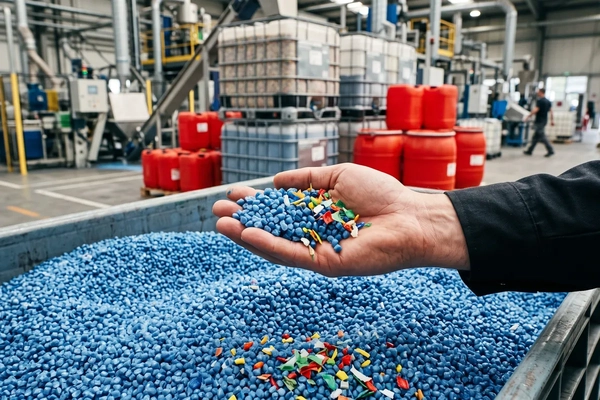
EU member states have voted in favor of an EU-wide end-of-waste criteria for recycled plastics during a Technical Adaptation Committee meeting at the European Commission (EC) earlier this week.
The end-of-waste criteria aim to provide legal certainty, create a level playing field across member states, and facilitate the free movement of recycled plastics within the single market, according to the European Waste Management Association (FEAD).
FEAD, representing private waste management entities in the EU, is among the industry organizations actively supporting the end-of-waste criteria. It estimates that the lack of such criteria costs EU plastics recyclers €120 million (US$134 million) a year.
Following the member states’ vote in favor, the criteria are to be adopted formally and published in the Official Journal of the EU, normally coming into force 20 days later.

“The decision should have a considerable impact on the European recycling market, highlighting the transition from national markets towards a more European one, resulting in reduced administrative costs,” Lauriane Veillard, chemical recycling and plastic-to-fuels policy officer at the environmental organization Zero Waste Europe, tells Packaging Insights.
Mathilde Taveau, public and regulatory affairs manager at Plastics Recyclers Europe, also an EU-wide industry organization, adds: “This decision is crucial for removing existing bottlenecks and laying the foundations for creating a genuine single market for secondary raw materials by ensuring that the same rules apply when materials move from one EU country to another.”
Harmonization in practice
Another industry voice to support the move is Recycling Europe, the face of 84 national federations and companies across the EU and the UK. Recycling Europe anticipates the new criteria to result in a stronger, more integrated, and competitive market for recycled plastics.
 Mathilde Taveau, public and regulatory affairs manager at Plastics Recyclers Europe (Image credit: Mathilde Taveau LinkedIn).Recycling Europe expects the end-of-waste criteria to begin applying six months after it comes into force, which is around mid-2027. “Yet, progress has been slow. Technical work began in 2022, and the new criteria are expected to apply only around mid-2027. The final rules must deliver harmonization in practice,” the organization continues.
Plastics Recyclers Europe’s Taveau elaborates: “In practical terms, a common criteria will provide greater legal certainty over when recycled plastics cease to be waste and can be traded as products across the EU.”
“This should facilitate cross-border movements of recyclates, reduce the administrative burden resulting from different national and case-by-case approaches, and give recyclers and users of recycled plastics greater confidence in the quality and status of the materials they place on, or source from the market,” she tells us.
“Ultimately, a more predictable and harmonized framework can also support investment in European recycling capacity and improve the uptake of recycled plastics. In addition, it also covers the imports coming from outside the EU — promoting a level playing field and ensuring all parties are operating under equivalent conditions.”
The EC proposed the union-wide end-of-waste criteria to create a single market for recycled plastics at the start of the year.
In February, the Waste Technical Adaptation Committee voted in favor of implementing recycled-content calculation rules under the Single-Use Plastics Directive at the EC.
According to Veillard, the biggest remaining challenges for the EU recycled plastics market, particularly in terms of demand and competitiveness, include “the economic advantage of virgin plastics that is built on the embedded linear economy.”
“The challenge is to bridge the financial gap to create a level playing field,” she argues. “A way to do this could be to build on the currently discussed Circular Lever in the Netherlands, which aims to tax the proportion of virgin materials in certain products.”
Circular Economy Act
Discussing what the EU should prioritize next to strengthen the single market, Veillard says that the upcoming Circular Economy Act “aims to set the ground for circular economy to thrive in Europe in the future.”
“For this transition to remain relevant in the long term, ensuring transparency and traceability along the value chain to support recycling, so materials composition that will be recycled in the future shall be more easily accessible.”
 Lauriane Veillard, chemical recycling and plastic-to-fuels policy officer at the environmental organization Zero Waste Europe (Image credit: Zero Waste Europe).Recycling Europe adds: “Through the upcoming Circular Economy Act, we will continue pushing for faster adoption of EU-wide end-of-waste criteria across material streams and stronger demand for recycled materials.”
Earlier this year, packaging industry groups called for the EU’s forthcoming Circular Economy Act to strengthen the EU single market and harmonize circular packaging rules.
Echoing the sentiment coming from the NGO sector, Plastics Recyclers Europe’s Taveau says a “principal challenge” is that future recycled-content targets are not yet translating into sufficient demand today.
“European recyclers are operating under pressure from high energy and operating costs, weak recyclate prices, and low-cost imports of virgin and recycled plastics. As a result, established European recycling capacity and investment are under pressure.”
Taveau asserts that increasing collection or capacity alone will not solve the operating problems unless the resulting recyclates have stable outlets at economically sustainable conditions.
“The Circular Economy Act should therefore put demand for recycled materials at its core.”
“This means harmonized EPR schemes that cover the cost of waste management and create incentives for the use of verified European recyclates, stronger circularity criteria in public procurement, targeted fiscal measures such as Green VAT, and a level playing field for imports through equivalent standards, traceability, and enforcement.”
“The objective must be to make circularity economically viable in Europe, while securing investment, industrial resilience, and access to high-quality secondary raw materials.”