


Foodservice packaging moves toward “verified sustainability” with fiberization & recyclability


Key takeaways
- Foodservice packaging trends are shifting toward fiber-based materials, driven by consumer demand and regulatory pressure.
- Companies like Siegwerk and Huhtamaki are innovating with fiber solutions, focusing on recyclability and monomaterial structures.
- Technological advances, including data systems and traceability, are becoming essential to enhance transparency and support sustainable claims.
Fiberization remains a driving force in foodservice packaging, but consumer and regulatory pressure are compelling brands to ensure their sustainability claims are substantiated through the use of monomaterial, recyclable materials, data, and tracking.
Packaging Insights speaks to the UK’s Foodservice Packaging Association (FPA), Huhtamaki, and Siegwerk to find out more about the latest trends shaping foodservice packaging innovation.
Mike Revell, executive chair at the FPA, says there is a continued shift toward fiber-based materials in the foodservice space, “driven by regulatory pressure and consumer perception.”
“Fiber-based foodservice packaging is often more complex than it appears, particularly where barriers, coatings, and end-of-life outcomes are concerned,” he adds.

Substantiated sustainability
Sally Molyneux, head of Sales and Marketing for the UK and Ireland for foodservice and FMCG at Huhtamaki, adds that beyond fiber-based, other “simpler” solutions are also gaining traction in the space, including monomaterial structures, to support recyclability and material recovery.
Revell continues: “There is a growing focus on recyclability and design for compliance. In the UK, the packaging EPR (pEPR) is forcing businesses to look much more closely at material choices, formats, and data. There’s also an increasing scrutiny around environmental claims. Businesses are becoming more cautious, which is a positive development, but it also reflects a lack of clarity and consistency in guidance.”
Gilles Le Moigne, head of Circular Economy Coatings at Siegwerk, says: “Brands are moving beyond simple, often unsubstantiated, ‘eco-friendly’ claims which had sometimes been seen as ‘added value’ and focusing more on solutions that are genuinely recyclable and work within established paper recycling streams as a compulsory requirement for their packaging.”
Innova Market Insights also highlighted “substantiated sustainability” as its top packaging trend for 2026.
“At the same time, regulatory developments in the EU, such as the Single-Use Plastics Directive (SUPD), EPR schemes, and the new Packaging and Packaging Waste Regulation, are starting to provide the clarity required to accelerate the shift toward fiber-based, recyclable structures as a complement to reusable formats,” says Le Moigne.
Plastic layer-free
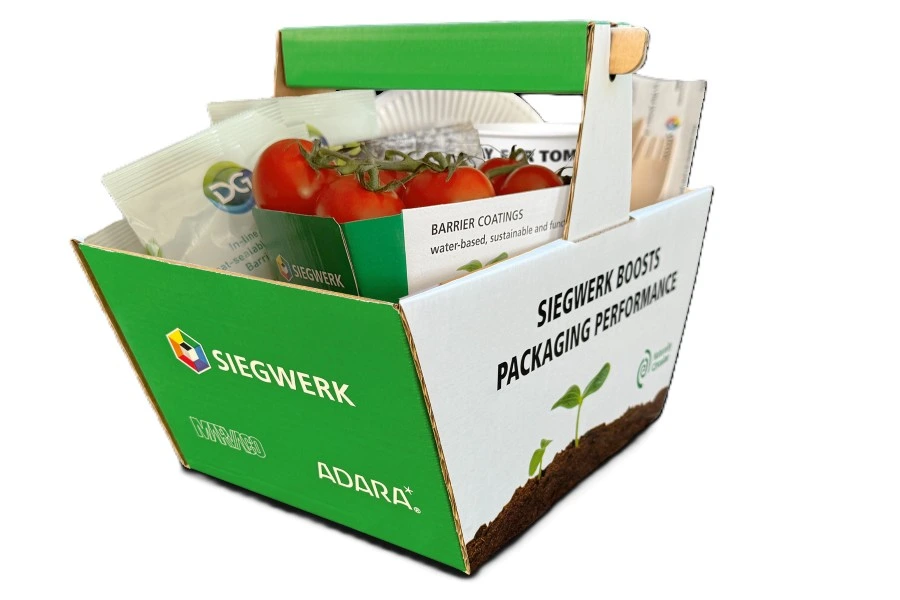 Siegwerk uses its plastic-free Cirkit coatings in its corrugated cardboard picnic basket set (Image credit Siegwerk).In order to move to simpler, monomaterial solutions for foodservice packaging, Siegwerk’s “clear objective” is to replace the plastic layers in fiber-based solutions, according to Le Moigne.
“Through our Cirkit portfolio, we support a wide range of solutions for different foodservice formats, including hot and cold cups, plates and trays, clamshells and cartons, as well as sealable and non-sealable wraps,” details Le Moigne.
“Advances in functional paper and board and barrier-coated substrates are making it possible for fiber to replace plastic in applications that were previously considered too demanding. This transition is closely linked to cost and operational efficiency, as converters look for solutions that run on existing high-speed lines and help reduce material complexity and EPR costs.”
Huhtamaki’s Molyneux adds that by reducing unnecessary material complexity, packaging can help enable higher quality recycling outcomes, whether in paper-based systems or within plastic streams designed for circularity.
“At the same time, functionality remains critical. Foodservice packaging must protect food quality, extend shelf life, and perform reliably in demanding, high-volume environments.”
“Advances in barrier technologies, coatings, and material science are helping deliver these outcomes while keeping structures streamlined and more compatible with recycling systems, particularly for high-throughput foodservice applications.”
Fully cardboard “picnic basket”
Siegwerk uses its plastic-free Cirkit coatings in its “picnic basket” complete set of foodservice packaging developed using corrugated cardboard and Siegwerk inks, such as UniNature.
“For paper cups, Cirkit Bar Seal CT 1422 enables brands and converters to replace traditional inner PE layers with an easily repulpable alternative that performs reliably for hot and cold beverages, without compromising on barrier or sealing performance,” Le Moigne continues.
The Cirkit barrier coatings are also said to provide the necessary balance of liquid and grease resistance while maintaining functionality and recyclability.
Le Moigne describes the Cirkit Natubar PR 4798 paper plates as SUPD-compliant and “truly” plastic-free with sufficient resistance for typical use, such as a summer picnic or a garden barbecue.
The Siegwerk picnic basket was developed and filled in collaboration with partners including Adara Pakkaus Oy, Marvaco, and Franz Veit.
Data for EPR
 Huhtamaki says monomaterial foodservice packaging supports recyclability and material recovery (Image credit: Huhtamaki).The FPA’s Revell points to the current technological developments as another key aspect driving foodservice packaging’s transformation.
He says technology plays a critical role in making data systems like EPR work effectively in practice and moving it from a complex administrative burden toward a more transparent, efficient, and credible system.
“EPR relies heavily on accurate, timely reporting of packaging placed on the market, yet many businesses are still grappling with complexity and inconsistency. Smarter digital reporting platforms and automated data capture can reduce errors, improve compliance, and give regulators a clearer picture of the market.”
Revell says that a key challenge for the foodservice packaging industry in the UK is policy implementation. “For example, the pEPR is fair in principle but remains complex and, in some areas, lacks transparency. There is a risk that the current system places a disproportionate burden on compliant businesses, while others remain outside scope.”
Ensuring traceability
Huhtamaki’s Molyneux says that beyond material innovation and regulatory compliance, technology and data also play a growing role in waste sorting and efficient manufacturing.
“Traceability is key,” adds Revell. “Tracking packaging through the value chain is key, from production to disposal, providing evidence of recyclability, to end-of-life outcomes.”
“This is particularly important for mechanisms such as the UK’s pEPR Recyclability Assessment Methodology, where robust evidence is required to support claims.”
He adds that improved data matching between company registrations, producer responsibility schemes, and waste flows could help identify gaps in the system and ensure that all obligated businesses are contributing appropriately.
“Digital tools can support clearer communication, including between businesses and with consumers, helping to ensure that packaging is disposed of correctly and that recyclability claims are understood and trusted.”
Looking ahead, Molyneux says the future of foodservice packaging will be defined by a pragmatic approach to sustainability, where fiber-based, flexible, and low-plastic and plastic-free solutions play a role depending on usage, infrastructure, and performance requirements.
“Collaboration across the value chain will remain essential to scale innovations that protect food, meet regulatory expectations, and support customers’ transition toward a more circular packaging economy.”