



Packaging Innovations 2026 review: Foodservice industry tackles pEPR confusion and drives change

Key takeaways
- UK’s pEPR has sparked some confusion, while driving innovation among foodservice packaging providers.
- Industry players are working to meet compliance despite issues surrounding enforcement.
- A shift toward more environmentally sustainable solutions is underway, but uncertainty around regulations and data collection remains a concern.
 Image credit: Packaging Innovations
The UK’s packaging EPR (pEPR) was a major topic of discussion among foodservice packaging providers exhibiting at this year’s Packaging Innovations in Birmingham, UK.
We spoke to Ecosurety, the country’s pEPR compliance scheme, the UK Foodservice Packaging Association (FPA), and packaging providers Coveris and Xampla, to explore how the industry is responding and what factors are causing confusion.
People have been working on different innovative and sustainable solutions for many years, but really it’s now crunch time, and businesses are realizing that if they are going to innovate,” Alison Appleby, packaging sustainability specialist at Ecosurety, tells Packaging Insights.
“They have to innovate quite quickly to avoid costs associated with materials that might not be recyclable or that they may have had on the market previously. Now, we are starting to see shifts in the types of packaging they are using.”
Mike Revell, executive chair at the FPA, adds: “If you go around to all the stands, you see the topic of pEPR at the top of the agenda, and we’re right at the beginning of the implementation, and it's causing some confusion.”
“At the moment, pEPR is still very gray, and that’s a concern, and as a trade body, we have to try and find ways to navigate that, to support our membership in our industry to make it more clear.”
“Considering we have that challenge, the suppliers here and our members who are also exhibiting here should be applauded for the quality of the products they are presenting at the show with that backdrop.”
Working toward green
Ecosurety’s Appleby sees unnecessary materials being removed from the F&B packaging industry, as well as lightweighting to reduce tonnage and drive down costs.
 Alison Appleby, packaging sustainability specialist at Ecosurety.“Having walked through the show floor this year, I see there’s a lot of fiber-based materials and flexible packaging that’s on the market. And that’s a trend that we’ve seen over the last few years. I’m curious to see whether that will change given the recyclability assessment coming into play and ensuring that packaging is meeting with red, amber, and green ratings.”
“Everyone’s working toward the green outcomes, so that they have reduced costs, and that seems to be a hot topic that people are working toward, and that makes sense, given the costs that are associated with that.”
Will Mercer, director of paper R&D at Coveris, tells us that brands have to accept that the pEPR is happening and that it is not going to go away.
“From our point of view, driving circular materials and helping our customers to get their products into the right classification and to minimize their liability with pEPR and designing that packaging for recyclability is absolutely key.”
“We’re very much pushing to get the materials to the best categorization, best level, and designing for recyclability, and now in line with our no waste and EcoVadis commitment.”
Lack of enforcement
FPA’s Revell says that despite the many positive examples of foodservice packagers innovating to ensure compliance, functionality, and sustainability, the UK government’s Department for Environment, Food & Rural Affairs (Defra) is being unclear about their expectations, and that enforcement remains weak.
“When you drive legislation, you expect the government to police that legislation. This is not happening. When you go to the Environmental Agency, there are no people there. Is the industry expected to do the policing? Well, if we do that, we want a tax rebate.”
“We know lots of companies that are not ready for the pEPR. Why should we, as an industry, keep on whistleblowing? Shouldn’t there be a proper structure that's actually going to do that?”
Revell says the FPA will continue to work with Defra to help it find the best solutions. “That’s all we can do at this stage. We’re the alarm bell, trade bodies are the alarm bell for the industry.”
“All we can do is continue to have dialogue, and hopefully there will be some amendments within the pEPR legislation, because they’ll be able to recoup the money they want — the money that was set out to be for recycling plants to be built to increase recycling. The general public would like to see that.”
Weight and material
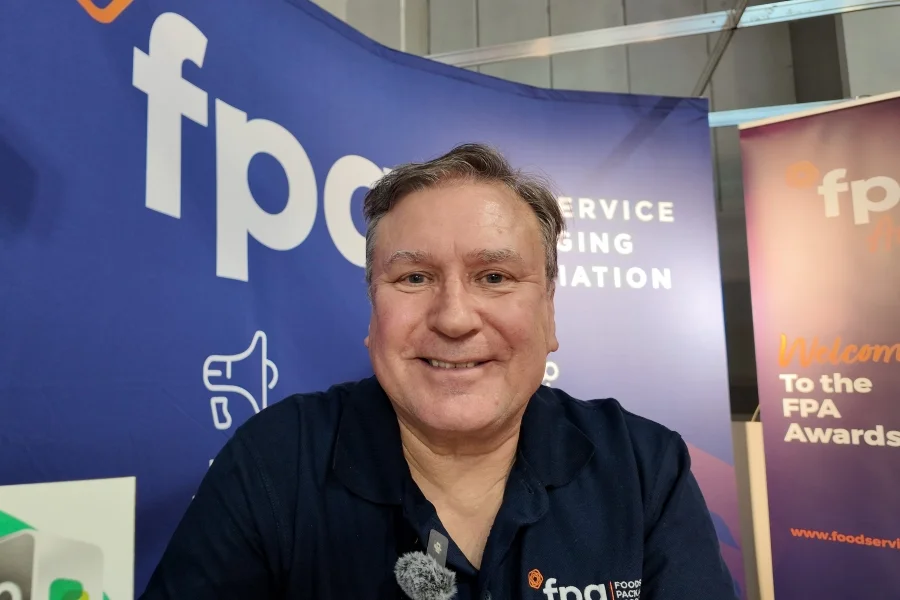 Mike Revell, executive chair at the FPA.Revell further says that collecting the data for the pEPR “is like a minefield, trying to make sure we calculate that data correctly is not easy.”
“This has been a massive burden on our industry. It’s something that needs to be done, but we do believe it could have been done simpler. So if you talk to all the people in our industry at the moment, they’re saying you’ve got these lovely new products, but there’s a big question, how does it link to the pEPR?”
“It’s all about weight. Tonnage is a big issue. Is that really the right way to go? We have a different pEPR number for each weight.”
Meanwhile, Ecosurety’s Appleby says material innovation is “a critical part of the transition, but it’s really tricky, because lots of businesses want to be innovative, but in many cases, the system isn’t there to support those innovations.”
“We’ll see businesses might move to an interesting material type that wouldn’t necessarily be recyclable in existing systems, or be able to go through processes without a dedicated collection.”
She explains some companies are innovating while knowing that the material might fall under red for now, but then it could potentially scale up in the future and become emerald green.
Alexandra French, CEO at Xampla, the company behind the Morro coating made from natural plant polymers with foodservice packaging applications, tells us: “We’ve been working with Defra and PackUK to make sure that they understand our materials and to make sure that innovation is going to be championed and supported to help the industry move away from plastic.”