
Scientists tune plastic degradation rate for packaging applications


Key takeaways
- Rutgers University scientists have created plastics with programmable degradation rates, allowing materials to break down naturally without heat or harsh chemicals.
- The plastics can remain stable during storage and use, then start degrading when triggered.
- The team is working to integrate the chemistry into plastics like PE, PP, PET, and PS.
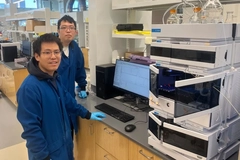 Assistant professor Yuwei Gu and graduate student Shaozheng Yin from Rutgers University.
Scientists from Rutgers University, US, have unveiled plastic for packaging that breaks down under everyday conditions at programmed speeds, without adding heat or harsh chemicals.
Chemical bonds are the “glue” that holds atoms together in molecules. In polymers, these bonds connect each building block to the next. The strength of these bonds in plastics makes them difficult to break down.
In the study, published in Nature Chemistry, researchers have found a path to enable a programmable deconstruction process. They arranged components of the plastic’s chemical structure in a way that they could start breaking down when triggered.
Yuwei Gu, assistant professor at the Department of Chemistry and Chemical Biology, Rutgers University, tells Packaging Insights: “Our strategy makes it possible to design plastics that break down at different rates, depending on how long they need to last.”
“In packaging, this flexibility is crucial. For example, packaging for fresh produce or short-lived foods ideally shouldn’t last for years in the environment, whereas packaging for items like toys or laundry detergents needs to be much more durable.”
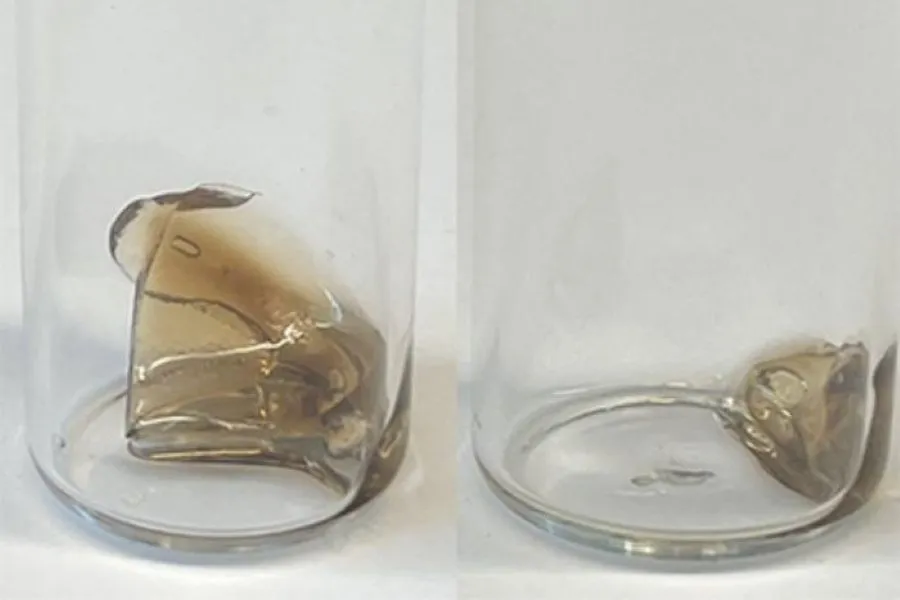 PDCPD made with the scientists’ process using degradable chemistry breaks down on its own at normal room conditions.“Our approach allows us to ‘tune’ the degradation rate so that each type of packaging can match the product’s actual lifespan.”
Light-triggered degradation
The team highlights that the breakdown can be built-in or can be switched on or off using ultraviolet light or metal ions, creating another layer of control.
“We understand that packaging materials are often manufactured months before they are used to hold food or other products. To address this, we built in a triggering mechanism: in our system, the plastic does not begin degrading until it is exposed to strong sunlight,” shares Gu.
“This means the packaging stays completely stable during storage and use, but begins to break down once it enters the waste stream and encounters sunlight.”
“Taken together, this strategy enables the creation of packaging plastics with programmable, sunlight-triggered degradation rates, offering a promising pathway toward reducing plastic waste without compromising performance.”
Technical challenges
Gu shares that the biggest challenge is integrating this chemistry into different packaging materials used in the industry, such as PS, PE, PP and PET.
“In our current study, we focused on one specific plastic, polydicyclopentadiene (PDCPD), which is an extremely durable material used in applications like agricultural equipment. Our strategy was able to make PDCPD fully degradable without compromising its mechanical strength, which shows the power of our strategy,” he says.
“We are now designing related chemical building blocks that can be incorporated into the manufacturing processes of other major commodity plastics. It’s a significant challenge, but the underlying chemical principle behind our strategy is highly generalizable, so we are optimistic.” The scientists are developing plastics that disappear once they have served their purpose, supporting a green future.
Conducting cost analysis
Gu points out that cost is another challenge for adopting this mechanism at scale.
“Adding extra components to a plastic formulation can increase manufacturing expenses, and realistically, not everyone will want to pay significantly more for packaging — even if it’s more environmentally friendly. We are currently performing a detailed cost analysis and developing lower-cost variants of our approach.”
“The encouraging part is that our system only requires incorporating about 5–10% of the degradable building block into existing plastic formulations. Because this is such a small fraction, we believe it can be integrated into current industrial workflows with only a minimal additional cost.”
The researchers also note that the principle could enable innovations like timed drug-release capsules and self-erasing coatings. Early laboratory tests indicate that the liquid produced by the breakdown is non-toxic, and researchers are conducting additional studies to confirm its safety.