

Selenis expands copolyester capacity with Polisan Hellas asset acquisition


Key takeaways
- Selenis has acquired Polisan Hellas’ copolyester production assets, expanding its specialty copolyester capacity to 200,000 metric tons.
- The company aims to improve packaging supply resilience by enabling multi-site production, reducing dependence on single plants, and supporting more predictable resin availability.
- Expanded continuous production capacity will support PETG shrink sleeves, films, sheets, and recycled-content copolyester grades designed for packaging applications.
 (All image credits: Selenis).
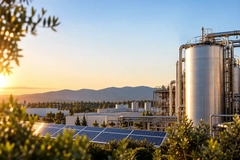
Plastics producer Selenis has purchased the copolyester production assets of Polisan Hellas in Greece for installation at its site in Portugal. Following the acquisition, Selenis’ total specialty copolyester production capacity will reach 200,000 metric tons annually across production sites in Portugal, Italy, Tunisia, and the US.
Selenis says that it is now Europe’s only producer of specialty copolyester, a type of modified polyester with glass-like properties. Packaging Insights sits down with a company representative to discuss the benefits of copolyester for packaging applications, as well as Selenis’ goals for the new acquisition and expanded capacity.

“For shrink sleeve, film, and sheet customers [in the packaging industry] the acquisition means more capacity, a second plant behind the same grade, and a lower cost base,” the spokesperson tells us. “These are the first grades we will move onto the continuous line. Customers keep the specifications they have already qualified with, and they can now secure multi-year, volume-committed supply agreements.”
“We will take on new projects and give existing customers more security of supply at the same time. We also know the converter’s side of the business: our sister company Evertis extrudes PET film and sheet within IMG Group, a family-owned group in polyester since 1959.”
The company says the acquisition facilitates high-volume applications to specialized grades, combining the scale and efficiency of continuous production with the flexibility of batch manufacturing.
With the investment, Selenis further aims to grow in four priority markets: shrink sleeves for packaging; Texnascis which produces copolyesters for specialty applications; Selcare, which supplies materials for medical packaging; and Mimesis 3D printing on copolyester.
“Europe needs a strong specialty materials manufacturing base, and we are investing to build it,” comments Duarte Matos Gil, CEO at Selenis. “When customers qualify our materials, they make a long-term commitment. Our responsibility is to invest ahead of their needs, to put more than one plant behind every grade, and to give them a cost base that lets them compete. This acquisition puts industrial capacity behind that commitment, and further steps will follow.”
Supply chain resilience
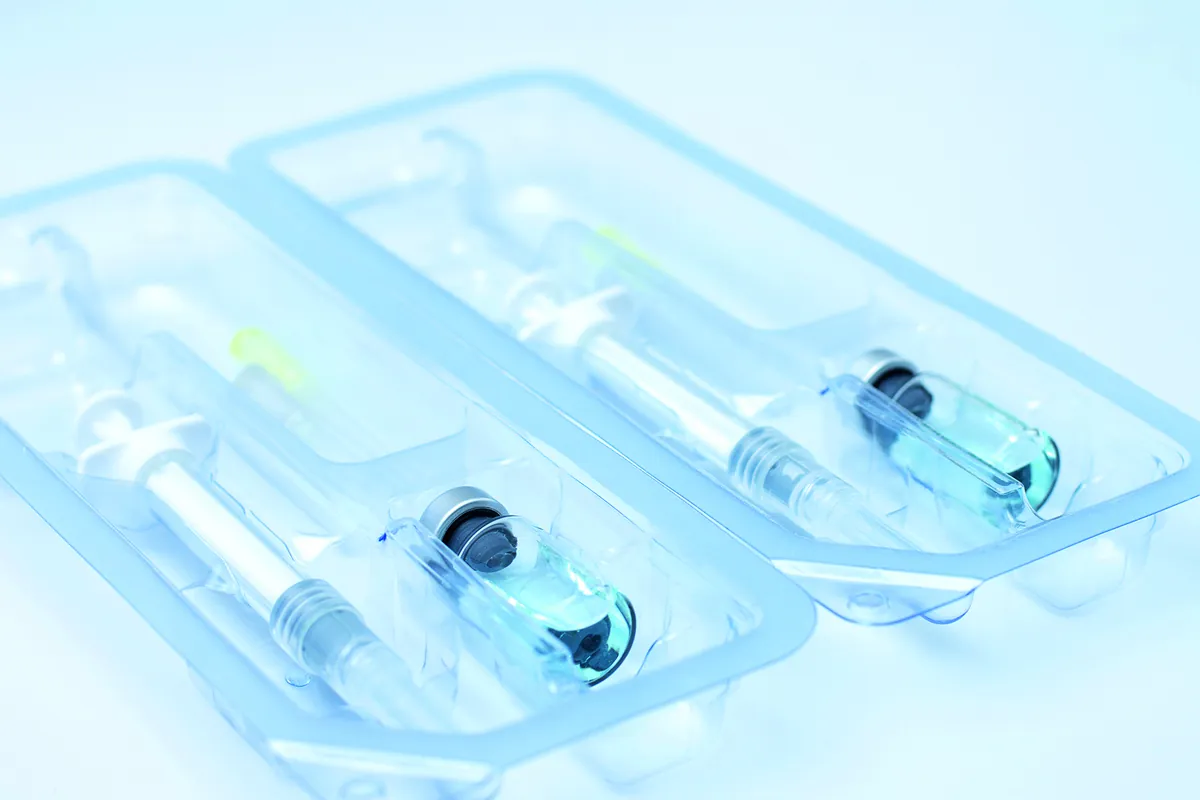 Selenis’ copolyester can be used for pharmaceutical packaging application through Selcare.Selenis highlights that ensuring a resilient supply of material was a key aspect in its decision to expand. The company now intends to work with customers to qualify selected grades at more than one manufacturing site.
The plastics producer notes that a converter can hold the same specification from two plants, with no dependency on a single line or region, allowing movement between sites as demand and logistics change.
The spokesperson tells us that in recent years, packaging converters have experienced the negative outcomes of depending on a single supplier or a single region. “We will qualify selected grades at more than one site, so a converter can hold the same specification from two plants and move volume between them as demand and logistics change.”
“European converters are supplied from Europe, and US converters from the US. With batch and continuous technology in four countries, no customer depends on one line of ours.”
The company spokesperson further explains that a European converter can now buy from Portugal or Italy and receive its resin by truck in days, rather than after weeks at sea. This also opens the door to lower safety stock requirements, according to the company.
“Availability improves because the same grade will come from more than one plant. On cost, continuous production lowers the conversion cost per ton, regional supply saves freight, and the working capital a converter ties up in stock. This supports what our customers ask us for: multi-year agreements, qualified, and priced on a predictable basis for both sides.”
Matos Gil adds: “Our ambition is to be the supplier customers choose for their next generation of products. That takes technical depth, dependable supply from more than one plant, and the capacity to grow with them.”
Continuous copolymer production
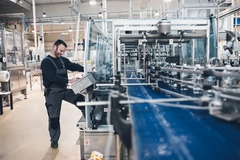
Selenis’ spokesperson explains that its continuous lines can produce copolyesters “around the clock, without batch-to-batch variation.”
“For a converter, that means stable color, clarity, and melt viscosity from one lot to the next, and an extrusion line that runs with fewer adjustments. Continuous production also has a lower conversion cost per ton than batch production.”
“High-volume packaging grades go onto the continuous line, and our batch lines stay free for specialty and custom formulations, where smaller volumes and fast changeovers matter. Customers get scale and formulation depth from the same supplier.”
Discussing which copolyester grades will be prioritized for packaging applications, the spokesperson asserts that shrink sleeve PET glycol-modified (PETG), a type of copolyester, would come first.
 Selenis provides copolyester for shrink sleeves, films, and sheets.“Then comes PETG for film and sheet, including thermoformed and rigid packaging, and medical packaging through Selcare, where multi-site qualification and continuity of supply decide who gets approved. For each of them, we develop recycled content grades and grades designed for recycling in the PET stream.”
According to Selenis, its copolymer is compatible with 3D printing. Specifically, it highlights its Mimesis product range, which enables PETG and PCTG (polycyclohexylene dimethylene terephthalate glycol) resin supply to filament producers in the industrial manufacturing, automotive, electronics, education, and consumer markets.
Recycling copolyester
In textile-to-textile recycling, Selenis says it works with Texnasci and chemical recycling partners to turn recovered monomers into new polyester.
Eduardo Santos, Strategy and Integration director at IMG Group, says: “We are evaluating new investments in Germany in the bio-based field and in Tunisia, where we are exploring textile-to-textile opportunities through DMT [chemical recycling] technology. Each investment adds a capability to one manufacturing platform, and each is chosen for the markets where our customers see the strongest long-term growth.”
“Circularity at industrial scale needs dependable volumes of standard, qualified resin, and the continuous line gives us that,” Selenis’ spokesperson continues. “We develop grades with up to 50% recycled content and grades designed to be recyclable in the PET stream, which matters for sleeves that go into recycling with the PET bottle.”
“With our chemical recycling partners, we polymerize recovered monomers into new polyester, and more capacity gives those monomers an industrial outlet. Inside IMG Group, Evertis’ packaging know-how and the group’s own PET recycling mean we develop our resins with the EU’s Packaging and Packaging Waste Regulation recyclability and recycled content requirements for 2030 in view.”