



Sidel targets label material reduction with EvoDeco Next

Key takeaways
- Sidel has launched EvoDeco Next, a next-generation roll-fed labeling platform that enables partial labels while maintaining high-speed industrial performance.
- The company claims that partial labeling can reduce label surface by up to 75%, helping beverage producers cut material use.
- The platform integrates new cutting, buffering, camera, and changeover technologies.
 (Image credit: Sidel).
Sidel has unveiled EvoDeco Next, its next-generation roll-fed labeling solution, integrating high-performance production with decoration freedom and lower material consumption.
The solution is said to allow beverage producers to use less label material while offering premium brand expression by bringing partial labels to a roll-fed platform. The company designed the system while prioritizing the robustness required for industrial production.
Anne Philippe Lafon, product manager for labeling at Sidel, says: “EvoDeco Next rethinks what is possible with roll-fed labeling. Producers no longer need to choose between industrial efficiency, material reduction, and impactful decoration.”
“By enabling partial labels on a simplified roll-fed architecture, we can help customers use less material, create new brand opportunities, and maintain the performance their production lines demand.”
Increase bottle visibility
Sidel observes that brands are confronting challenges to differentiate shelf presence as PET packaging continues to evolve toward greater material efficiency and circularity.
“Much of the industry’s lightweighting work has focused on the bottle itself, from the neck and body to the base. EvoDeco Next extends this thinking to decoration, treating the label as another packaging component that can be optimized,” says the company.
Roll-fed labeling is traditionally connected to wraparound decoration. Sidel says that through EvoDeco Next, it can now be used with smaller partial labels. By revealing more of the bottle, manufacturers can turn the container shape, transparent PET, and product part into its visual identity.
Depending on the decoration selected, the company highlights that partial labeling can cut label surface by up to 75% compared with a conventional wraparound label. “The maximum figure is based on its illustrated 90-degree partial-label configuration, while a 180-degree configuration reduces the label surface by 50%.”
The solution aligns with Sidel’s Just label proposition, combining sustainability, branding, lower total cost of ownership, and simpler technology.
Strengthening management efficiency
EvoDeco Next is developed as an integrated platform, instead of an existing roll-fed machine adapted for shorter labels. Its architecture brings together Cutter 2.0, Smart Buffer, Smart Camera, and high-speed changeover parts, with feeding, cutting, transfer, and control designed.
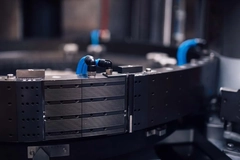
The new cutting system is positioned directly on the transfer drum. The rotary cutting device handles shorter labels using two blades, cutting faster at high speed.
The machine’s Smart Buffer is engineered to absorb reel changes without variation in production speed. Sidel says its lean configuration does not need additional footprint or changes to the standard film path and enables the splicing operation to be managed at the nominal speed, maintaining overall production efficiency.
Meanwhile, a Smart Camera allows reference-mark-free label management. Sidel says that eliminating the conventional reference mark and quiet zone enhances raw material and label flexibility, while providing opportunities for material savings. Dedicated software supports autocorrection, improved auto-homing, and enhanced diagnostics.
Additionally, the platform’s high-speed changeover parts enable machine autonomy and process robustness. An improved sliding surface and air-blade system are engineered to reduce glue cross-contamination and label stress, extending machine autonomy by up to five times while reducing related unplanned stops, according to the company.
EvoDeco Next can also be integrated with Sidel’s CoboReel automated reel-management solution, which is said to require less operator intervention, offer embedded traceability, and support greater production autonomy of up to 18 reels.