
- Industry news
Industry news
- Category news
Category news
- Reports
- Key trends
- Multimedia
- Journal
- Events
- Suppliers
- Home
- Industry news
Industry news
- Category news
Category news
- Reports
- Key trends
- Multimedia
- Events
- Suppliers
Internet of Packaging: Are connected technologies the future of brand engagement?
12 Apr 2023 | Packaging Insights
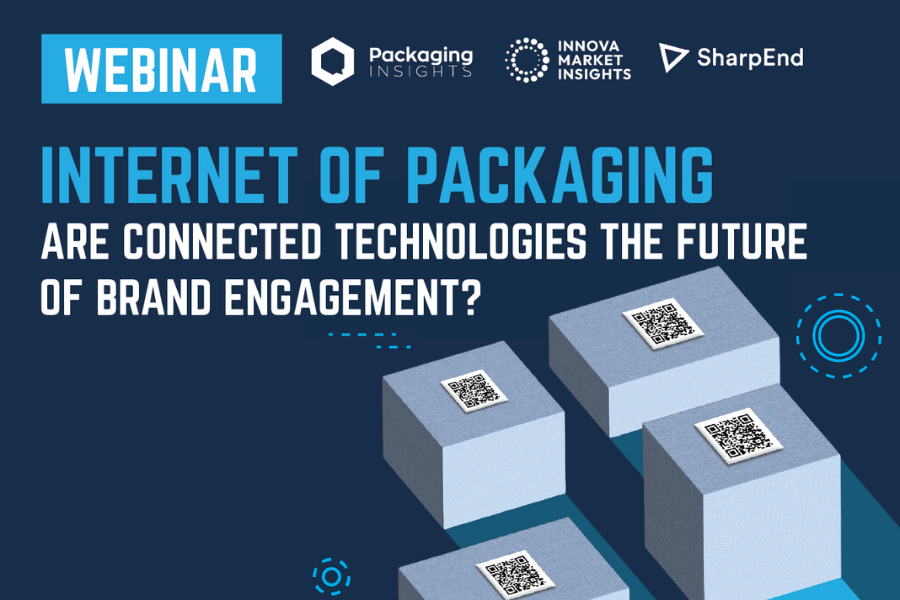
Consumers exist in a connected world and packaging is increasingly seen as a valuable platform for digital engagement. Technologies like QR codes, Near Field Communication (NFC) and Augmented Reality (AR), have emerged in recent years. In the first of PackagingInsights’ 2023 webinar series, we discussed digital brand engagement and how these technologies can boost consumer connection and brand loyalty through packaging.
OK, this is Louis Gore Langton for Packaging Insights.com.
Welcome to today's webinar, The Internet of Packaging.
Are connected technologies, the Future of brand engagement.
Today we're gonna be talking about connected packaging technologies like QR codes, augmented reality and near field communication, and how these technologies are revolutionizing the packaging industry.
We're going to be speaking with two speakers today.
The first is Akhil Ayal, a project leader at the Nova Market Insights who specializes in research for the food and beverage industry.
We're also joined by Cameron Worth, the CEO and founder of Sharp End, one of the world's leading IOT companies.
Welcome to you both.
We're gonna begin today with a presentation by Akil on Enova's latest research into connective packaging, and then we're gonna go into a panel discussion where we'll be taking questions from the public.
So with that, I give the floor to a kill and fire away.
Thank you for the introduction, Louis.
Hello everyone and welcome to the webinar.
Today we will be exploring how connected technologies are being used as a tool for digital brand engagement, how consumers perceive and engage with such technologies, and we'll also be exploring a few cases that illustrate the different avenues for consumer engagement.
Now, before we dive into the innovation landscape for the use of connected technologies, let us have a quick glimpse at how consumers interact with such technologies.
Now, according to a consumer survey that we conducted, we found that QR codes garner the most consumer interest when it comes to engaging with connected technologies, followed by augmented reality, invisible barcodes, and NFC.
Now if you look at the pie chart on the left, we'll see that only 25% of consumers surveyed indicate that they interact with the packaging if a product features connected packaging technologies, while 33% of consumers indicate otherwise.
Now we also noticed that there's close to 1/3 of consumers that are on the fence when it comes to interacting with such technologies.
When it comes to interaction with such technologies, what sort of information do consumers wish to see?
According to our consumer data, we found that nutrition information is the most important information from a consumer standpoint, and this is followed by traceability and transparency information, information on recipes, and the chance to win prizes and discounts, which features a bit lower on the list of priorities for consumers.
Now there are several different avenues that we can explore that are being used for leveraging connected technologies.
This can range from ingredient traceability to product authenticity, CSR and sustainability communications, and it can also be used as a tool for increasing consumer engagement through exclusive offers and perks.
Let us now look at a few examples of how companies are leveraging these technologies.
Now, let us start first by looking at retail products that leverage these technologies to enable ingredient traceability.
Now, one thing that we've observed, over the past few years when it comes to the use of these technologies is that compared to NFC and, augmented reality and also Bluetooth, in some cases, we find that companies tend to use QR codes a lot more to facilitate consumer engagement.
When we look at traceability, there are many different ways in which companies can approach this.
So the example on the left, for example, from One Degree provides complete transparency on the ingredients sourcing for its granola products, going so far as to include a picture of the farmer from whom they purchased the ingredients.
The example on the right is a bit more novel approach to providing ingredient traceability through QR codes.
The example on the right is basically featuring edible QR code on the smoked grains not product, which facilitates transparency in both ingredient sourcing and the production of the end product.
Now, the next avenue that companies can leverage, for connected technologies, is to provide greater information on the product authenticity.
Now, the example, showcased on the slide here is that of a hemp-based supplement.
Now, we've noticed that there has been a lot of, developments within this space, especially within the United States.
And one notable development that we've observed over the past year is that, Several states in the US now have made it mandatory for manufacturers to include a QR code in the labels for hemp products, with many more states expected to join them soon.
Now, according to the Utah Department of Agriculture and Food, these QR codes, inform consumers about the ingredients that are being used and also link them, redirect them to a third party certification, done to sort of reinforce the authenticity of the ingredients that are being used in the product.
Now, we've also observed that, especially when it comes to the consumer demographics, the younger generations are a lot more, willing to explore such technologies.
So, we also conducted a consumer survey to look into this in more detail.
And we found that when we ask consumers how they feel about digital food and beverage experience, we observed that we received strong responses.
With responses about being amused and curious about such technologies from consumers between the age group of 18 to 34, whereas we found that consumers that are older than 55, tend to be a lot more, intrigued by such technologies and what they can, the sort of information that they can provide.
Now, we have observed over the past few years that consumers want brands to do more and more and to use their platforms for good.
Big brands have tremendous reach through the sort of.
Big platforms that they have access to.
Now, one of the, the leveraging their reach, to communicate about certain, pressing issues in today's society would be that from Doritos.
Now, Doritos basically changed its packaging across its entire range, to feature, be bold reach out message in June last year.
Now these new packs contain a QR code which once scanned.
Opens Reach outs, checking in with yourself quiz that has been designed to help young people track how they're feeling and, provide them with, some information on what sort of steps they can take, to get some additional advice or to get some additional support.
Now, the next, slide is really looking into how storytelling is being leveraged as an avenue for consumer engagement.
Now, between 2021 and 2022, we observed 215% year over year growth in QR code references on food and beverage packaging.
Now, there's, as I've already mentioned, there's many different ways in which QR codes could be used, so it could be used to guide consumers on proper recycling, providing information on product consumption through recommended recipes.
And also boost supply chain sustainability, among other initiatives.
A very good example of how QR codes were being used to.
Use for storytelling, and for CSR communication is that from Cadbury.
So, Cadbury basically launched a new initiative last year, the Homegrown Stories.
So this was, introduced in South Africa.
And the main objective of this mission was to take a step in a long-term social mission, to grow, co-author and distribute.
Inspiring and relatable children's story, children's stories in all of the 11 official South African languages.
Now, there's also other ways when it comes to, other avenues that companies can explore when it comes to leveraging such technologies.
One example being sustainable communication.
So this is an example from Hutamaki.
So last year, in, in late 2021, Hutamaki launched a fully recyclable paper-based packaging.
And in this case, they made it fully recyclable by replacing the traditional PE liner, with a new water-based repurpable coating.
Now this packaging basically features a QR code which redirects you to a website that features a short video explaining how the new repalpable coating improves the recyclability of the overall packaging, how much plastic savings it provides, and also provides additional information on the end of life disposal of this product.
Simply put, it's bringing a smaller footprint to the freezer section, and through the replacement, of these, there's a significant amount of savings in terms of the amount of PE being used.
Now, the next example that we would like to, I would like to explore, is looking into Technologies that move beyond QR codes.
So we see, that a lot of companies are leveraging Bluetooth, in combination with other technologies, to facilitate innovations in hydration tracking.
So the two examples, shown on this slide are perfect examples of, an application of such technologies, for hydration tracking when it comes to beverages.
So the example on the left is basically a collaboration between Aptar and Reebo.
And it's basically a reusable water bottle which comes with a hydration tracking Bluetooth cap, and it also features a sensor and a laser, to track the amount of water that is being consumed, by the consumer.
Similarly, Gatorade also launched a Smart GX bottle.
It's a tech, tech enabled squeeze bottle which also leverages Bluetooth as a technology, and it is designed to help athletes set and track their hydration goals.
Now, both of these apps obviously come with associated, both of these, solutions come with associated apps, which you can download on your phones and, receive push notifications when you're running low on, hydration levels.
Now, moving beyond, Bluetooth and QR codes, when we talk about the more novel, IOT technologies such as AR and NFC we've seen that manufacturers of alcoholic beverages have really embraced these technologies as a tool for consumer engagement.
Now, in the past, we saw such technologies being used primarily for limited edition offerings.
However, since NFT tags, like in this case, they were used mainly for limited edition offerings because NFC tags were often included as a collar around the bottleneck, and this required an additional step in the production process, which, was a major barrier towards large scale, large scale commercialization.
However, this has all changed, since integrated NFC closures entered the market with, the collaboration between Sharpen and Gala closures, enabling the first large scale deployment of, connected wins in the US, followed by, developments from Amcor who also released, unveiled connective closures for digital brand enhancement, towards the end of 2021.
Now, moving beyond just NFC and AR we're also seeing companies, beyond looking at it as an avenue for, digital brand engagement and sustainable storytelling and stuff like that, or just general storytelling about the production process.
We're also seeing companies leveraging these technologies to offer more information on the nutrition and health, aspects of the product.
Now, We've already looked at a few different avenues in which connected technologies could be leveraged.
Where do we see this heading?
Now, besides consumer engagement, a lot of companies are also exploring how these technologies could be potentially used to tackle food and packaging waste.
Now, when it comes to, potential solutions for tackling food waste, Cornell had conducted a study last year, and within this study, basically, they had two different options provided to consumer, consumers.
They were given the choice to buy a milk carton that either featured Best Buy or use-by dates, or the option to buy milk containers that featured a QR code.
And based on the results of their study, they found that 60% of consumers purchased the containers with the QR code.
Now, how could this potentially help?
So in, in addition to providing more accurate information on the drinkability of the product, it can also help facilitate dynamic pricing wherein the price of the product reduces as it nears the end of its shelf life.
And so that is one avenue when we look at food waste, but when we look at packaging waste, we've seen that over the past, few years, there have been a lot of developments when it comes to the Digimar invisible recycling technology, and there have been a lot of trials, semi-industrial trials that have been conducted.
Now, finally, the Holy Grail project is moving on to the next phase, with a pilot, in France to test the digital watermarks for packaging waste and to validate all the results from the semi-industrial trials.
Now, looking ahead, what do we see as, the future for, companies to consider?
So, for companies to gain inspiration, it would be prudent to monitor the developments in the beverages segment to seek inspiration on how such technologies are being leveraged.
And finally, when we look at other avenues for the use of such technologies, we are also expecting connected technologies to be increasingly leveraged to support packaging circularity and also facilitate greater accessibility and inclusivity.
Finally, with consumers seeking greater traceability and transparency, manufacturers are leveraging these advances in connected technologies to rewrite the narrative, regarding consumer perception of certain ingredients, provide greater transparency along the supply chain, and also provide more information on the sustainability aspects from farm to fork.
Now, when we look beyond traceability and transparency, there's also a few other avenues that companies are exploring and there's further avenues that are being generated as we enter a more and more digitalized world.
Now, as you can see on this slide, using our extended trends, trends frameworks for, food and beverages, food and beverage trends and packaging trends, we have really observed how this trend has been evolving over the past few years.
Now, where do we see this trend moving?
We expect companies to be, investing a lot more, on enabling greater accessibility and inclusivity by leveraging IT technologies.
So, this is where we see that heading.
And besides that, we also have a packaging webinar coming up in, June where we will be talking a bit more in detail about.
How exactly companies are going to be leveraging these technologies to provide greater accessibility in addition to shedding some light on other overarching packaging trends that are expected to shape the industry, shape developments in the industry in the coming years.
With that, I would like to bring my presentation to a close, and back to you, Louis.
Brilliant.
Thanks for the presentation, Akhil.
I'll lead off on one of your last points, and this is a question for both of you.
In terms of connecting with disabled consumers, particularly the visually impaired, how should the industry be looking to improve inclusivity with connected technology?
Right.
Should I answer first?
Yeah, you go first.
I'll, I'll, I'll follow if, if there's anything.
All right.
So yeah, I think when it comes to connecting with disabled consumers, we've seen quite some innovations in the past few years.
So one example that comes to mind is that from, PNG, so for the Herbal Essences brand, to enhance the accessibility of their, shampoo and conditioner products, they basically added race stripes and circles, to enable visually impaired consumers to easily identify their products.
This is, however, an example of where it's not really leveraging technology per se.
So, most recently in the past year, a company called Zappa, unveiled, Zapsion technology.
So this basically builds onto the existing QR code technology, and enables, consumers, most importantly, consumers who are visually, impaired.
To be able to scan the QR codes from a much further distance.
So it increases the distance from which QR codes can be scanned by up to 55 times.
And most recently, we've also noticed that Unilever for their personal brands have already adopted this technology.
So this was, I think, a couple of weeks back, that it was unveiled that, they are actually leveraging this technology.
Yeah, I think just just building on Akil's point from my side, I think that there's kind of two ways to approach, the, the, the specific challenge slash slash opportunity for, for visually impaired and I think one is technology, and the second is the actual experience itself.
So I think technology is, is where a lot of the focus is right now.
So how do we get people to scan products to get them to an experience, but I think actually there's a real, Big opportunity to start looking at voice-based interfaces once you get onto the experience itself, so rather than having anything that's scrollable, then you actually really start thinking about how do you design kind of conversational interfaces through the experience and that's something that we've got a lot of experience with Akhil mentioned the, The, the, the Bowen brand where we rolled out the kind of the first, large scale rollout of NFC and actually a project that we delivered, last year I think was was Ask Joe which was our next version of a connected product experience which is you scan the product, you're then taken through to a voice based experience where you can speak directly to the winemaker.
So we spent a long time in a recording studio.
He was uploading a lot of questions and answers and you know, where does the wine come from, what does it go with, etc.
Etc.
But done in a way where 10 questions lead to the same answer so it feels very broad in terms of the the question and answer set.
And that in itself I think is a really clever technique for how to take any form of buttons or or typing away from the actual experience itself which will of course open up more, more opportunities to deliver kind of information, services and experiences.
Brilliant.
My next question then is about the fact that, nutritional information was found to be the main consumer desire.
So what are the main challenges in utilizing connected tech to communicate to to consumers?
I think making making nutritional information vaguely interesting is probably step one, I, I would, I would really.
I, I, I would be as a, as a creative first and a kind of an experienced designer at, at, at, at my core, I, I would question if nutritional information in and of itself is the most interesting thing you can do with a connected product.
And I think if you say, if you've got a, a drop down list and you say you can have, you know, coupons, nutritional information or authentication, maybe it's nutritional information, but actually I think wrapping a proper experience as in a brand experience around that.
Is always going to be the more interesting thing, you know, the psychology of someone who is engaging with a product, is that you have chosen that brand already, you've chosen to go in store or you've gone online, you've bought the product, you now have an opportunity to go deeper with the brand and I don't think that that relationship is gonna be forged through, You know, clearer nutritional guides, I think that that's one thing that you need to do as part of the overall brand experience but I think you need to think more about, you know, context of use and how do you make the, the usage of the product better as a result of a connected experience.
Right, and in terms of legislation, you've spoken recently about potentially lobbying on these matters.
Could you talk a bit more about that?
Yeah, trying to find, trying to find people bigger than we are to help us lobby I think is probably the the right approach, but I, I think there's a.
I think there's an opportunity for, for, for kind of some of the bigger players to, to kind of come together and say look, we're, we're living in a world right now where you've got one QR code that based on a directive has to have nutritional information or transparency guides or whatever, and then you've got another QR code on the same product that can deliver an experience.
For, for me, a layup is to.
Combine the two codes onto one product to make it easier for the brand to scale that does both, that serves both purposes.
It, we're, we're in that very, I, I can't remember the book, but it, it, it, it, it describes the messy middle and I think it's more about kind of change management and business growth where they call it the messy middle, but I, I think we're at the messy middle of connected packaging.
Kind of scaling, which is you've got more technology companies than ever, more kind of industry awareness than ever, more consumer appetite than ever, and we're, we're, we're just trying to figure out, OK, a way, I think Akhil mentioned a really good point on the timeline is now we're kind of out of the pilots and now we're into kind of full scale rollouts, we're gonna have to identify what those com complexities are gonna be.
And I, and I think that, that, that lobbying is going to be a key part of that, which is making sure that we can make it as easy as possible for brands to, to, to roll out connected packaging for consumers to get what they need and for the industry to be able to support it as.
And Sharpened as a, as an experienced partner and as, you know, one of the world's kind of biggest IoT platforms for managing connected products, we definitely have a, a, a, a, a, an opinion and a point of view that, that we would be.
That we would be bringing to the table, but then you know there's there's printers, there's material companies.
There's converters, there's manufacturers of tags, you know, there's a whole consortium of people that, that could come together and really have a strong industry point of view and, and start to affect, upcoming directives in my, in my opinion, yeah.
Hm.
Do you envision a time when things like nutritional advice will be legally required through connective packaging?
Akhil, I think you were mentioning something around that on the, on the presentation, right?
Yeah, I think, there's already some developments in that space, especially for certain specific subsegments of products.
So in the US they've already started making some movements, towards that space.
So for hemp-based or CBD-based products, it is mandatory now by law in certain states in the US to have nutrition labels that feature QR codes and that redirect you to a third-party certification.
That provides an analysis of the overall product as.
I think, one space where I feel, and this is starting with supplements, which I feel like is a bit.
How do you say, the regulations are a bit.
Yeah, I, I'm not finding the right word for it, but compared to like food and beverage, you find like companies, not having to really go through the rigors to sort of communicate what exactly the benefits are and whether consuming the product leads to the benefits.
It's all a bit up in the air.
So it feels especially in certain categories where.
There is, there are some uncertainties with regards to the actual benefit of consumption of a product.
I think they could dispel certain consumer concerns through the use of certain technologies like this, which really provides you more information and third-party tests to sort of really.
Verify the veracity of the claims that are being made by a particular company regarding the effectiveness of the product.
So yeah, I think eventually we are moving towards that and I think just to go back on.
Nutritional information, what, Cameron already mentioned, I think this is where there's like a bit of a consumer gap.
I think consumers aren't as aware of what all is possible in terms of experiences that can be enabled through, IoT technologies, which is why for now, since their whole mindset is, especially when it comes to food, focusing a bit more around nutrition and traceability and transparency.
The more experiential aspects of how these technologies could be leveraged for better brand engagement is sort of not as high on their list, but I'm assuming if you look at certain other segments, like, for example, clothing or fashion, there's probably, a whole other approach that we would like a whole other.
Sort of importance that we would see towards the experience, the unboxing, and understanding a bit more about the overall product.
Yeah, I think it is a good point earlier, like, in terms of a legal requirement, we also noticed that certain companies, for example, manufacturers of alcoholic beverages, they're not obligated to share as much information with regards to the ingredients and nutrition labeling and stuff like that.
So the example from Perno Ricard, for example, they're trying to use the technology to still sort of go beyond what is.
Obligated for them based on legislations and really trying to provide more information on the ingredients being used, the nutrition labeling and stuff like that.
Oh, brilliant.
We've got a couple of questions coming from the public now.
This one's from Rebecca In from McKinsey Company and she asks whether packaging material shifts like plastic to paper substitution could impact the feasibility of digital engagement.
For example, if QR code print quality would be lower on paper packaging and harder for consumers to detect with their smartphones.
I think there's, there's probably 22 ways to, to answer that.
The the first one is that there's already a lot of precedent of paper packaging carrying QR codes and being incredibly readable and it not really being detrimental.
And I think the second one is that there's a lot of industrial print.
And printer companies that are upgrading their systems to be able to do things like print, you know, more high fidelity QR codes and do line speeds that match individualized QR codes versus SKU levels.
So I, I think there's a really nice, nice groundswell happening between the printers getting better and the packaging already being able to carry readable codes, so it's only probably gonna get easier than, than more difficult in, in my opinion, but I don't know if the kill has a, a separate opinion.
No, I, I think, I'm on the same page.
I don't really believe this is a major bottleneck, just based on all the points that you mentioned, there's continuous improvements taking place, like this shift from plastic to paper, something that we've been observing over the past few years, wherever it is possible.
And it's not just about the labeling itself, it's also just about sealing.
So when it comes to paper, you want to make sure that you can have a proper seal without having to use a plastic liner.
So there's so many different elements when it comes to the switch from plastic to paper, with the ceiling being one of them, printability, readability of eventual QR codes and stuff like that.
So I don't really see this being a major issue.
And like Cameron already said, there is already precedent set for it.
There are a lot of companies that are already using these technologies, and there haven't been any.
Sort of challenges or concerns raised about the use of these on certain products like this.
The only thing I can think of is probably where, for example, on glossy paper, depending upon sort of the light reflecting and stuff like that, that is where you could potentially have a problem in certain specific situations, but yeah, I, I think there's enough, enough movement happening there.
There's, there's also, you know, you, you go and buy like a shitty cheap drink from the newsagents and it's got a shitty print quality and you can't even read the ingredients and at that point you're probably not looking for a QR code to scan at that point anyway, so I think it's probably about just finding the right clients to work with, but , you know, we've all seen those disaster kind of print executions where you sort of all the, all the ink's smudged and stuff like that and I don't think they'll be our, our target partners scaling connected products in the first place.
Alright, brilliant.
We've got another question here from Robert Schumbacher who asks whether you see any particular advantages of connected technologies for the pet food sector.
I see opportunities for connective packaging in every sector.
I think that's probably the first thing.
There, there is always, if you're a brand who has an engagement strategy and has an audience.
Profile and an appetite for digital, there's always a role for connected products, right, then there's more the kind of executional pieces around, the specific industry or vertical and I think pet food is a, I always, I always associate pet food with looking after children, right, and if you look at a lot of the examples to date, we've been responsible for, for a few of them.
You know, stuff like infant formula, management, you know, managing the dosing of, of how much formula you're giving your kid, uploading a diary about their height and their weight, being able to track their progress over time.
You could probably look at doing the same thing through, you know, puppies, kittens and everything else that's cute in the world, but I, I think generally, the, at, at its most, Basic level for me, connected products are about closing the gap between awareness and engagement, and if you're a brand who produces content, so if you're a pet food brand who produces content, why not get that content to live on the product as a, as a key enabler.
And then apart from that, thinking more about who your audience are, and then the role of the connected product and you'll always be able to find use cases.
Right.
Yeah, I think just to add on to what Cameron, yeah, just to add on to what Cameron mentioned, like we've already observed that a lot of companies are using these sort of technologies, but again, they're doing it in the same way as they would do it for food.
So again, with regards to ingredient traceability and stuff like that, but I think Cameron mentioned a very good point.
Like most pet owners will look at their pets similar to how they would treat their children.
So one thing that we are observing within the space, especially within pet food, is weight management.
That is like a pretty pressing concern, among pet owners and also depending upon how frequently they visit, the vet, they might not be as aware of what might be perceived as being, how, like, just based on visual, looks, they might not be able to perceive whether or not their cat is obese, whether they're feeding them properly or not.
So I think, this could be a potential, tool.
So, you know, you could have.
Like a QR code.
Also, it could eventually be linked to an app.
Maybe you can take a picture of your pet and then the, like using imaging technology or something like that, it can gauge whether or not your pet is overweight or not.
So there's many different avenues in which this could be explored, and definitely like weight management being an issue because it eventually affects the overall sort of quality of life of your pets as.
So I think that is one potential, avenue that consumer education, obviously, and.
Yeah, in this case, I think there's like a very big gap between consumer awareness and education, especially when it comes to pets and weight management.
So that could be one potential avenue as.
All right, brilliant.
Another question here is, if you could expand a bit on how packaging companies can improve their environmental sustainability targets.
Many companies are now, producing sustainability reports and how can they use Connected tech, in this space.
Guess from a Yeah, I think Akhil mentioned about circularity, recycling, you know, more, more conscious disposal.
I think that there's, there's, there's two things, right?
So, so one is the packaging companies being able to provide the infrastructure for circularity to happen.
I think we live in a world now where most of the tech companies are going to market saying.
Put a code on your packaging, you become more sustainable, but actually unless you've got the infrastructure to recycle and reward, it's, it's all kind of meaningless and you just end up in an industry that has QR codes on every single product and none of them are actually behaving more sustainably.
So I think looking more at the infrastructure and saying, OK, how can we partner with industry and partner with brands to be able to provide the infrastructure that allows our packaging to become more circular.
And I know there's a lot of the, the bigger companies that are doing that, but having more, A, a, a clearer understanding of what role they need to play as part of it rather than just saying, hey, we're going to get brands to put QR codes on stuff.
We, we've all seen the mountain of press releases of brands rolling out QR codes and saying, hey, we're doing this to be more sustainable, it's like, how, like, do you know, apart from just having the code on the packaging, how are you being more sustainable?
So I think holding the industry to account is probably a really good approach and also brands at the same time, you know, if you're being more sustainable, how and how is the QR code or how is the connected tech on the product enabling that and if not, then, then it isn't a more sustainable product, it's just a another empty press release, you know.
You talk about holding the industry to account.
Is there also a role here to be played by legislators and policymakers?
OK.
Yeah, I think this is where, yeah, I have like mixed feelings, but again, it really depends.
It's just based on like what we have also observed with like legislative pressure not really leading to a lot of change in the industry.
So for example, if you just take the UK Plastics Act, there is like a lot of tax being levied on companies, but currently there's no real solution that can help most companies.
At scale, replace all the virgin plastic that is being used with a certain percentage of recycled plastics.
So I think, yeah.
In most cases, like most companies are just willing to pay the tax instead of actually making the shift because there is just a lack of supply for these sort of materials.
So I also feel like when legislations are being made, it has to be a bit more realistic.
We're also seeing this with a lot of circular economy targets that were set by the EU and they were quite ambitious to begin with.
And COVID sort of derailed any progress that we had in terms of that switch.
Towards more sustainable packaging.
And also when we look at sustainability, there's so many different angles that you can look at what exactly is sustainable.
Something that is sustainable for packaging, a particular product might not be for another product.
So I feel any legislative changes that are made should not be made in haste, and there should be like a much clearer, time frame, with regards to how they want to achieve these steps and how exactly it is going to.
Improve things, instead of just doing it as a stopgap measure.
Brilliant.
Cameron, anything to add?
No, no, I think that was put.
Yeah, but , of course there's a role for legislation to play, but I'm, I'm kind of looking forward as a.
As a as a as a member of the industry to finding out what that role is and sort of doing our bit to help.
Oh brilliant.
Final question then is what are the most important things for the packaging industry to consider when attempting to incorporate connected technology for the first time?
I think their, their role in the value chain is probably really important.
So what are you actually bringing to the table and, and I, I always go back to question one is how do you make it easier for brands to scale connected products?
And I think really understanding your role in, in that is, is, is, is key.
And then the second part on top of that, which is, you know, how does connected packaging help you to increase the.
Usage of your solutions or services and I think if you can answer those two questions and come out with a positive outcome then you're in really good shape and if you can't then, then you're not.
So I think, I think we, we spoke a couple of weeks ago about, you know, it's just very trendy for now for, for packaging companies to build platforms and we're gonna end up in a world where, I always, I always look back to, to mobile payments, right, and everyone tried to build their own wallets and no one was using mobile payments until the wallet companies came together and said guys, come on, like we're, we're, we're building walled gardens all over the place and now no one's partying.
So I think now what we're, we're hoping happens is there's some sort of consolidation around a few of the key platforms and again that kind of makes it easier for brands to scale connected products.
So kind of always laddering.
Laddering back to those two key questions I think is, is, is, is critical.
Right.
Thank you.
Yeah, I think Cameron summarized it pretty.
I think the key attribute, like the key factor in this case, if you're attempting to incorporate connected tech is like, OK, what exactly is the context and what's the value proposition?
Because if you're just throwing a QR code on there, then, yeah, it doesn't really add anything because I've also observed like a lot of products that feature QR codes that like the domains that it leads you to don't remain updated.
So it already shows you that, OK, there was not as much thought behind it, and it was just something that was done just to keep up with the trend, as opposed to having like a very clear value proposition on how exactly this is going to bridge the gap, how exactly it's going to sort of bring in more loyalty from consumers, brand loyalty, consumer education, stuff like that.
Yeah.
OK, brilliant.
Unfortunately that's all we've got time for today.
Thanks to everyone who's joined us from around the world and sending questions.
Before you go, be sure to download the top packaging trends 2023 infographic.
Incidentally, we'll also be hosting a webinar in collaboration with Enova later this year in which we'll explore these top trends.
Big thanks to both of our speakers and make sure to subscribe to Packaging Insight's free newsletter service.
Also check out Sharp End's latest developments and follow the latest research from Renova Market Insights.
Finally, if you're interested in exploring webinar opportunities with us, please contact us at sales@cnsmedia.com.
Thanks and goodbye.
Thanks, Louis.
Bye-bye.

Akhil Eashwar Aiyar
Projects Leader

Cameron Worth
Founder and CEO
Akhil Eashwar Aiyar
Projects Leader

Cameron Worth
Founder and CEO