



Avantium partners with Klöckner Pentaplast to advance PEF food packaging


Key takeaways
- Avantium has signed a capacity reservation agreement with kp films to explore the use of the plant-based PEF polymer releaf in thermoformed food packaging.
- Releaf PEF offers enhanced oxygen and carbon dioxide barrier properties compared with PET, with potential benefits including extended shelf life, cutting food waste, and lightweighting.
- The agreement supports Avantium’s plans to scale FDCA and PEF production through licensed industrial plants, following progress at its FDCA Flagship Plant in the Netherlands.

Avantium has signed a capacity reservation agreement with Klöckner Pentaplast (kp films). The agreement allows the companies to explore the commercialization of Avantium’s plant-based polymer PE furanoate (PEF), branded as releaf.
The agreement aims to support commercial deployment of releaf in thermoformed food packaging applications across Europe, and aligns with Avantium’s strategy to establish a global network of licensed PEF production facilities.
The solution, made from furandicarboxylic acid (FDCA), can be used in thermoformed food packaging, including trays and other packaging designed to protect fresh and prepared foods.
Caroline van Reedt Dortland, director of communications at Avantium, tells Packaging Insights: “PEF is a next-generation, circular polymer that offers a unique combination of performance and sustainability benefits. Compared with conventional PET, PEF provides improved barrier properties, helping to keep oxygen out and carbon dioxide in. This can extend product shelf life, better preserve taste, color, and vitamins, and reduce food waste.”

“PEF’s oxygen barrier is approximately ten times better than PET, while its carbon dioxide barrier is up to fifteen times better, making it particularly attractive for applications such as soft drinks, juice, and food packaging.”
The move comes after Avantium signed a capacity reservation agreement with Logoplaste Consultores Técnicos and a memorandum of understanding with Tereos and Louis Vuitton Moët Hennessy last year to accelerate the industrial-scale production releaf.
Lowering carbon emissions
According to Avantium, releaf’s oxygen and carbon dioxide barrier properties provide the potential to extend shelf life in selected rigid packaging applications and cutting food waste.
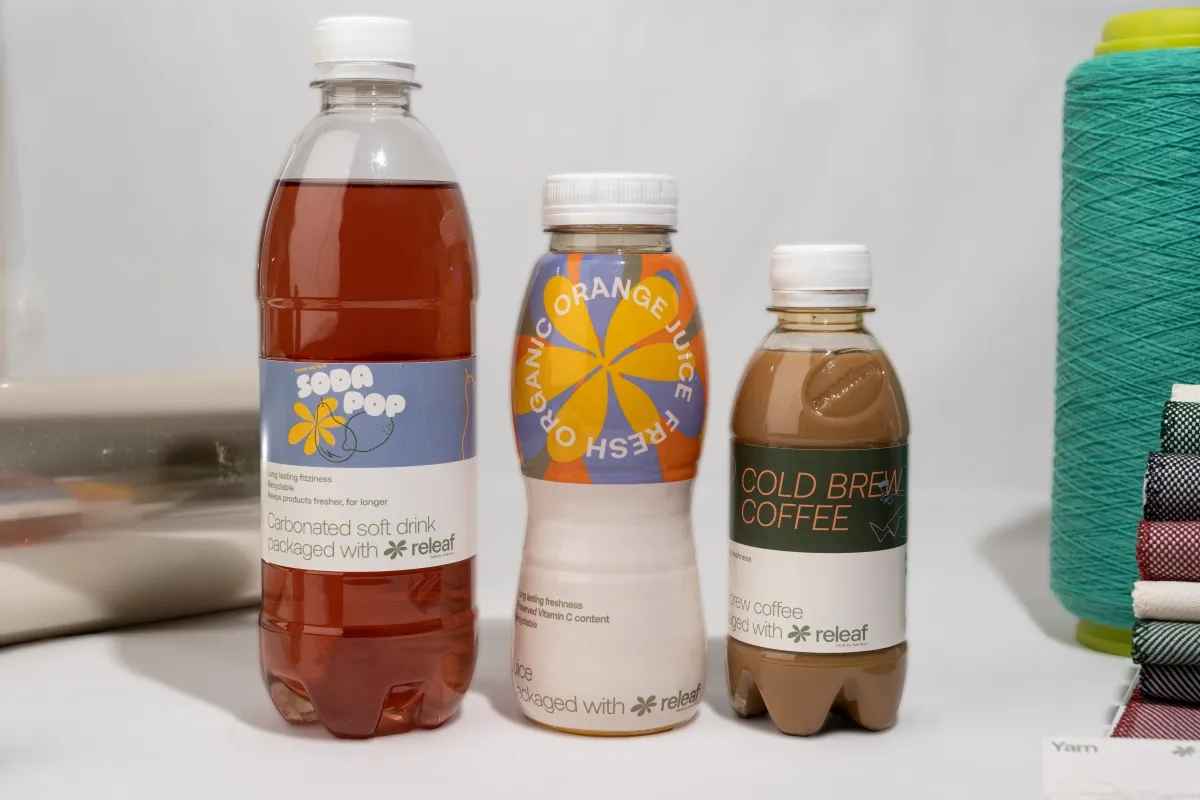 Releaf is a high-performance polymer made from Avantium’s flagship molecule (Image credit: Avantium).“PEF enables lightweight packaging, requiring more than 20% less material than PET to achieve comparable performance in certain applications. It is made from renewable plant-based feedstocks, is recyclable, and can help reduce the carbon footprint of packaging by up to 88% compared with fossil-based alternatives,” says Van Reedt Dortland.
“PEF’s combination of strong barrier performance, recyclability, and renewable origins allows brand owners to improve product protection and sustainability without compromising functionality.”
The company says that the barrier properties are being assessed for use in flexible lidding films and flow-wrap packaging structures requiring high barrier performance.
Samuel Pardo, senior innovations manager at kp films, a packaging and specialty film solution provider, highlights that releaf integrates renewable feedstock origins with conventional barrier characteristics.
“Through this agreement, we plan to continue assessing the material’s performance, processability, and suitability as part of our broader innovation program.”
Growing commercial interest
Looking ahead, the capacity reservation agreement supports kp films’ access to future volumes of releaf from prospective industrial-scale plants to be built and operated by licensees using Avantium’s technology.
“Avantium is currently reaching an important commercial milestone with the start-up of its FDCA Flagship Plant in Delfzijl, the Netherlands. All major process units have been successfully commissioned, and during the remainder of 2026, the company is focused on completing plant start-up, producing the first FDCA batches, and beginning its first commercial shipments by the end of the year,” shares Van Reedt Dortland.
The start of the plant was previously delayed due to construction-related issues, expected to cost an additional €7 million (US$7.6 million) in capital expenditure.
“The Flagship Plant is the foundation of Avantium’s licensing-led growth strategy. Rather than building and financing every future production facility itself, Avantium intends to license its YXY Technology to industrial partners that will build and operate larger FDCA plants. The plant serves as the commercial-scale reference for these future licensees, providing operational experience, product validation, and production data.”
Van Reedt Dortland tells us that commercial interest in the technology is increasing. Avantium has signed 23 offtake agreements for FDCA/PEF volumes from the FDCA Flagship Plant and secured more than 150,000 metric tons per annum of capacity reservations for volumes produced in future licensed plants.
“Avantium is also building a resilient supply chain through a flexible feedstock strategy. The company’s current process uses plant-based sugars derived from abundant agricultural co-products (high fructose syrup), while ongoing technology development is focused on expanding future feedstock options,” she says.
Earlier this year, Avantium reached an agreement with UPM for the sale of the intellectual property related to its Ray Technology business.