

Amcor expands rigid and flexible refill range for personal care products

Key takeaways
- Amcor has expanded its refillable packaging portfolio for personal care with new rigid containers and flexible AmPrima recycle-ready spouted pouches.
- The company is targeting the growing demand for refill solutions by combining convenience, recyclability, and compatibility with PCR materials and closures.
- Amcor says refill systems can help brands reduce virgin plastic use and address circularity goals linked to regulations such as the EU PPWR.
 (All image credits: Amcor).
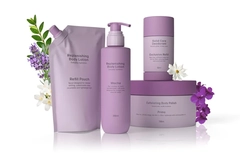
Amcor has expanded its refillable packaging ranges to include new materials and formats for personal care products, offering rigid and flexible solutions from a single supplier. The expansion responds to a growing demand for refillables in the beauty sector, according to the packager.
“For the personal care sector, a 2025 Innova Market Insights survey found that 42% of global consumers chose brands with refillable packaging options last year, and 25% overall opted for product alternatives that were packaged in refillable options,” says Lara Alemany, product line director, Amcor Global Rigid Packaging Solutions.
“We are therefore developing products to help companies maximize opportunities, with particular interest currently in refill solutions for soap and bath products.”
The broadened product portfolio includes a range of refillable container sizes, suitable for pairing with an “extensive choice’’ of closures and dispensers. The new introductions include Amcor’s customizable Mocha bottle, which is also compatible with a variety of closures and pumps, such as the monomaterial Wave 2cc.
Also for refill applications, Amcor provides its AmPrima recycle-ready spouted stand-up pouches in sizes from 30 mL to 2 L, which it describes as a leak-proof solution, optimized for e-commerce delivery.
“Amcor’s AmPrima recycle-ready refill pouches are designed to support circularity objectives while maintaining functionality and convenience for consumers,” Ellen Seyda, director of Sustainability for Rigid Packaging Solutions International at Amcor, tells Packaging Insights.
“Refill systems can reduce the amount of packaging material required over the product lifecycle by enabling consumers to reuse the primary container multiple times and replenish it using lightweight refill formats.”
Seyda highlights that consumer research also points to convenience as critical for long-term adoption, “with concerns around spills and mess during refilling cited as barriers by some consumers.”
“Availability and visibility in retail environments are also important factors influencing adoption.”
Incorporating recycled material
 Ellen Seyda, director of Sustainability for Rigid Packaging Solutions International at Amcor.Amcor aims to support customers’ circularity goals by incorporating post-consumer recycled (PCR) material into its expanded range of refillable solutions.
Alemany highlights: “The key focus for all our development work is to ensure that refill and refillable packs continue to combine aesthetics and functionality to promote and support brand image. Such benefits also help to reinforce consumer perceptions of the enhanced value for money from purchasing these packs.”
“Equally important for companies, the availability of high-quality refill solutions will help them to meet one of the key requirements of the EU Packaging and Packaging Waste Regulation (PPWR),” she adds.
Seyda shares that incorporating PCR content into its refill solutions assists brands in increasing their recycled material use within their packaging portfolios.
“By combining reusable rigid packs with recycle-ready refill formats, companies may be able to support multiple packaging sustainability objectives, including reducing virgin material use, increasing the use of recyclable packaging designs, and preparing for emerging legislation such as PPWR.”
“Regulation is also accelerating refill adoption,” she continues. “In Europe, the PPWR is encouraging greater use of circular packaging systems and increasing the focus on refill and reuse models.”
She argues that “high-quality” refill solutions are needed to help brands address key PPWR requirements while supporting broader sustainability commitments.
In a recent conversation with Amcor, Coveris, and SP Group, Packaging Insights explored how refill solutions can support packaging weight reduction, while also incorporating recycled content and facilitating recyclability.
Seyda presented Amcor’s research finding that refill systems are now an established packaging solution across personal care products used in Europe. She stated that refill pouches in particular have emerged as a leading format, with 66% of consumers purchasing a refill pouch within 12 months.
Earlier this year, Amcor expanded its partnership with Ocado Retail as part of a Refill Coalition project in the UK. As part of the project, the packaging company produces the containers, allowing the retailer to deliver online orders for products such as pasta, rice, and washing liquid in refillable packaging.
For the personal care space, Amcor launched an airless dispensing system to protect formulations, such as foundation or skin care. The PE Magic One dispenser is said to be recycle-ready in countries with appropriate infrastructure.
The company also provided the French hair care specialist Luxéol with a tailored version of its Prima jar for Luxéol’s curl mask, also including PCR material.
In February, Amcor released a consumer survey revealing that 91% of EU shoppers support the use of recycled plastic in packaging.