




McDonald’s Netherlands risks €3.75M penalty over single-use cup violations

Key takeaways
- Dutch authorities found McDonald’s Netherlands violated single-use plastics rules by providing disposable cups for dine-in consumption without collecting them for recycling.
- The company must comply by January 5, 2027, or face penalties of €625,000 per violation, up to €3.75 million.
- McDonald’s will introduce reusable cups but argues that overlapping dine-in and takeaway behavior complicates reuse in fast-food restaurants.
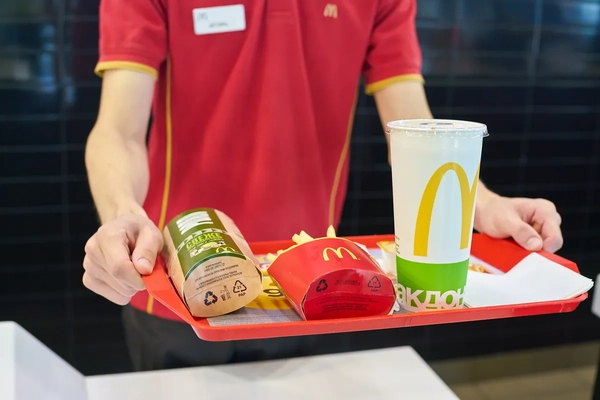
McDonald’s Netherlands was determined to have violated Dutch single-use plastics (SUP) rules, introduced to implement the EU’s Single-Use Plastics Directive (SUPD), following an investigation from the Human Environment and Transport Inspectorate (ILT).
The ILT found that the fast food giant has been offering single-use cups for on-site consumption, despite the Dutch Regulation on Single-Use Plastic Products (RKEG) mandating that either reusable cups must be offered for dine-in eating or single-use cups be collected for recycling.
The ILT has issued an enforcement order to McDonald’s Netherlands, giving the fast food company until January 5, 2027 to comply with Dutch single-use plastic rules, or risk a penalty payment of €625,000 (US$726,059) per violation, with a maximum of €3.75 million (US$4.4 million).
McDonald’s Netherlands has committed to switching its single-use cups to reusable ones, though it highlights that reuse systems do not always accurately reflect consumer behavior, which can make enforcement challenging. The investigation was launched by the ILT following an enforcement request from the Fair Resource Foundation, a non-profit that advocates for the equitable use of resources.
Packaging Insights sits down with McDonald’s Netherlands, the Fair Resource Foundation, and the ILT, to discuss the impact of the ILT investigation and the viability of reuse systems in quick-service restaurants.
“As a result of this ruling, we have received an order subject to a penalty payment. We have informed the ILT that, in our view, we are implementing SUP legislation in line with its underlying objectives: reducing plastic use and lowering environmental impact,” a McDonald’s Netherlands spokesperson tells us.
Setting an example
Chloé Schwizgebel, project coordinator at Fair Resource Foundation, says she wants the decision to set a “precedent” for other players in the fast food sector.
.webp) The ILT found violations at nearly all 32 McDonald’s restaurants inspected and will resume compliance checks in January 2027.“We expect that it will help ensure that foodservice companies concerned by this ban on single-use plastic cups and trays for dine-in will work toward an effective application of this rule.”
The ILT found violations at nearly all 32 McDonald’s restaurants inspected and will resume compliance checks in January 2027.“We expect that it will help ensure that foodservice companies concerned by this ban on single-use plastic cups and trays for dine-in will work toward an effective application of this rule.”
Under the Dutch SUP rules, there are certain exemptions to the requirement to use reusable containers for on-site consumption, provided businesses collect a certain percentage of disposable packaging for recycling, register for the exemption, and maintain the required records.
The ILT investigation further concluded that McDonald’s Netherlands has not been collecting single-use cups for recycling, nor has it maintained a record of the use of disposable plastics — both of which are required to use the recycling exception under the Dutch regulation.
Following the investigation
As part of the ILT investigation, inspections were conducted at 32 McDonald’s locations in the Netherlands in 2026. The ILT found that the fast food giant has been violating regulations regarding disposable cups for on-site consumption since 2024.
Previously, the Fair Resource Foundation conducted its own investigation before informing the ILT of its results. “[Initially] we were alerted by the very low average number of reusable cups for dine-in in Dutch restaurants versus in France,” says Schwizgebel. “We therefore went ourselves to 12 different restaurants and followed the consumer journey.”
The Fair Resource Foundation has a “broad expertise” on how reuse systems are supposed to achieve high return rates, according to Schwizgebel. “As we investigated, [we found] this clearly wasn’t the case of the McDonald’s system.”
The ILT investigation found similar results. A spokesperson tells us that, based on the EU SUPD, the Dutch government has implemented a number of measures, the most important one for McDonald’s is the RKEG.
“The RKEG contains rules for the use of reusable cups for ‘dine-in’ service at foodservice establishments such as McDonald’s. The ILT visited 32 restaurants; in nearly all of them the RKEG rules were violated.”
The ILT furthers that its focus now is to monitor McDonald’s Netherlands’ compliance. “McDonald’s needs time to make this transition and the ILT has agreed with the transition period. Starting in January 2027 the ILT will recommence inspecting McDonald’s to ensure they are adhering to their commitment and complying with Dutch law,” adds the ILT spokesperson.
The McDonald’s Netherlands spokesperson tells us that throughout the investigation, it has been forthcoming with its data and operational experience. However, it has also “consistently highlighted that the current approach does not necessarily contribute to the environmental objectives of the legislation in practice,” says the spokesperson.
 McDonald’s argues that current reuse rules do not always reflect consumer behavior or deliver the intended environmental benefits in quick-service restaurants.Last year, a study exposed the major FMCGs’ role in global plastic pollution. It found that Coca-Cola, PepsiCo, and Nestlé produced around 138 million metric tons of plastic between 2000 and 2023, of which 8% to 11% was recycled.
Reuse in high-traffic areas
The situation highlights the tension between reuse requirements laid out in reuse rules and consumer behavior in quick-service restaurants (QSR) or high-traffic environments.
Recently, a similar situation arose in Germany after Environmental Action Germany alleged that national rail operator Deutsche Bahn unlawfully sells disposable takeaway beverages on long-distance trains, violating Germany’s reusable offer obligation in the Packaging Act.
“We support the objectives of the SUP legislation,” underscores the McDonald’s Netherlands spokesperson. “At the same time, we see that the current rules are not working as intended in QSR. In our restaurants, dine-in and takeaway consumption frequently overlap.”
“Guests who initially consume their drinks on-site often decide to take them away afterward. This is typical consumer behavior and a challenge faced across the entire fast service sector.”
The spokesperson argues that real-world performance indicates that low return rates for reusable cups can lead to higher plastic volumes.
Designing for reuse
The doubts of McDonald’s Netherlands over the effectiveness of reuse systems in fast-food environments are, according to Schwizgebel, indicative of the fast food company’s “intention to never make their system a success.”
Following the Fair Resource Foundation’s initial investigation, she argued that the largest QSR chain in the country “deliberately” designs a confusing and complicated reuse system and then blames the concept of reuse for its ineffectiveness to curb plastic pollution.
“Most of the big players in the Netherlands within the QSR sector already have reuse systems in place which are better designed than the one of McDonald’s Netherlands,” outlines Schwizgebel.
 The Fair Resource Foundation hopes the enforcement action will set a precedent and encourage foodservice companies to implement effective reuse systems.“Burger King, for instance, reports that their reuse system for dine-in is economically viable and environmentally-friendly. This makes the fact that McDonald’s Netherlands deliberately refused to apply the rules something which was essential to address.”
McDonald’s has, in recent years, communicated that it aims to reduce plastic use at its restaurants, but implementation has not always aligned with its corporate sustainability plan. In Japan, last year, the fast food giant said it would gradually change its cold drink lids for paper cups to strawless lids made entirely from recycled PET. Meanwhile, McDonald’s, KFC, and Nestlé have backed the UK program “Keep Britain Tidy” packaging waste reduction pilot.
Taking action
Schwizgebel says that the ILT must continue to enforce McDonald’s switch to reusable cups. She stresses that companies need to take responsibility and work toward systems that help change throwaway consumer behavior.
“From our side, where necessary, we will continue requesting good enforcement of this rule toward the inspection, similarly to what we did in our investigation in Dutch McDonald’s restaurants.”
The McDonald’s spokesperson shares that its team is reviewing the current process of how to transition from disposable to reusable cup systems for on-site consumption.
“At the same time, we will continue to draw attention to the practical effects of the current rules and the question of whether they genuinely deliver the intended environmental benefits.”
“We remain committed to a constructive dialogue with the Ministry [of Infrastructure and Water Management] and the ILT on packaging policies that both deliver measurable environmental benefits and are workable in practice. Our focus continues to be on proven solutions that reduce environmental impact, including the use of renewable and recycled materials and improved recycling systems.”