
Premium aesthetics and paperization to shape alcohol packaging design in 2026


Key takeaways
- Premium aesthetics, tactility, and storytelling are reshaping alcohol packaging design and materials.
- Paper bottles are gaining traction as brands pursue low-carbon, lightweight alternatives to glass.
- High-performance labels are becoming central to branding, sustainability messaging, and shelf differentiation.
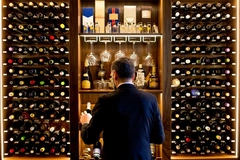
Premium aesthetics, functionality, paperization, and optimized labeling are key trends driving the packaging transformation for alcoholic beverages.
Packaging Insights speaks to Frugalpac, PulPac, and UPM Adhesive Materials about their latest alcohol packaging solutions and the industry shifts within the space.
“One of the strongest trends in alcoholic beverages packaging is premiumization, as brands aim to differentiate their products through packaging designs and materials,” says Stefano Pistoni, senior manager of business growth for wine and spirits, EMEIA, at UPM Adhesive Materials.
“Color, tactility, contrast, and finishing combinations all influence attention, perceived quality, and purchase intent of consumers. This is true especially in premium, craft, and artisanal segments, where storytelling and brand values are crucial.”

Pistoni notes that as a result, packaging producers seek label materials that combine strong visual and tactile impact with premium performance throughout the product life cycle.
Discussing the paper bottle PulPac produced for Johnnie Walker, Sanna Fager, chief commercial officer at PulPac, tells us: “The trial demonstrates how paper-based bottles can take on premium brand cues and a distinctive design aesthetic, while reducing weight and climate impact compared to glass bottles.”
Malcolm Waugh, CEO at Frugalpac, says that younger consumers are driving demand for sustainable packaging and brands that resonate with them.
“Surveys consistently show that these groups prefer brands with strong environmental credentials, and many will switch products or pay more to support companies reducing their packaging impact.”
He argues that “glass bottles with corks and pictures of chateaux” are not enough to meet the expectations of young consumers. “They want creatively designed ‘360 branding’ in a paper bottle with an easy-to-remove screw cap.”
Embracing paper bottles
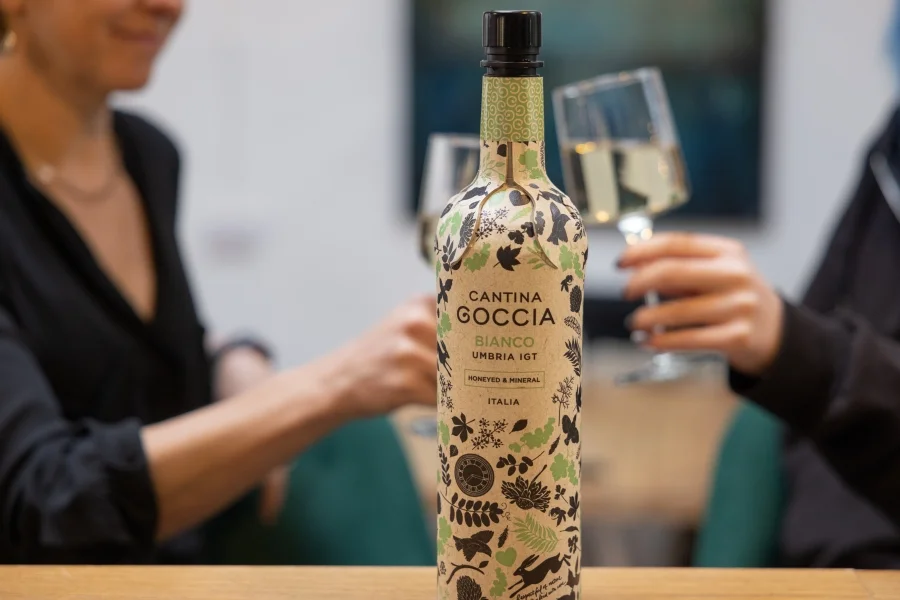 Frugalpac says its Frugal Bottle is the world’s first commercially available paper bottle (Image credit: Frugalpac).Waugh tells us that Frugalpac is pushing the boundaries of low-carbon, paper-based packaging, adding that its Frugal Bottle is at the centre of that mission. “It’s the world’s first commercially available paper bottle.”
The Frugal Bottle is made from 94% recycled paperboard with a food-grade liner and has a carbon footprint up to six times lower than glass, according to Frugalpac.
“Brands can fill, ship, and merchandize it exactly as they do today. What is new is the scale of adoption. More than 60 customers in 27 countries now use the Frugal Bottle across wine, spirits, and RTDs,” Waugh points out.
In North America, the products in the Frugal Bottle are available in Target, 7-Eleven, Whole Foods, and LCBO. The solution can also be found at Dan Murphy’s in Australia, Sweden’s Systembolaget, and other European supermarkets.
“Many producers have used the same packaging formats for generations, and change can feel risky. That is why we focus on demonstrating that the Frugal Bottle performs on shelf, protects product quality, and delivers commercial benefits at scale. As more proof points emerge globally, adoption continues to accelerate.”
Progress over perfection
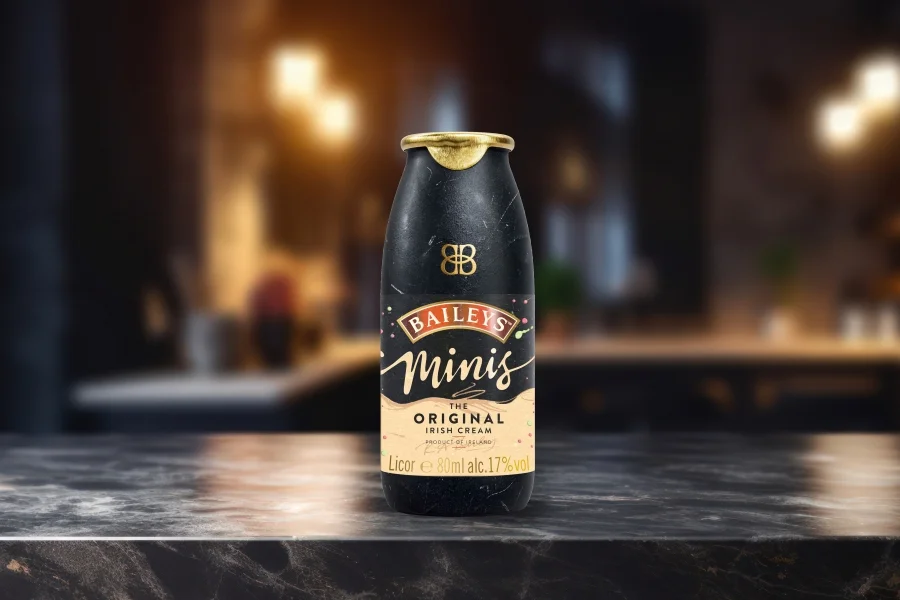 PulPac’s Baileys mini bottle trial, developed with Diageo and PA within the Bottle Collective (Image credit: PulPac).PulPac’s Fager argues that as the Bottle Collective is expanding, the direction is clear. “Fiber-based bottles are moving forward, and there’s more to come.”
“Diageo’s ‘progress over perfection’ mindset is a real accelerator,” argues Fager. “Testing in the real world helps us learn quickly and refine. And across the ecosystem we’re seeing breakthroughs not only in bottle formats, but also in caps and closures on the market and within our own R&D.”
“At scale, the intention is to source materials locally where possible. In this case, the pulp itself was colored black to align with the Johnnie Walker Black Label design. The focus is on renewable inputs, strong recyclability, and a lower environmental footprint compared with conventional packaging.”
PulPac also conducted a Baileys mini bottle trial, developed with Diageo and PA within the Bottle Collective. “The idea is simple: share the R&D to move faster with less risk and accelerate the path toward commercial production. It’s about joining forces and leading the change, not waiting for it.”
Labels that stand out
 UPM Adhesive Materials’ Premium Performance labels perform under “demanding” conditions (Image credit: UPM Adhesive Materials).UPM Adhesive Materials helps alcohol packaging producers stand out and says it understands the challenges they face.
“In a wine and spirits market defined by economic headwinds on one side and increasing premiumization on the other, label converters are under pressure to make every label work harder,” shares Pistoni.
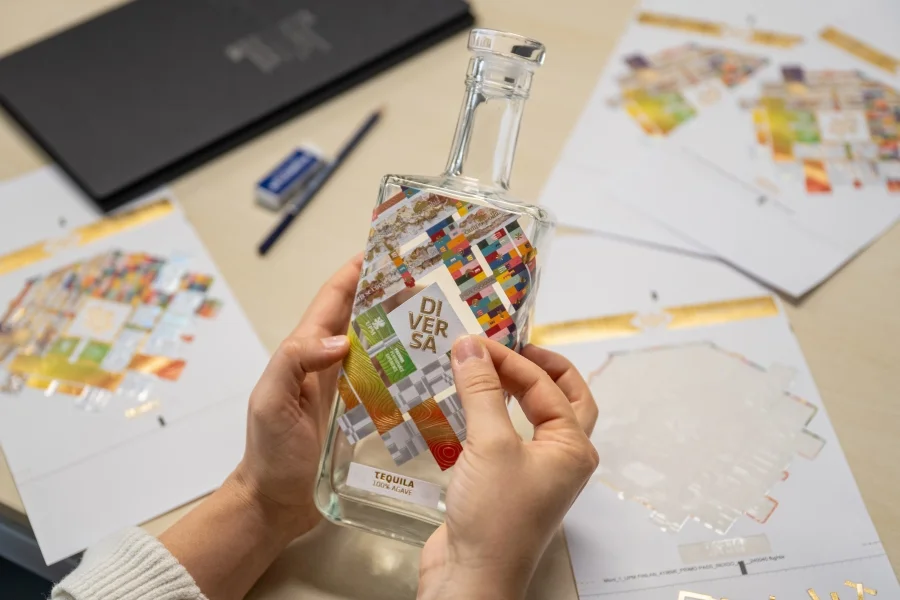
“At the same time, many have invested heavily in advanced embellishment technologies that deserve substrates that can unlock their full potential. This is why UPM has recently created a dedicated sample folder showcasing its ‘Ice’ and ‘Ice Premium’ materials.”
UPM’s sample folder aims to demonstrate how material clarity, printability, and tactile refinement can amplify embellishments and elevate brand storytelling to generate value for converters and brand owners.
“The folder includes five label materials, each paired with a printed sample to showcase material performance with complex designs and embellishments. Alongside these, unprinted sheets with removable labels provide technical specifications and allow printers to test the adhesive performance and on-bottle application of the materials.”
“Engineered to perform under demanding conditions, such as ice bucket submersion, they [the label materials] deliver high wet opacity, strong adhesion, and moisture resistance. Printers can also count on secure supply and mechanical properties compatible with high-speed converting and print finishing.”
The future of alcohol packaging
Pistoni says that the global premium alcoholic beverages market is expected to experience a CAGR of 10.89% and reach US$1.686 trillion by 2034. Similarly, Innova Market Insights data shows a 7% average annual growth in alcoholic beverage packaging launches between October 2022 and September 2025.
PulPac says the fiber used in its Johnnie Walker bottle is sourced through responsible forestry supply chains (Image credit: PulPac). “It is clear that the global wine and spirits industry will continue to focus on premiumization,” adds Pistoni.
“At the same time, market and consumer demand are also pushing the need to combine premium design with high technical performance and sustainability credentials. As producers are encouraged to reduce secondary packaging, more messaging is transferred directly onto the label.”
Pistoni further emphasizes the importance of labels in branding and communication, as well as their recyclability.
Meanwhile, Frugalpac’s Waugh argues that “the most exciting development” in alcohol packaging is the global momentum behind local bottle production. “As well as making the bottles, we make and export the Frugal Bottle Assembly Machine (FBAM), which can produce up to 2.5 million bottles a year.”
“The FBAM allows producers to manufacture bottles on-site or close to filling lines — a decentralized, low-carbon, scalable model that fundamentally rethinks how bottles are made. It’s a major step forward in decarbonizing the category.”
Waugh continues that alcohol packaging is “ready for disruption,” and that brands which embrace next-generation materials will “shape the market for decades.”
“With climate targets tightening and consumer expectations rising, sustainable packaging will become the default, and the early movers will lead. The biggest challenge isn’t technology; it’s inertia.”
“Glass dominance is finally being questioned after a century of being the default,” asserts Waugh. “Its weight, emissions, and energy intensity are no longer acceptable trade-offs.”