

Asahi upgrades Australian soft drink bottles to fully recycled plastic


Key takeaways
- Asahi Beverages has transitioned its Australian soft drink portfolio, including Pepsi Max, Schweppes and Solo, to bottles made with 100% recycled plastic.
- Around 350 million Asahi soft drink bottles will now be produced annually in Australia using recycled plastic.
- The shift was supported by Container Deposit Schemes and two Circular Plastics Australia PET recycling plants.
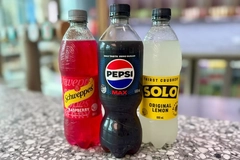
Asahi Beverages, a manufacturer and distributor of brands including Pepsi, Schweppes, and Solo, has switched its Australian soft drink range to bottles entirely made from recycled plastic.
The company says the transition will result in hundreds of millions of bottles each year from Australia be made with repurposed plastic instead of virgin material.
Amanda Sellers, CEO at Asahi Beverages Group, says: “This announcement gives Australian consumers and retailers certainty that when they purchase an Asahi-made soft drink, such as Schweppes, Solo, or Pepsi Max, the plastic bottle has been more sustainably sourced.”
She adds that around 350 million Asahi soft drink bottles each year are now made in Australia with fully recycled plastic, as are all its Cool Ridge and Frantelle water and Cottee’s cordial bottles.
“Redesigning our supply chains this way helps secure our supply of plastic bottles into the future and makes financial sense. As Australia’s leading beverages company, we are committed to embedding sustainability into our strategy, systems and processes.”
Bottle-to-bottle circularity
The shift was accelerated by Asahi’s investment in Container Deposit Schemes and the construction of two PET plastic bottle recycling plants in Australia, as part of the Circular Plastics Australia (PET) joint venture between Asahi Beverages, Cleanaway Waste Management, Pact Group, and Coca-Cola Europacific Partners.
The PET recycling plants, in Albury and Altona, have increased in the volume of recycled plastic made in Australia and enabled Asahi to source more material for its bottles onshore. Previously, Asahi Beverages, Pact Group, Cleanaway, and Coca-Cola Europacific Partners signed a memorandum of understanding, forming a joint venture to build and operate a PET recycling facility in Australia.
“Circular Plastics Australia and the establishment of Container Deposit Schemes by governments and the beverage industry in every state and territory are major initiatives that have helped ensure we have the raw material required to produce fully recycled soft drink bottles,” says Sellers.
“By recycling old bottles so that they once again become new bottles and repeating the process, everyday Australians are helping create a more circular economy in Australia.”
The move came as Australia’s Department of Climate Change, Energy, the Environment and Water updated its circular packaging economy strategy earlier this year. It affirmed its commitment to support the packaging industry, reduce single-use plastic, and increase recycling.