



Packaging Innovations 2026: Polymateria and eGreen showcase “world first” biotransformable cup


Key takeaways
- At Empack 2026, Polymateria and eGreen International will present the VeriGreen Plus cup, a bio-based, biotransformable, recyclable solution made from recycled cooking oil.
- The cup includes a dormancy-phase technology, ensuring functionality for up to three years before triggering biotransformation into a biodegradable wax with no microplastics or toxins.
- Early large-scale trials, including at Twickenham Rugby, show promising collection rates.

Polymateria, a polymer science and tech company, and eGreen International are set to present VeriGreen Plusut at Packaging Innovations and Empack 2026, taking place February 11–12 in Birmingham, UK.
The company says VeriGreen Plus is a “world first” bio-based biotransformable cup. It is designed to be recyclable, and should it fall outside the recycling stream, it can return to the natural environment. The solution is designed to preserve the functional advantages of plastics, such as strength, flexibility, and durability, while removing the long-term environmental impact.
Caroline Wiggins, chief executive at eGreen International, says: “It’s a single-use product but made from fossil fuel-free material. It’s made from recycled cooking oil that’s turned into a polymer, and then a technology is included that if the product is left in the open air, it biotransforms and returns to nature.”

Celine Moreira, global partnerships director at Polymateria, adds: “The VeriGreen Plus cup has a dormancy phase — a shelf life of three years. Within that time, it behaves like conventional plastic. The technology in the material is dormant during this phase, ensuring full strength, appearance, and usability.”
“If it ends up in the environment, biotransformation is triggered, attacking crystalline and amorphous regions of the polymer and transforming into a wax-like substance that microbes can safely metabolise. The timing of this transformation depends on the climate and location. In Southeast Asia or India, it can be as quick as three months. It leaves no microplastics and no toxins.”
Science meets practicality
The solution combines scientific innovation and practical operational design. The companies share that the self-destruct technology could initiate a process Polymateria calls biotransformation, transforming the plastic into a wax that fully biodegrades.
“The self-destruct technology means it will biotransform when exposed to heat, air, sunlight, and moisture. It transforms into an earth-friendly wax. If you touch it, it feels like a powder, or icing sugar, and eventually it returns to the earth, where bacteria consume completely,” highlights Wiggins.
“The QR code on the cup also links to information for consumers, supporting education and behavior change.”
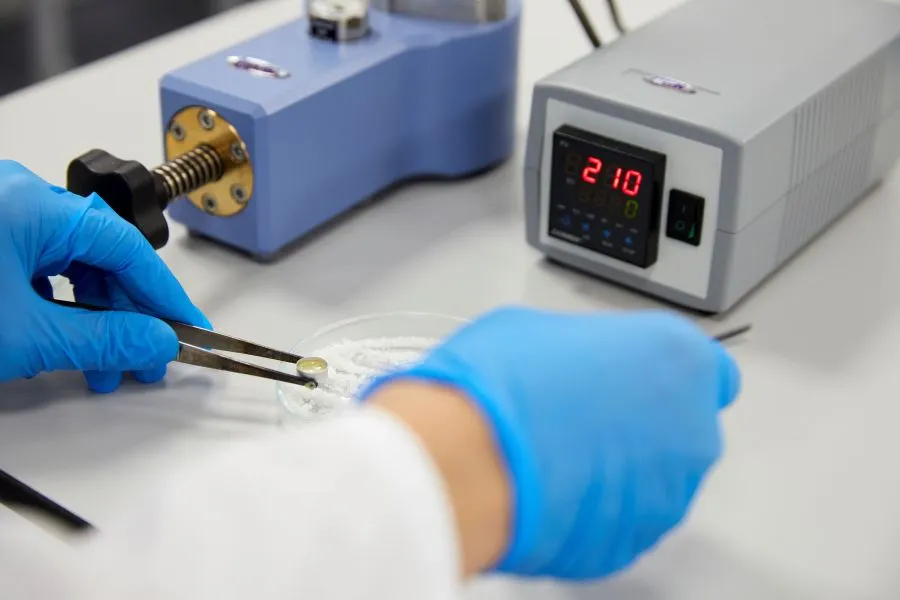 The companies did trials in the factory, which took around 18 months because the material is heat-sensitive.VeriGreen Plus is said to be carbon-neutral and made from fully ISCC-certified material linked to used plant oil via Mass Balance.
Scaling via standardization
The companies have launched the product at scale recently, with Twickenham Rugby among the first major adopters. At the Twickenham site in the UK, a 98% cup collection rate was achieved on its first attempt, according to the companies.
Steven Altmann-Richer, corporate affairs officer at Polymateria, says: “No single solution is a silver bullet. VeriGreen Plus works best when combined with proper collection, recycling infrastructure, and consumer education. That’s why standardization, independent testing, and credible verification are essential. They give manufacturers and end users confidence to adopt new materials and scale solutions globally.”
“Everything we do is backed by independent testing. There’s a specification, BSI PAS 9017, with stringent pass/fail criteria to guarantee no microplastics or toxins. This standard underpins rollout in multiple markets, from stadiums in the UK to coffee chains in Malaysia, providing confidence that the product does exactly what it claims.”
Wiggins says that the companies are developing the next generation of materials and products.
“Government policy is very clear: reduce, reuse, recycle. That is the mantra. Reduce where you can, reuse where possible. Recycle the rest. What matters is the end-to-end picture: how something is made, where it’s made, how much energy it uses, how far it travels, how it’s used, and what happens to it afterwards. Not everyone has the resources to investigate all of that, but it is increasingly important.”
“You can’t stand still. Legislation changes fast, and it’s hard to predict what the next five years will bring. You have to be flexible and adapt to what customers and consumers want.”