



Canada introduces front-of-package nutrition symbol for “unhealthy” foods


Key takeaways
- Canada has mandated a front-of-package nutrition symbol for some F&B products starting January 1, 2026.
- The symbol appears on prepackaged F&B products exceeding specific nutrient thresholds, with exemptions for certain products.
- The design ensures visibility while considering packaging constraints, and with writing in French and English.

The Canadian government has mandated the use of a front-of-package nutrition symbol on F&B products deemed unhealthy, starting January 1, 2026.
“The front-of-package nutrition symbol is designed to help Canadians quickly and easily identify packaged foods that are high in saturated fat, sugars, or sodium,” a spokesperson at the Health Canada federal department tells Packaging Insights.
“The regulations were finalized in July 2022, and companies had until January 1, 2026, to make the required changes. The transition period allowed sufficient time for manufacturers to plan label redesigns, use up existing stocks of product or labels, and reformulate products to reduce levels of nutrients of concern below thresholds, where possible.”
The front-of-package nutrition symbol is black and white, featuring a magnifying glass and highlighting what the food is high in: saturated fat, sugars, sodium, or any combination of these. The words “Health Canada / Santé Canada” appear at the bottom of the symbol.
Appearance on packaging
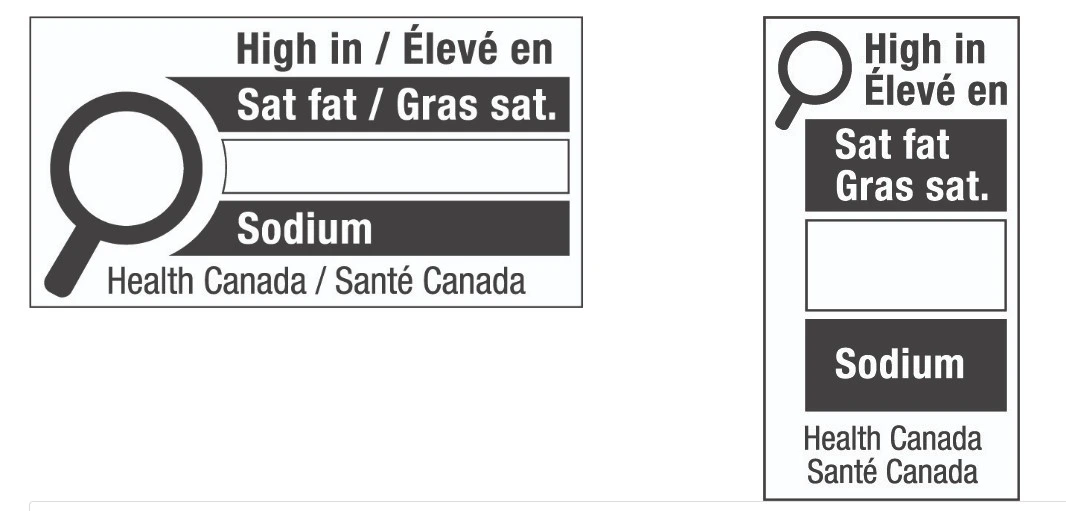 Health Canada’s front-of-package nutrition symbol (Image credit: Health Canada).The new labeling requirements insist that the nutrition symbol “must always appear in the same way, so that it is easy to find and use.” There are specific requirements for its size, location, and language.
“To account for design constraints when space is limited, the size of the symbol is based on the size of the packaging,” notes the spokesperson.
“In other words, the required height and width of the symbol decrease as the size of the package decreases. This helps ensure the symbol remains easy to see while being practical for companies to fit on their label.”
“The nutrition symbol will appear in the upper half of the label for most package shapes. It will appear on the right half of the package label if the label is wider than it is tall. The front-of-package nutrition symbol is in both English and French. There could be two separate symbols, one in English and one in French, or both languages on the same symbol.”
Health Canada says that feedback from people living in the country and consumer research informed the choice of the nutrition symbol.
Exemptions
The front-of-package nutrition symbol is mandatory for prepackaged foods that meet or exceed set levels for saturated fat, sugars, or sodium. However, some food packaging does not need to display the symbol.
These include foods exempt for technical reasons, such as individual packaging portions that are only intended to be served by a restaurant or other commercial enterprise to accompany meals or snacks, milk and cream sold in refillable glass containers, foods in very small packages, and single-ingredient whole cuts of meat that do not carry a nutrition facts table.
.webp) The nutrition symbol appears on prepackaged F&B exceeding specific nutrient thresholds (Image credit: Health Canada).The packaging of “foods with a protective effect on health,” such as fruits and vegetables without added saturated fat, sugars or sodium, and certain dairy products, such as plain milk, plain yogurt and cheese, are also exempt because they are “important sources of calcium,” states the law.
The nutrition symbol appears on prepackaged F&B exceeding specific nutrient thresholds (Image credit: Health Canada).The packaging of “foods with a protective effect on health,” such as fruits and vegetables without added saturated fat, sugars or sodium, and certain dairy products, such as plain milk, plain yogurt and cheese, are also exempt because they are “important sources of calcium,” states the law.
Butter, sugar, salt, and “other products used for the same purpose as butter, sugar, or salt,” are also exempt.
“At this time, Health Canada is not planning any further changes to nutrition labeling requirements that would require label redesign,” the spokesperson says.
Last year, the Canadian government published its “State of PFAS Report,” concluding that the class of PFAS, excluding fluoropolymers, is harmful to human health and the environment.