



Researchers develop “degradable” bio-based PS for electronic packaging

Key takeaways
- Researchers have developed a conventional PS alternative containing around 50% bio-based raw material derived from plant-based carbohydrates.
- Microwave-assisted polymerization is said to be able to reduce energy use compared with conventional heated reaction vessels.
- Built-in chemical “breaking points” allow the polymer to degrade into smaller fragments that can be further processed.
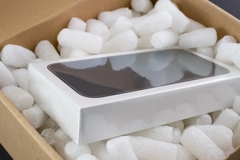
Researchers have developed a polystyrene (PS) alternative containing renewable raw materials, offering potential for use in electronic packaging. The German research team says that the material can be produced in an energy-efficient way and that it is more easily degradable than conventional PS.
The study, published in the journal Chem Circularity, describes how the scientists engineered degradable PS-based copolymers through microwave-assisted free-radical polymerization. The solution aims to address plastic waste accumulation in landfills, marine environments, and terrestrial ecosystems.
Phannaro Nhem, scientist at the Institute of Functional Materials for Sustainability, Teltow, Germany, and co-author of the study, tells Packaging Insights: “Our work was designed for single-use laboratory plasticware, such as Petri dishes. For packaging, the more interesting candidate is our ternary version, in which half of the styrene is replaced by bio-based itaconic anhydride. Its glass transition temperature is 157–172 degrees Celsius, compared with about 100 degrees Celsius for PS.”
“The paper suggests it could suit applications that need heat resistance plus end-of-life degradability, such as electronic packaging or durable consumer products."
The project also involved researchers from BTU Cottbus-Senftenberg, Freie Universität Berlin, and Helmut Schmidt University in Hamburg.
Metabolized by bacteria
Conventional PS is created by chemically linking styrene molecules into a plastic material. The styrene molecules form a rigid polymer throughout this phase, and the reaction vessel is heated, according to the research team.
“In cell culture, contaminated dishes can’t practically be thermally recycled, so we built in chemically cleavable thioester linkages. These break down under basic conditions, which also decontaminates the material. Our binary copolymer was injection-molded into Petri dishes, with a thioester content of about 2.5 wt % in the feed. Human stem cells grew on them with over 99% viability, and the dishes degraded into much smaller fragments. Injection molding is standard in plastics manufacturing, so the material fits existing production equipment,” Nhem tells us.
The scientists supplemented the styrene with the chemical compound itaconic anhydride, which can be created via the fermentation of plant-based carbohydrates such as sugar. The resulting PS contains around 50% of this bio-based raw material.
To improve energy efficiency, the researchers employed microwave radiation as a heat source instead of using heated reaction vessels.
“It is similar to a kitchen at home. Heating food on a stove takes time and consumes a lot of energy. Microwaves are much faster,” says Nhem. “Microwave technology has not yet been widely adopted in polymer synthesis,” says Francesca Toma, director of the Institute of Functional Materials for Sustainability at Helmholtz Zentrum Hereon and corresponding author.
“However, our results suggest that it could become a more energy-efficient alternative for controlled polymerization processes.”
The researchers incorporated the compound dibenzo[c,e]oxepane-5-thione into the material, which deliberately integrates breaking points within the polymer network. This enables the material to be chemically broken down into smaller fragments at the end of its life cycle.
The research demonstrates that smaller fragments can be further processed chemically. Bacteria that cannot degrade the tightly cross-linked structure of conventional PS can metabolize these fragments.
Toma concludes: “The new polymer was developed according to the design-for-degradation principle, meaning it is engineered for controlled breakdown at the end of its service life.”
“This opens up a pathway for PS toward closed material cycles and a circular economy.”