


E-commerce packaging balances compliance, cost & consumer experience

Key takeaways
- E-commerce packaging is shifting toward right-sized, shipping-ready formats.
- Companies are exploring solutions including lower-temperature adhesives, recyclable paper and film formats, reusable packaging systems, and sensory features.
- Reuse remains constrained by return logistics, cost, infrastructure, and regulatory uncertainty, according to Re-Zip.

E-commerce packaging is no longer a post-production afterthought, flag industry players. It has evolved into a field requiring alignment across chemistry, material engineering, reverse logistics, regulatory compliance, and digital infrastructure.
Packaging Insights speaks to Aicomp, Henkel, Re-Zip, and Turn Green about how the e-commerce packaging industry is exploring the intersection of process integration, sensory branding, economics, and total system compliance.
Jens Hennecke, CEO at Aicomp, tells us: “E-commerce is pulling packaging in two directions at once. Orders get smaller and more varied, and buyers expect a price and a delivery date almost immediately.”
“Packaging is now designed around the parcel network itself, so one format can be adapted to the content and handled quickly and flexibly by the carrier. Right-sizing is becoming standard, and more brands are rethinking their primary packaging so it can ship without an outer box.”
Regulatory demand and functionality
Raphael Cazalbou, co-founder and chief strategic officer at Turn Green Holding, a Vietnam-based sustainable materials and packaging manufacturer, identifies that e-commerce packaging is balancing performance, regulation, and consumer trust.
“In Vietnam, EPR makes brands financially accountable for the packaging they put on the market. In the EU, the Packaging and Packaging Waste Regulation (PPWR) targets over-packaging and empty space in e-commerce and demands recyclability by design. Packaging is no longer a cost line in procurement. It is a compliance line,” says Cazalbou.
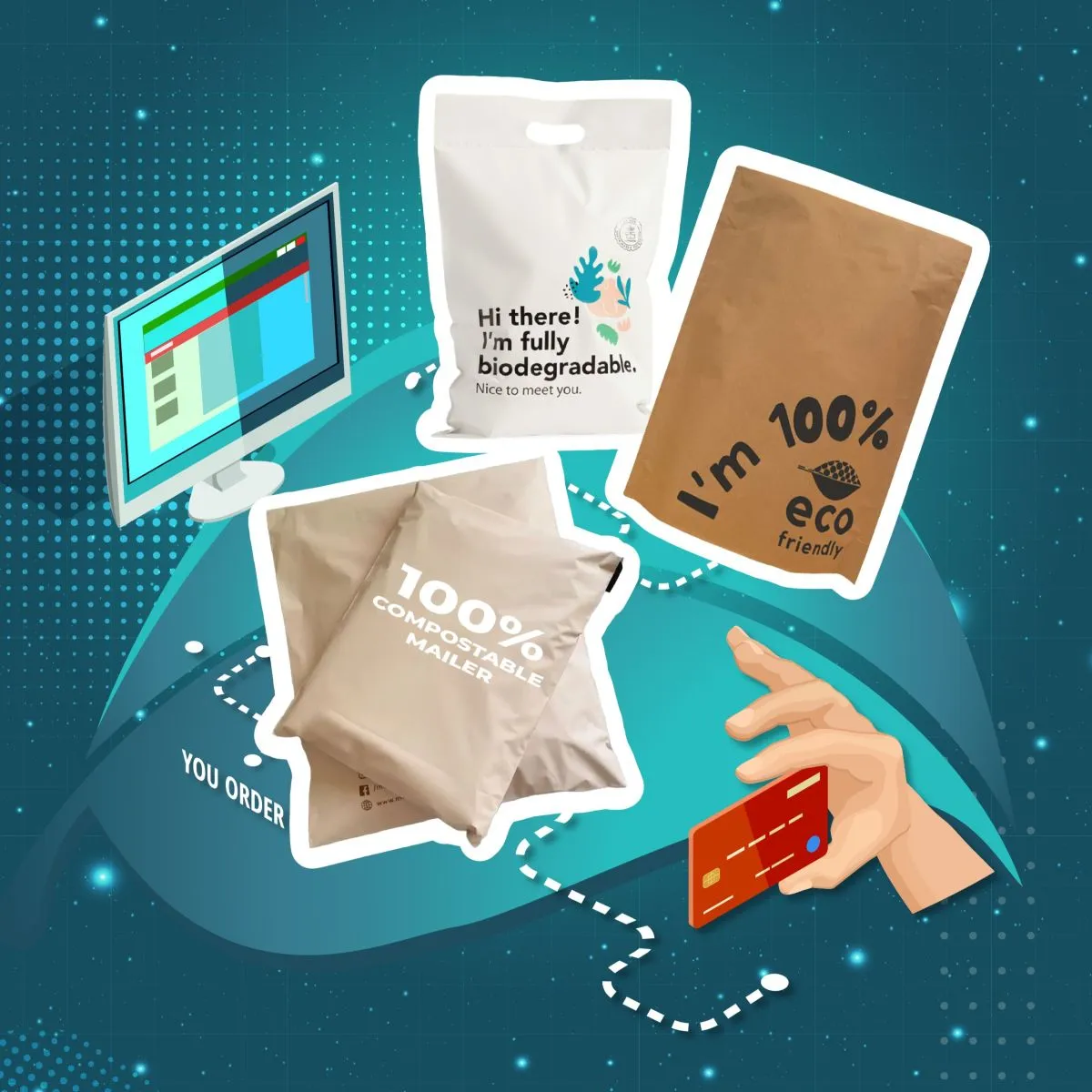 Turn Green says its parcels aim to survive long-haul logistics and arrive looking as good as the brand they carry (Image credit: Turn Green).Yet, despite the regulatory pressure, Cazalbou emphasizes that performance and functionality must remain key priorities. He shares that a mailer needs to travel through different machines and needs to be capable of withstanding varying levels of heat and humidity.
Moreover, he notes that e-commerce packaging should keep a reliable seal, often be reusable for returns, and stay light and flat to avoid paying air shipment fees.
“We start with three questions: what is the product, how long will the bag sit in storage, and where will it end its life? We then communicate in the language of standards and provide claims. If a claim cannot be traced to a certificate number, we do not make it.”
Turn Green is said to be vertically integrated from resin formulation to finished, customized film. This allows the company to provide right-sized solutions. “Owning the formulation means we can tune thickness, strength, and print for each brand instead of over-specifying the bag, with shorter lead times and consistent quality,” says Cazalbou.
Enhancing unboxing experience
On the unboxing side, Turn Green aims to improve consumer experience by exploring the sensory dimension of e-commerce packaging.
“Unboxing is the moment a brand physically meets its online customer. Print and color are now expected. Smell is the sense most closely tied to memory and emotion, and it is the one packaging almost never uses. We want customers to recognize a brand before they have even seen the product,” shares Cazalbou.
The company’s scented bags integrate fragrance compounds directly into the raw materials during manufacturing, so the scent can be long-lasting. Turn Green highlights that it is available across all the company’s materials: ReFlex, CompoFlex, and AquaFlex.
Turn Green manages the process end-to-end to co-create signature scents with individual brands, then standardizes them, so every parcel smells the same. Scents range from freshly roasted coffee, roses, and a clean green tea fragrance developed for the Japanese luxury market.
“Regulation will keep raising the bar. And the brands that win will be those that can prove what their packaging does, and make the customer feel and smell it, the moment they open the parcel,” says Cazalbou.
Reducing empty space
As PPWR is set to cap empty space in e-commerce packaging at 50%, Steffen Lesemann, head of OEM management for Packaging Adhesives EIMEA at Henkel, tells us that the key challenge is balancing packaging reduction with product protection, process reliability, and speed.
“Right-sized packaging means that lines must reliably process continuously changing box dimensions, different product combinations, and variations in corrugated board quality, coatings, and recycled fiber content. The closure system must adapt to this variability while maintaining secure bonds at high line speeds,” he says.
“Scaling the technology also requires companies to look beyond the packaging machine itself. They need to assess available floor space, order profiles, peak volumes, material supply, application equipment, and integration with existing fulfillment processes. Substrate, adhesive, machine, and application-equipment suppliers should therefore be involved early, followed by testing under realistic operating conditions.” Henkel highlights that advanced adhesive technologies are a key component in the successful implementation of right-sized packaging (Image credit: Henkel).
Lesemann adds that another challenge is documentation. “Companies will increasingly need reliable data on packaging formats, material use, and empty-space ratios. PPWR compliance must ultimately be assessed for the complete packaging solution, not for an individual component.”
Cutting energy consumption
According to Henkel’s case study, hot melt adhesives can cut adhesive use by 52% and energy consumption by 42%.
“The adhesive choice plays an important role in the sustainability and cost efficiency of automated e-commerce packaging. It affects application temperature, material consumption, line reliability, maintenance requirements, and ultimately the cost per parcel,” says Lesemann.
“Switching to a low-temperature hot melt reduces charring, downtime, and wear on application equipment. These results are specific to the individual setup, but they demonstrate the potential of evaluating the adhesive as part of the complete packaging process rather than simply as a consumable.”
“From a sustainability perspective, the right adhesive can also support lower energy use, reduced material consumption, and paper-based packaging concepts designed for recycling. The greatest impact is achieved when the packaging design, corrugated board, automation technology, application equipment, and adhesive are optimized as one integrated system.”
Henkel has also developed its Technomelt E-com portfolio to meet the demands of automated e-commerce packaging.
Lesemann remarks: “The range addresses the different requirements of dynamically produced boxes and paper mailers, including changing formats, varying substrates, high processing speeds, and reliable package integrity. Depending on the application, the portfolio includes solutions designed for lower processing temperatures, reduced cradle-to-gate carbon footprints, or a combination of both. Compatibility with paper recycling processes is also an important development criterion.”
Expand the market for reusables
Re-Zip, based in Denmark, is a data-powered reuse system for e-commerce packaging. The company has joined other brands in the Reuse Fast Track program, an initiative aiming to put 100,000 reusable parcels into circulation by the first half of 2027.
Anne-Laure Daniel, country manager for France at Re-Zip, tells us: “Single-use e-commerce packaging is a mature, heavily optimized system: warehouses, carriers, and packaging producers have all built their operations and capex around a one-way flow.”
“Reuse has to compete with that on cost, while adding a step nobody designed for: the empty return. As a start-up, we see three barriers and work on all three.”
Re-Zip has built the Reuse Fast Track program in partnership with Raja, which handles distribution and reconditioning, and DS Smith, which provides manufacturing support.
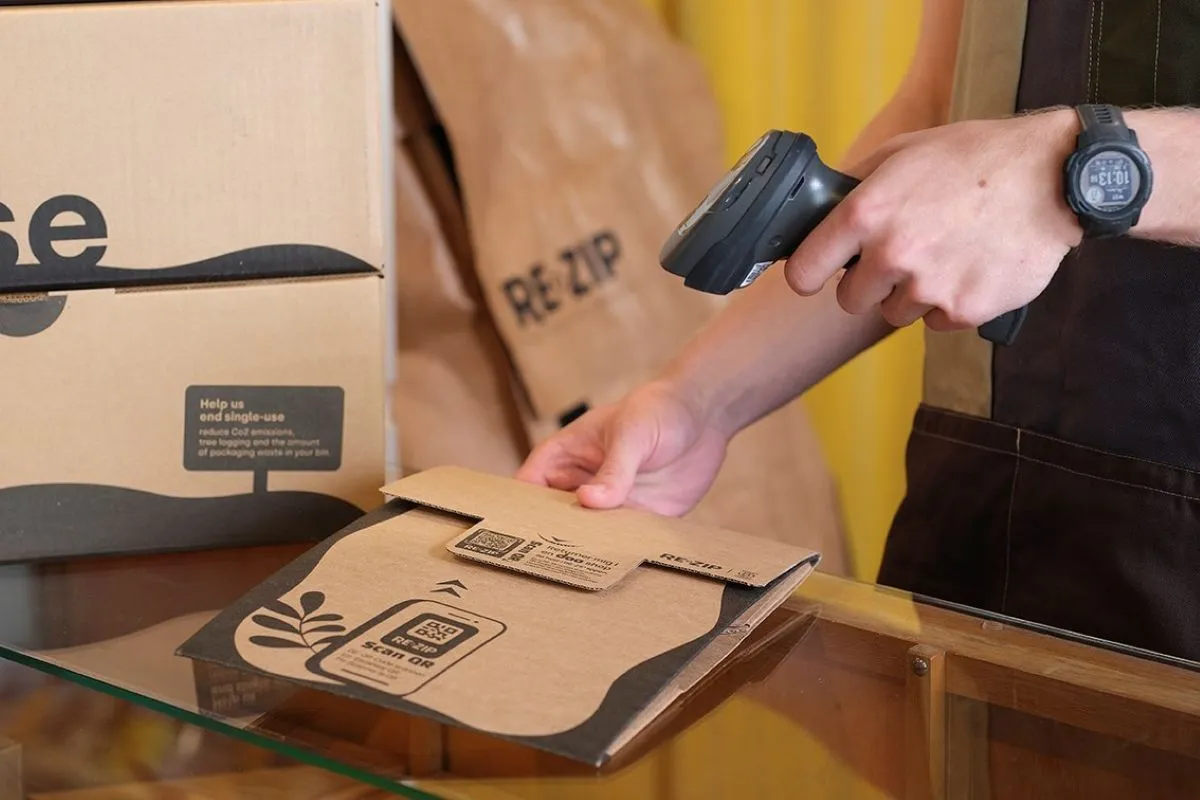 Re-Zip’s solution can lower the need for new raw materials, conserving energy and resources (Image credit: Re-Zip).
Addressing the cost
Daniel notes that reusable e-commerce packaging is not yet cheaper than single-use alternatives. “Existing transport networks are priced for one-way parcels, which makes an empty return too expensive for the market. We are building our own low-cost return infrastructure, based on existing empty flows and collection points, looking for amortization.”
“Today, the extra cost is partly covered by the funding from the EU’s Programme for the Environment and Climate Action, and we have applied for Citeo support in France to go further. These programs are a bridge, not a business model. The goal is to be a competitive option by 2028.”
To make returnable e-commerce packaging move into the mainstream, more regulatory clarity is needed, underscores Daniel.
“Brands need a stable signal. Whether cardboard stays within reuse obligations is still being debated in France as the PPWR is transposed, which is why reuse players, ourselves included, have asked lawmakers to keep it in scope within the Anti-Waste for a Circular Economy Law,” she says.
“Shared and interoperable return infrastructure is also required. No single brand or provider can build a collection network alone. Ours is designed to be open to several brands and reuse operators, starting in Paris, France, in 2027, subject to funding.”
Daniel shares that, next year, Re-Zip will release a new range designed for French e-commerce and carrier constraints in a cost-effective way. “2027 should be a real transition year. This is a market move, not the story of one player, and the brands starting now will be the ones making that market.”
Looking into the future
Hennecke from Aicomp notes that e-commerce packaging today is a mix of corrugated, mailers, and flexibles, built for the parcel network. Looking ahead, he predicts that producers will have to handle more options and more variants without losing margin.
“Paper-based solutions are replacing plastic film in more applications, pushed by regulation and retailer targets, and we expect that to continue,” he adds.
“Film still deserves a place in the discussion. It is often lighter than its paper or board counterpart, and a monomaterial film can be designed to be recyclable, so the fair comparison covers the whole supply chain, from production and transport to end of life.”
“Longer term, we expect shipping-ready primary packaging to become standard for robust products, while brands with a strong unboxing story will use it to stand out.”
Lesemann from Henkel says: “Moving ahead, we see further potential in reducing application temperatures and adhesive consumption, increasing the use of bio-based raw materials, and improving processing efficiency.”
“Close collaboration with machine manufacturers, application-equipment suppliers, and packaging-material producers will remain essential because improvements need to work reliably across the complete packaging system.”