
EU and China to confront plastic packaging pollution as cooperation gains urgency


Key takeaways
- The EU and China reaffirmed their commitment to tackle plastic and chemical pollution ahead of CBD COP17 in Armenia and renewed Global Plastics Treaty negotiations.
- Both sides called for accelerated international action on a legally binding treaty to end plastic pollution across the full lifecycle of plastics.
- The talks also focused on hazardous chemicals, including persistent organic pollutants and PFAS.
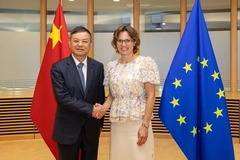 (Image credit: The European Commission).
The EU and China reaffirmed their commitment to step up joint action against plastic and chemical pollution, including from packaging, ahead of the 17th meeting of the Conference of the Parties to the UN Convention on Biological Diversity (CBD COP17) in Armenia and the resumption of negotiations of the Global Plastics Treaty.
High-level dialogues were held this week in Brussels, Belgium, including the 11th EU-China Environment Policy Dialogue and the 10th Ministerial on Climate Action (MoCA), co-hosted by China, the EU, and Canada. China‘s Minister for Ecology and Environment, Huang Runqiu, co-chaired both meetings.
“As global changes accelerate, countries must stand together. China will advance a comprehensive green transformation across its economic and social development,” states Huang.

Enhancing product safety
During the policy dialogue, the EU and China agreed on the need to accelerate global action, noting that plastic pollution is rising and cannot be addressed by any country alone.
Both sides reaffirmed their joint commitment to advance negotiations on a legally binding global instrument to end plastic pollution, requiring global action across the full lifecycle of plastics.
The discussions also highlighted the need for chemical pollution prevention and control, including hazardous substances such as persistent organic pollutants and PFAS.
European Commissioner for Environment, Water Resilience and a Competitive Circular Economy, Jessika Roswall, says: “We discussed the importance of ensuring that products entering the EU market meet our environmental, chemical, and safety standards.”
“In the current geopolitical context, effective diplomacy is more important than ever. The EU and China must continue to work together to finalize the negotiations on a global treaty to end plastic pollution, to implement our shared commitments on biodiversity, and to strengthen environmental multilateralism.”
Last year, China’s Ministry of Ecology and Environment published a draft indicative list of long-chain perfluorocarboxylic acids, their salts, and related compounds. This is said to be the first time China has systematically released an indicative list of long-chain PFAS substances.