

EU sets chemical recycling calculation rules for PET bottles


Key takeaways
- The EC has adopted a new method for calculating, verifying, and reporting chemically recycled PET content in single-use PET bottles under the SUPD.
- The rules aim to improve transparency, support investment in chemical recycling, and complement mechanical recycling.
- In the first phase, chemically recycled plastics from the EU and EEA will count toward targets, with some OECD material eligible from November 21, 2027.
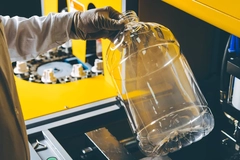
The European Commission (EC) has adopted a new Implementing Decision on the calculation, verification, and reporting of data on chemically recycled content in single-use plastic beverage bottles for compliance with the EU Single-Use Plastics Directive (SUPD).
The EC says that with the new rules, it aims to ensure transparency in the calculation of chemically recycled PET, to “level the playing field,” and secure the plastic recycling sector.
“Europe’s plastic recycling sector faces mounting pressures,” adds Jessika Roswall, Commissioner for Environment, Water Resilience and a Competitive Circular Economy. “The new rules on chemical recycling are part of the answer to that challenge.”
“With clearer rules in place for chemically recycled content, we give industry the certainty it needs to invest and innovate. This is a concrete step to support the sector, complement mechanical recycling, and advance technologies like chemical recycling. This will strengthen our competitiveness and keep Europe on track towards a circular economy.”
Fuel-excluded approach
The Implementing Decision establishes rules for the application of mass balance accounting, the tracking of recycled materials through the production process. It dictates how the input eligible material can be allocated to the outputs in case of multi-output processes.
 Jessika Roswall, Commissioner for Environment, Water Resilience and a Competitive Circular Economy.“The rules laid down in this Decision reflect the so-called ‘fuel-use excluded’ approach, meaning that at each calculation point economic operators should deduct eligible material that is processed into fuels or losses from the calculation of recycled content, in order to comply,” the document outlines.
Aiming to increase the transparency of the process, the document says chemical traceability should be applied.
“The ‘fuel-use excluded’ allocation rule should be complemented by additional provisions to ensure that the attributed amount of eligible material does not exceed the amount of eligible material that can theoretically be present in a product.”
The EC defines the fuel-use excluded allocation rule as: “Waste used to produce fuels or energy recovery cannot be counted as recycled content, in line with the definition of ‘recycling’ in the Waste Framework Directive.”
“The rules aim to balance transparency with minimal administrative burden for companies and national authorities. Annual third-party verification will be required for the most complex stages of the value chain, for example, during chemical recycling.”
Verification phases
In the first phase of implementation, the EC indicates it will count chemically recycled material from EU member states and countries of the European Economic Area as recycled plastics, “where compliance with EU environmental rules can be fully verified.”
From 21 November 2027, chemically recycled plastic from OECD countries will also count, unless excluded under the Waste Shipment Regulation.
Material from non-OECD countries can be recognized in the same way if covered by arrangements ensuring “equivalent standards related to human health and environmental protection requirements,” with the benchmark for these equivalent standards coming from EU laws such as the Waste Framework Directive and the Packaging and Packaging Waste Regulation (PPWR).
 Lauriane Veillard, Zero Waste Europe's policy officer for Chemical Recycling and Plastic-to-Fuels.The EC states that it counts recycled content toward EU targets based on “credible, traceable, and environmentally sound standards.”
The Implementing Act will enter into force 20 days after it is published in the Official Journal.
The EC adds that it consulted with “stakeholders” to prepare the rules under the Implementing Act.
In February, representatives of the EU’s member states voted in favor of the SUPD amendment, which was welcomed by the recycling industry.
At the time of the vote, environmental NGO Zero Waste Europe condemned the “legitimization” of chemical recycling.
Lauriane Veillard, Chemical Recycling and Plastic-to-Fuels policy officer, stated: “While we appreciate the reduction of the proposal’s scope to PET bottles, we do not support rushing to adopt another accounting method, especially when this system will be subject to further discussions as part of the PPWR, which goes against the regulatory certainty.”
The spokesperson for Plastic Recyclers Europe also told Packaging Insights that while PET is the EU’s second most frequently recycled polymer, it faces issues such as low prices and rising stockpiles due to imports of cheap virgin plastic and high energy costs.
The EC announced its plans to set the rules for chemically recycled plastic content for PET under the SUPD as part of measures to support the EU’s recycling industry amid virgin plastic imports.