


Refillable packaging under PPWR: Personal care & e-commerce packagers accelerate adoption


Key takeaways
- Packaging companies are accelerating refillable and reusable alternatives as the EU’s PPWR introduces binding reuse targets.
- Amcor research shows European consumers are increasingly receptive to personal care refills, especially when formats are affordable and recyclable.
- DS Smith aims to scale reusable fiber-based e-commerce packaging, while ZWE warns that stronger infrastructure and economic incentives are needed.

Major packaging companies are increasingly looking to develop refillable and reusable alternatives to single-use packaging as the August 12 implementation deadline of the EU’s Packaging and Packaging Waste Regulation (PPWR) approaches.
DS Smith has launched the Reuse Fast Track initiative alongside the French wings of e-commerce manufacturers and suppliers Re-Zip and Raja Group to push for reusable fiber-based packaging in line with the PPWR.
Meanwhile, consumer research conducted by Amcor finds that consumers are becoming “more receptive” to refillable personal care formats, driven by affordability and environmental considerations.
Packaging Insights speaks to Amcor, DS Smith, and the NGO Zero Waste Europe (ZWE), to explore the future of refillables and reusable packaging under the PPWR.
“The PPWR provides a good first basis of a regulatory framework with binding reuse targets and requirements that can support the market certainty needed for businesses to invest in reuse infrastructure,” Larissa Copello, packaging and reuse policy officer at ZWE, tells us.
“The PPWR represents a significant opportunity to move Europe away from an approach that has historically prioritized recycling over waste prevention. Reuse and refill systems are recognized as essential tools to reduce packaging waste, lower resource consumption, and move toward a circular economy.”
She says that in PPWR terms, refill is understood as a specific waste prevention measure that counts toward, and is necessary for, meeting the prevention targets set out in the Regulation.
The PPWR recognizes packaging designed for multiple uses while maintaining safety and hygiene as reusable. In 2027, it will mandate rotations for common reusable packaging.
Consumers in line with PPWR?
 Geoffrey Gendebien, marketing manager for Home and Personal Care at Amcor.Amcor has surveyed 2,749 consumers across six European countries, finding that 86% expect refill products to cost less than products sold in single-use packaging and 69% said they would buy more refills if prices were lower.
Environmental sustainability was the main driver, with 81% indicating that they would be more likely to buy personal care refill pouches if they are recyclable, and 74% indicated the same if the refills are produced using recycled plastic.
“PPWR will be a major accelerator, as it pushes brands toward waste reduction, recyclability, and circular systems. However, this regulation mirrors strong and growing consumer demand for refill formats,” Geoffrey Gendebien, marketing manager for Home and Personal Care at Amcor, tells us.
“Amcor’s own research revealed 77% of European consumers view reusable packaging positively, signaling how circular formats are becoming commonplace in personal care routines. At the same time, sustainability is playing a bigger role than ever in purchasing decisions.”
“Therefore, PPWR adds another layer to this pre-existing demand through structural pressure via waste reduction targets, recyclability requirements, post-consumer recycled material minimums, and eco-modulated EPR fees. In practice, that means consumer demand creates pull, while PPWR creates regulatory and economic push, especially in the EU.”
At the same time, ZWE’s Copello asserts that refill solutions need to be well-designed and implemented in order to deliver environmental benefits.
“The priority should be to eliminate unnecessary single-use packaging and replace it with reusable packaging models.”
“Refill stations for cosmetics with embedded reusable packaging systems, through in-store refill, take-back schemes, deposit systems, professional cleaning, and redistribution networks should be prioritized where possible.”
Paper e-commerce reusables
The EU-funded Reuse Fast Track, implemented by DS Smith and French e-commerce partners, aims to demonstrate that reusable e-commerce packaging provided at scale can help meet sustainability targets, while improving commercial profit and operational efficiency.
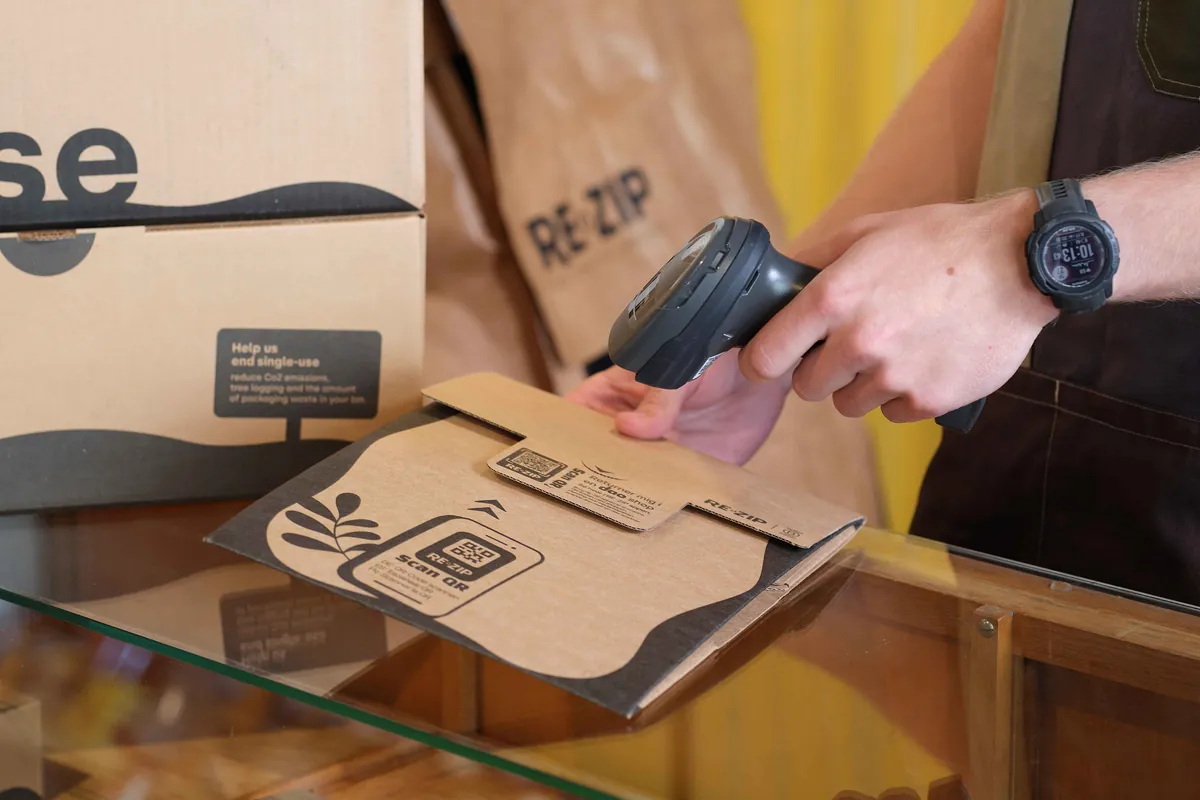 DS Smith, Re-Zip, and Raja Group have partnered to accelerate paper-base e-commerce packaging (Image credit: DS Smith). “The Reuse Fast Track is Europe’s first large-scale reuse acceleration program based on existing, proven, industrial-scale packaging solutions,” a DS Smith spokesperson tells us.
The spokesperson says that the initiative intends to help brands prepare for the upcoming PPWR reuse requirements by providing insights into end-customer desirability, reuse rates, and customer satisfaction.
“Corrugated board packaging can play the same role as plastic, while offering additional advantages. With reuse, regardless of the material, the return rate cannot be fully controlled, as it depends directly on consumer behavior. It is the consumer who decides whether or not to reuse the packaging,” the spokesperson continues.
“Consequently, when implementing a reuse solution, it is more cost-effective to use the material that is cheapest to produce and most recyclable at the end of its life.”
“Economic viability should not be based on the potential number of rotations, but rather on selecting the most efficient material — one that minimizes costs in the event of loss or misuse and offers the highest recycling rate at the end of its lifecycle, which is 90% in Europe for fiber-based packaging.”
The partners set out to promote the reuse of 250,000 packages within a twelve-month period by recirculating returned packaging. The project is open to companies across sectors such as cosmetics, fashion, apparel, and FMCG.
Economic and infrastructure hurdles
While European consumers and packagers are increasingly prepared to transition to reusables and refillables, according to ZWE’s Copello, in its current form, the PPWR may struggle to address some persistent economic and infrastructure challenges to phasing out single-use packaging.
 Larissa Copello, packaging and reuse policy officer at ZWE (Image credit: ZWE).“The PPWR does not provide sufficient economic incentives and regulatory framework to support the economies of scale needed for reuse systems to develop, grow, and flourish. The lack of economic incentives and a strong regulatory framework that supports reuse to scale up,” she argues.
“Without strong rules requiring reuse to grow, investors are unlikely to put money into it. A stronger regulatory framework is essential to help reuse scale up.”
Another barrier for reuse Copello spots is the “linear system wired for disposability.”
“Reuse systems can’t grow properly if they rely on infrastructure built for single-use packaging. It’s like trying to run trains on roads made for cars. Reuse needs its own dedicated infrastructure to be efficient and affordable at scale. Public investment and shared infrastructure are needed to level the playing field.”
Another challenge is that some refill concepts are marketed as circular while still relying on disposable packaging formats and linear consumption patterns, such as pouches, she asserts.
Copello adds that personal care brands should see refills as part of a wider transformation strategy, not simply as a packaging format change, and prioritize prevention and reuse first.
“Think about systems, not packaging alone. Brands should collaborate with retailers, logistics providers, and other companies to develop shared reuse and refillable networks.”
Packaging Insights also spoke to Borealis, Tomra, and Eco-Products about innovating materials, design, and return mechanisms to support repeated use of cups and food containers.
In e-commerce, Lola Valentina adopted Returnity’s reusable packaging system through FedEx parcel workflows.
On World Refill Day, earlier this month, L’Oréal promoted circularity in the personal care space with its 2026 refill campaign.