




HydroGraph advances graphene-based compound for electronics packaging

Key takeaways
- HydroGraph is targeting static-sensitive packaging applications, including ESD-safe trays, carrier tape, totes, and bags for electronics, with its graphene-carbon black hybrid compounds.
- The company says customer trials show that its Fractal Graphene FGA-1 can reduce electrical resistivity by up to 100 times and carbon black requirements by 50%.
- HydroGraph adds that its graphene additive can be incorporated into existing compounding, injection molding, and extrusion processes.

HydroGraph Clean Power will showcase its graphene-carbon black hybrid approach for conductive compounds, relevant for static-sensitive plastic packaging, at the US AMI Plastics World Expo 2026 in Cleveland, Ohio (Nov 11).
“Conductive and static-dissipative plastics are already used in packaging where static control matters, such as eElectrostatic discharge (ESD)-safe trays, carrier tape, totes and bags for electronics, and packaging used around flammable powders and solvents. Fractal Graphene is applicable across all of these,” Tom Eldridge, director of Business Development for Commercial and Industrial at HydroGraph, tells Packaging Insights.
HydroGraph, a graphene provider based in Vancouver, Canada, adds small amounts of its Fractal Graphene FGA-1 to conventional conductive carbon black formulations. The company says this can help manufacturers improve electrical conductivity or reduce the amount of fillers needed to meet performance targets and potentially lower material costs.

“A hybrid blend of Fractal Graphene and carbon black offers compounders a more efficient route to reach the target resistivity required. Combining Fractal Graphene with their existing conductive compound formulations provides lower resistivity, at lower total filler loading compared to carbon black alone,” Eldridge explains.
He says that according to HydroGraph’s customer trials, adding Fractal Graphene FGA-1 product grade has lowered resistivity by 100 times while reducing the required carbon black concentration by 50%.
“The incorporation of Fractal Graphene improves compound performance, while in many cases, the reduction of carbon black required also reduces the overall cost of conductive additives used.”
Ease of incorporation in packaging
 Tom Eldridge, director of Business Development for Commercial and Industrial at HydroGraph (Image credit: HydroGraphic).Eldridge explains that reducing conductive filler content to improve the processability and mechanical properties of packaging materials is one of the main reasons manufacturers use a hybrid.
“Carbon black is often loaded heavily to make plastic conductive, and that makes the material more viscous, harder to process, and less tough. Use less filler to get the same resistivity, and you get a compound that runs more easily through molding and extrusion and holds on to more of the base polymer’s impact strength,” he details.
“In practice, that means fewer brittle failures in finished parts, particularly thin-walled or snap-fit designs, and a wider processing window. It can also mean less carbon black shedding from the part, which matters for packaging used around sensitive electronics.”
Eldridge adds that Fractal Graphene FGA-1 can “easily” be incorporated into existing polymer and packaging production processes. “FGA-1 is added at the compounding stage, using the twin-screw extrusion equipment compounders already run for additives such as carbon black, so there’s no new equipment to buy.”
“From there, molders and converters receive compound or masterbatch exactly as they normally would, and it goes through injection molding or extrusion just like any other conductive grade. FGA-1 works at low loadings, so adding it is a small adjustment to the formulation rather than a change to the process.”
He says that HydroGraph’s customers and partners have allowed it to compound hybrid systems of FGA-1 and carbon black into polymers and to process them by injection molding, cast film extrusion, blown film, and compression molding.
Steps to commercialization
HydroGraph developed its graphene-enhanced compounds from material testing to commercial packaging applications, Eldridge tells us.
The steps it took included providing proof that the compounds perform in industrial conditions, securing graphene supply at scale, making compounds available in industrial quantities, and securing regulatory approval. “We’ve addressed all of these,” says Eldridge.
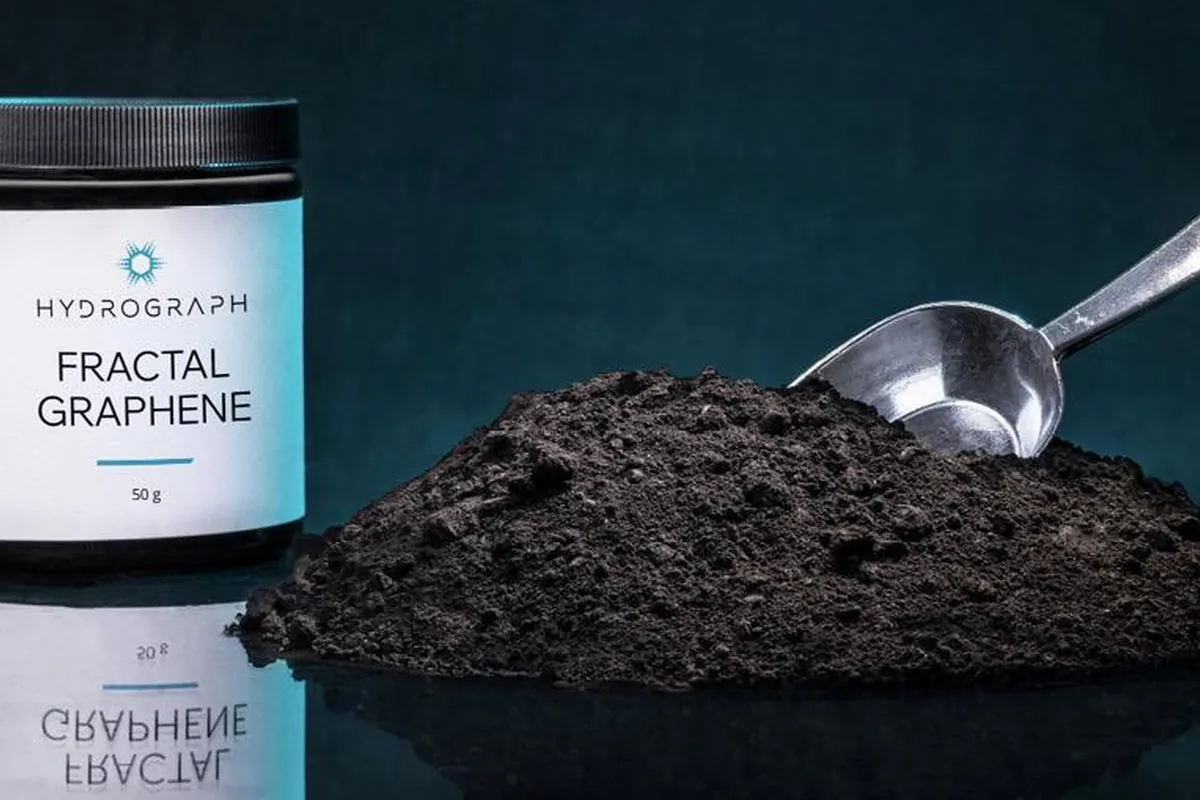 HydroGraph is targeting static-sensitive packaging applications, including for electronics (Image credit: HydroGraph).“Our R&D on applications has transitioned into industry partner trials, so the compounds have been evaluated in real production environments rather than just in the lab. On graphene supply, we’ve established commercial production of 30 metric tons per year in Austin, Texas, and our new site in Bellville, Texas, [US], due to open in 2027, will take us to 360 metric tons per year.”
“For compounds, our partner program lets customers source masterbatch and compounds in industrial quantities from preferred partners certified to compound Fractal Graphene into plastics, so manufacturers can buy a finished compound ready to use. “
On regulatory approval, the company says it has clearance from the US Environmental Protection Agency, as well as in the UK and EU under the EU’s Registration, Evaluation, Authorisation, and Restriction of Chemicals (REACH), and in South Korea under its K-REACH.
“We are ready to support customers looking at conductive solutions in plastic compounds.”
At AMI Plastics World Expo, Tarek Jalloul, business development manager for North America at HydroGraph, will present the company’s testing and technology solutions in a talk on: “More Conductivity, Less Filler, Lower Cost: A Graphene-Carbon Black Hybrid for Conductive Plastics.”
During the presentation, Jalloul will also share the technical and commercial advantages of graphene-carbon black hybrid formulations, such as facilitating conductivity, filler concentrations, and cost-effective manufacturing.
The session also aims to inform manufacturers how they can incorporate Fractal Graphene FGA-1 into existing conductive polymer formulations.