


Kingsland Drinks supplies Vinca with recycled aluminum wine bottles


Key takeaways
- Kingsland Drinks is expanding its partnership with Vinca by producing the wine brand’s red, white, and rosé in fully recycled 75 cL aluminum bottles.
- The bottles weigh around 70 g, compared to an average 450 g glass bottle, supporting lighter transport, faster chilling, and improved event safety.
- Vinca’s aluminum bottles are available in Tesco, M&S, and online retailers, with wider distribution planned in 2026.
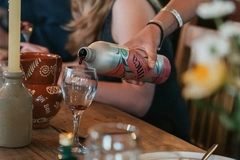 Image credit: Vinca
Kingsland Drinks and wine company Vinca have strengthened their partnership, with the production of Vinca’s wines in fully recycled 75 cL aluminum wine bottles alongside the existing canned wine format, also supplied by Kingsland Drinks.
Vinca’s red, white, and rosé wines are available in the new aluminum bottles. The UK-based companies say that the bottles are infinitely recyclable, adding that aluminum is one of the most recycled materials in the country.
Paul Braydon, director of Business Development and Marketing at Kingsland Drinks, comments: “Alternative formats are no longer niche — they’re becoming an essential part of how the wine category evolves. Our investment in aluminum bottle capability is about giving brands like Vinca the freedom to innovate while maintaining quality, scalability, and sustainability at the core.”
“We already produce Vinca’s full canned range and extending that partnership into 75 cl aluminum bottles is a natural next step. It reinforces our role as a long-term, full-service partner that invests in infrastructure and technical advancement ahead of demand to support our customers’ ambitions.”
Lighter alternative to glass
The aluminum bottles are said to weigh around 70 g, which is notably lower than the average 450g glass bottle. The companies argue that lightweighting cuts transport emissions and improves logistics, reducing CO2 emissions by up to four times when compared to a 75 cL glass bottle.
Their light weight is also making aluminum bottles increasingly popular at festivals and events. They are shatterproof, safer to handle, while their thermal conductivity can help drinks chill faster, the companies outline.
Jack Green, cofounder of Vinca, adds: “Aluminum bottles are already an important part of our range, delivering the sustainability benefits we care about while retaining the familiarity of a 75 cL bottle for consumers. Bringing production to Kingsland Drinks gives us greater confidence around quality, scale, and long-term partnership, while allowing us to localize production closer to market.”
Vinca wines in aluminum bottles are now available in the UK supermarkets Tesco and M&S, as well as in online retailers with broader distribution planned in 2026.
A study conducted this year at the University of Florida, US, found that aluminum is a suitable material alternative to glass for wine packaging. In particular, results showed a “minimal difference” in anthocyanin levels, color, and flavor degradation over time.