


Metsä Board LCA shows paperboard trays outperform PP on carbon footprint


Key takeaways
- An independently-verified LCA has found Metsä Board’s PE-coated paperboard tray has a lower carbon footprint than fossil-based PP alternatives.
- Biogenic carbon storage and high fossil-free energy use (89% in 2024) drive climate benefits.
- End-of-life scenarios show up to 91% lower emissions versus PP under full incineration
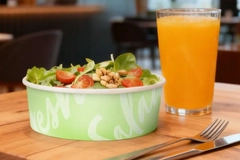
Metsä Board has published an independently verified LCA comparing its PE-coated paperboard tray to conventional PP takeaway food trays. It reveals that the MetsäBoard’s Pro FSB Cup tray has a lower carbon footprint than fossil-based PP.
The LCA analyzed biogenic carbon and multiple end-of-life scenarios, including recycling and incineration, of takeaway food trays, such as the MetsäBoard Pro FSB Cup tray and a PP tray. The LCA was independently verified by RISE and SimaPro UK.
The analysis shows that more carbon was bound in the paperboard’s fibers than was released during the processes of its first life cycle. The carbon footprint of the PP tray was 0.112 kg of CO2 emissions.

Lari Oksala, sustainability manager at Metsä Board, says: “In addition to the biogenic carbon and high recycling rates, our paperboard benefits from the high share of fossil-free energy in production, which was 89% in 2024. Metsä Board’s target is to phase out the use of fossil energy in its mills by 2030.”
“The packaging material must always be tested and selected according to the intended application. The greatest climate benefit comes when packaging performs its core task — protecting the product.”
End-of-life impact
Moreover, the LCA reveals that when the end-of-life scenario involved 100% incineration, the carbon footprint of the MetsäBoard’s Pro FSB Cup tray was 91% lower than that of the PP tray.
When the end-of-life scenario was recycling, the paperboard packaging had a higher recycling rate in Europe. Metsä Board explains that both paperboard and plastic contain the chemical element carbon, which forms CO2 when burned.
“The key difference is that paperboard’s emissions are balanced by the carbon dioxide absorbed from the atmosphere during tree growth, while fossil-based plastics add new carbon to the atmosphere,” says Metsä Board.
Marjo Halonen, vice president for marketing, communications, and sustainability at Metsä Board, adds: “This study is part of a larger set of comparisons Metsä Board has been conducting to provide transparent, science‑based insights into the climate impacts of different packaging materials.”
“It is essential that we provide verified, science‑based data to support our customers in making informed packaging choices. Such comparisons help the market move toward solutions that reduce climate impact.”
At this year’s FachPack, Metsä Board presented its renewed Classic Folding Boxboard under the Lead the Pack campaign, featuring curtain coating technology for smoother print surfaces and sharper visuals.
Meanwhile, the paperboard producer announced the installation phase of a board machine modernization at its Simpele mill in Finland this September. The modernization is part of a €60 million (US$70 million) investment aimed at enhancing the quality of the company’s boxboard grade, MetsäBoard Classic FBB.