


Pack Expo 2026 live: Siemens showcases AI-powered digital twin for flexible filling

Key takeaways
- Siemens is showcasing an AI-powered digital twin developed with PepsiCo and Nvidia to simulate and optimize packaging and filling.
- The system supports flexible production by adapting filling parameters, and pallet configurations.
- Siemens says connected facility data can improve traceability and help brands respond to growing EPR reporting requirements, while human operators retain oversight of AI-generated decisions.
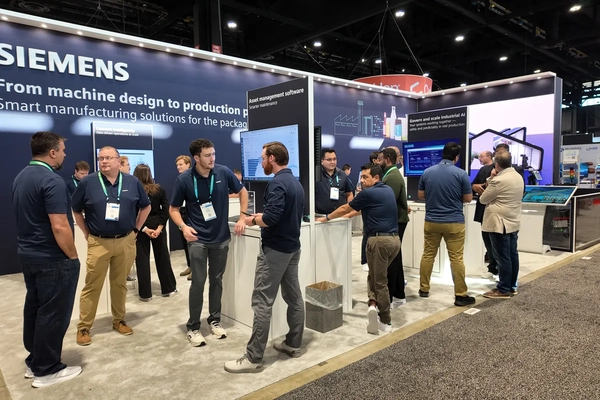
Siemens is presenting its digital twin robotic solution, made in collaboration with PepsiCo and Nvidia, that uses AI to improve the speed and efficiency of packaging and bottling lines, at the ongoing Pack Expo International 2026 exhibition in Chicago, US (Oct 18–21).
The partnership combines Siemens’ digital twin and industrial AI technologies with Nvidia’s AI and visualization capabilities to create high-fidelity virtual models of PepsiCo’s manufacturing and warehouse operations.
On the show floor, Packaging Insights, speaks with Andrea Sassetti, digital enterprise innovation manager at Siemens, about how the solution helps brands respond to emerging beverage trends and growing US EPR pressures.
“The solution is a full representation of a comprehensive digital twin. But behind the scenes, there are multiple software programs that are running that allow us to simulate what is happening for the packaging, filling, and robot. All of that is merging into the full facility.”
Across the US, EPR legislation is booming, as multiple states are enacting, or are in the process of enacting, the producer pays principle. Sassetti explains Siemens’ digitally integrated solution offers “trustability” by helping brands meet the data requirements set out in EPR’s.
“We are able to collect all the different information that is happening behind the scenes of the entire facility. All the data is connected, and we can provide trustworthiness.”
“We are also partnered with a couple of companies that are able to collect all the information and provide a certification of the authenticity of the entire system.”
Filling flexibility
Siemens aims to digitally transform the filling capabilities of PepsiCo using physics-based digital twins and AI, with the Digital Twin Composer as a cornerstone solution.
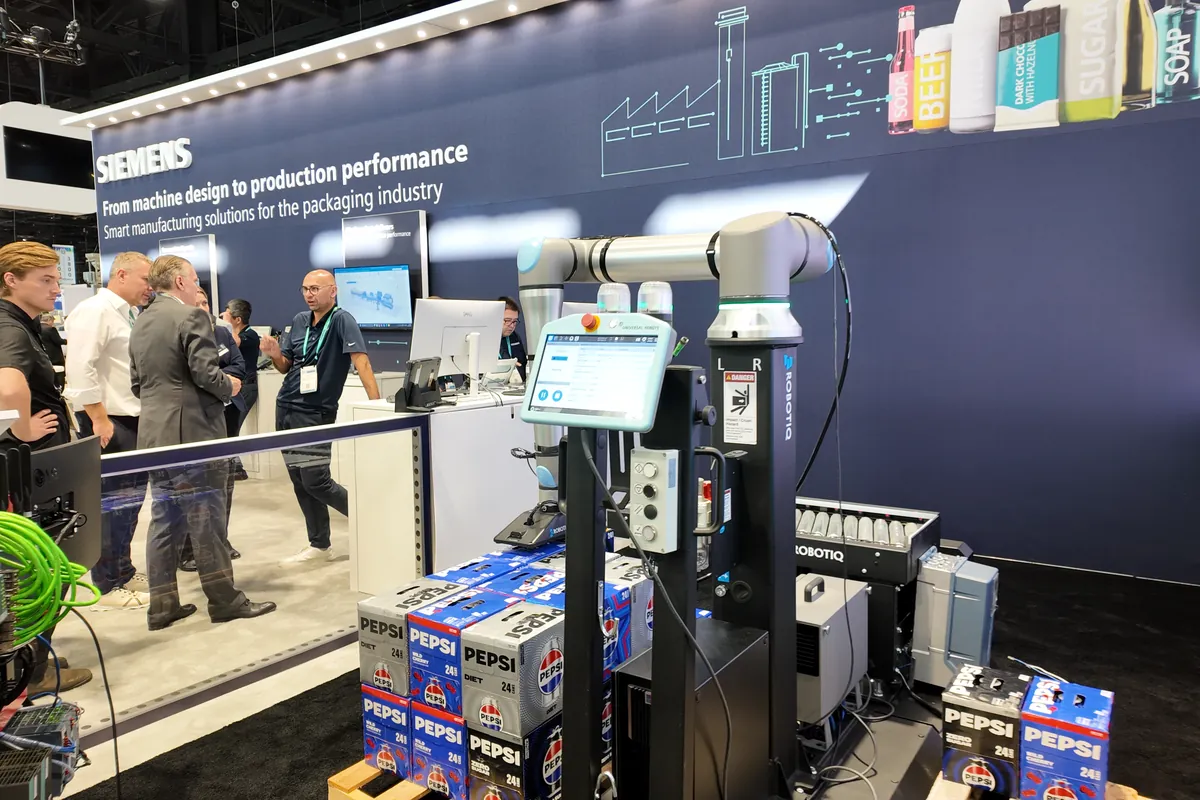 Siemens’ AI-powered digital twin helps PepsiCo simulate and optimize filling, packaging, and palletizing operations.Sassetti says that the system can choose liquid and powder specifications and then fill the bottle or can accordingly.
“From the palletizer point of view, we are able to make multiple layers, each one with a different package, so that brands can deliver what is needed for customization.”
He outlines that PepsiCo doesn’t always need a largepallet of one flavor, but that a mix of colors and flavors tailored to a specific event or distribution pathway are sometime preferable.
The solution enables PepsiCo to “simulate all the details” for accurate and flexible filling. Sassetti explains that the system also allows product testing and validation to ensure quality.
He adds that the system could be adaptable to many markets, such as wearable devices, but asserts that “the technology can also be applied with a more traditional fixed line.”
Also at Pack Expo 2026, Siemens has unveiled its next-generation Sinamics drives solutions, a range of motor drives designed to improve connectivity, standardization, and control across packaging and production equipment.
“Targeting standard industrial applications, from pumps, fans, and conveyors to processing machinery, the solutions expand the drives portfolio for industrial applications with a modern, general-purpose drive,” says the company.
Adaptable supply chains
Sassetti explains how the filling system taps into demand for localized supply offerings, especially for big events like the FIFA World Cup or the Rio Carnival in Brazil.
“It’s what we call a pop-up factory,” he notes. “It’s a temporary factory like a pop-up shop, but instead of selling, we are making the product. Usually, brands need to ship products.”
He underscores that a localized filling facility is especially important for brands adapting to fast-changing market trends.
“It’s difficult to estimate what the trend will be or who’s going to come and visit, and brands need to adjust the flavor. We created this factory with PepsiCo that can receive the order faster and then use AI to think about what the next trend will be.”
 Andrea Sassetti, digital enterprise innovation manager at Siemens.He adds that AI software integrated into the system can help PepsiCo predict trends based on things like weather, population demographics, season, or the number of spectators at sporting events.
“Plants are becoming adaptive so that they can react faster. Traditionally, brands need to add a code into the recipe, with time and speed [requirements].”
“But in this case, there’s an AI model that is running directly to the equipment that can determine, based on the viscosity, based on the particle size of the material, what will be the best combination of set point to mix [the beverage].”
AI caution
Sassetti tells us that, while the simulation uses AI “as much as possible,” there is always a supervisor to take corrective action in case there are issues.
“It’s just like when you’re opening Gemini, and it says: be careful, this is code, it’s AI-generated, and you copy and paste at your own risk,” he remarks.
“We have the same things here in that we can give you a possible solution, but the operator needs to have full confirmation of that.”
Earlier this year, Packaging Insights spoke to Jude Pullen about his collaboration with product and service solutions provider RS Group and Nvidia to enhance efficiency in packaging production.
With live reporting from Milana Nikolova at Pack Expo 2026.