

PureCycle and IPL Schoeller target New Jersey’s EPR rules with 20% PCR packs


Key takeaways
- PureCycle and IPL Schoeller’s new SnapPack Square EVO contains 20% PCR PP using PureFive resin.
- The food-contact container is designed to help brands prepare for New Jersey recycled-content requirements and emerging EPR rules.
- SnapPack Square EVO is expected to launch in fall 2026, with additional sizes and formats planned.
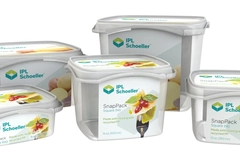 (Image credit: PureCycle).
PureCycle and IPL Schoeller have developed SnapPack Square EVO, a tamper-evident off-the-shelf container line incorporating PureFive recycled PP resin to meet EPR and recycled content requirements.
“The SnapPack Square EVO contains 20% post-consumer recycled (PCR) content, while the standard SnapPack containers do not contain recycled content,” Christian Bruey, director of Sustainability and External Affairs at PureCycle, tells Packaging Insights.
PureCycle’s recycled PP PureFive resin is made using a patented dissolution process. The resin is recognized as qualifying recycled content under Recycled Content Law in New Jersey, US, and is certified by the Association of Plastics Recyclers as PCR content.
New Jersey’s Recycled Content Law dictates that rigid plastic packaging should contain a minimum of 10% PCR content, with the threshold expected to rise to 20% and to include food packaging by 2027, PureCycle highlights. The company expects this threshold to rise to 50% by 2036.
The packaging solution will meet the recycling content requirements of the expected New Jersey EPR, according to PureCycle. Recently, Sahar Mehrabzadeh, chief revenue officer at Bay Cities, told us that New Jersey’s EPR is “close behind” states that have already adopted a regulation of this kind.
“EPR laws in California, Oregon, and other states will impose similar source reduction and recyclability requirements between 2027 and 2032, with the first deadlines arriving as soon as 2027,” PureCycle states. “SnapPack Square EVO is intended to give brand owners and producers a ready path to compliance and a head start on meeting those requirements, without waiting on a custom qualification process.”
Bruey continues: “Brand owners are being asked to meet recycled content targets on a timeline that a custom packaging program often can’t match. SnapPack Square EVO gives them a container that already contains PureFive resin, already performs like the packaging they know, and is already built for the regulatory environment they’re walking into. It’s a way to move fast without reinventing a package from scratch.”
Incorporating PCR
The SnapPack Square EVO is based on PureCycle and IPL Schoeller’s collaboration with Cleveland Kitchen, a supplier of private-label refrigerated pickle products, which expanded into a standardized container platform available to brand owners and retailers across food-contact categories.
Melissa Vettleson, Sustainability and Materials engineer at IPL Schoeller, comments: “Our work with PureCycle on the Cleveland Kitchen container showed us that recycled content and performance don’t have to be a trade-off.”
“SnapPack EVO takes what we learned from that program and turns it into a standard offering, so any brand owner can bring PureFive resin into their packaging without starting from zero. It’s a faster, lower-risk way to build recycled content into a container line.”
PureCycle expects SnapPack EVO to become available to brand owners starting in the fall of 2026, with new sizes and formats rolling out gradually.
Bruey notes: “PureCycle and IPL Schoeller are committed to providing brand owners with sustainable packaging. We look forward to broadening our partnership with IPL Schoeller beyond the SnapPack Square EVO containers in the future.”
Recently, PureCycle also partnered with RM Tohcello, a Japanese producer of biaxially oriented PP (BOPP) film, and Mitsui, a trading and investment company that collaborates with PureCycle. Alongside Innovia Films, PureCycle produced and trialed white, cavitated BOPP film containing more than 40% PCR PP content.
Additionally, the company joined Toppan to develop flexible films and thermoformed packaging using recycled content.