


Industry advances packaging solutions as “renewables do not mean compromise”


Key takeaways
- Renewable materials are overcoming the historical trade-off of performance, with advances in fiber engineering improving strength, thermal resistance, and structural integrity in packaging.
- The packaging industry is moving beyond vague environmental claims.
- It focuses on material transparency, responsible design, and integrating packaging into real recovery systems like recycling and composting.

The biggest barrier to renewable packaging adoption is not the materials themselves, but the systems and infrastructure around them, according to Benjamin Cassou, co-founder and CEO at ReStalk.
Stefan Mergel, head of Sustainability at SIG, says that the real roadblock — when considering a switch to more eco-friendly packaging — is not the lack of ambition but rather the lack of solutions that work here and now, and without trade-offs like loss of speed and efficiency in production.
We sit down with ReStalk and SIG to explore how the packaging industry can accelerate renewable material adoption.
“For decades, global packaging infrastructure has been optimized around petrochemical plastics. Manufacturing equipment, supply chains, and recovery systems were designed with those materials in mind,” Cassou tells Packaging Insights.
“Transitioning to renewable packaging requires alignment across manufacturing compatibility, feedstock logistics, and end-of-life infrastructure for composting or fiber recovery.”
Redefining materials
While agricultural residues are abundant, historically, they have not been integrated into large-scale industrial material supply chains.
Cassou notes that building the infrastructure to collect, process, and transform these materials efficiently is crucial to unlock their full potential.
“At the same time, the industry is moving away from vague environmental claims. Brands, regulators, and consumers now expect greater material transparency and the elimination of harmful chemistries,” he says.
“In our view, the most important packaging innovation today isn’t just replacing plastic: it’s redefining where materials come from.”
“When the origin of materials changes, the entire packaging system begins to morph accordingly.”
Regional feedstock advantages
For a long time, renewable materials were seen as alternatives that required a performance trade-off, Cassou tells us.
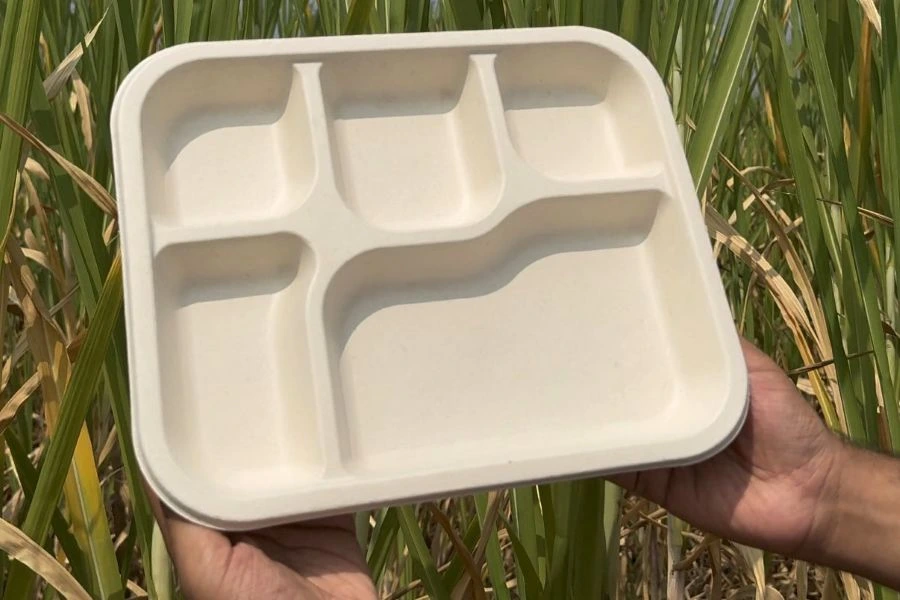 ReStalk’s molded fiber trays’ strength can compete with conventional, single-use materials (Image credit: ReStalk).“That narrative is quickly disappearing. Advances in fiber engineering, forming technology, and material science have significantly improved the strength, thermal resistance, and structural integrity of molded fiber packaging. This applies to many applications, including food service packaging and protective molded packaging.”
“Molded fiber packaging can deliver compression strength and thermal performance comparable to many single-use plastic formats used in food service applications, while remaining compatible with composting or fiber recovery systems.”
Cassou adds that where things become “particularly compelling” is economics.
“Regionally sourced feedstocks reduce transportation costs, minimize raw material volatility, and streamline manufacturing while offering farmers a new revenue stream. Our distributed production model allows us to manufacture closer to the markets we serve, which further improves efficiency across the supply chain.”
“These structural advantages create cost efficiencies that we intentionally pass along to our customers. As regulations tighten around plastics and brands rethink their material strategies, that change is happening faster than many expected. Renewable materials no longer mean compromise.”
Environmental impact reduction
Meanwhile, SIG Terra solutions are “plug and play,” designed to fit seamlessly into existing operations and to run on existing SIG filling lines, enabling rapid industry adoption, according to Mergel.
SIG Terra Alu-free + Full barrier protects all main beverage categories like liquid dairy, fruit juices, nectars, and plant-based beverages without the need for refrigeration.
“Our SIG Terra solutions demonstrate that it’s possible to ‘choose better’ — achieving top performance, product quality, and cost-effectiveness, while enabling manufacturers to reduce their environmental footprint without compromise.”
He notes SIG Terra Alu-free + Full barrier is a “great example” of how manufacturers can unwrap a more sustainable future. “With this solution, they can go aluminum-layer-free and reduce CO2 emissions by up to 61% when linked to forest-based polymers,” says Mergel. SIG Terra Alu-free + Full barrier products are said to have a lower carbon footprint than other, similar packaging formats (Image credit: SIG).
“They can reduce their environmental impact without compromising performance, product protection, or up to 12 months shelf life. It is a ready-to-go solution that works on existing SIG filling lines at a speed of up to 24,000 packs per hour, making sustainability scalable, fast, and cost-effective.”
Life cycle sustainability
With a high share of forest-based renewable materials, lightweight, and space-saving, designed to be fully recyclable, and produced with 100% renewable electricity, SIG carton packs are “the proven lowest carbon footprint choice” compared with alternative packaging options, according to Karina Boers, group director for Corporate Responsibility at SIG.
Boers says the company’s LCA results show that the biggest impact on the life cycle of its packs comes from the production of raw materials.
“SIG packs are already designed and manufactured to have a carbon footprint that is far lower than other packaging formats. However, we are committed to pioneering even lower carbon packs.”
ReStalk’s Cassou explains that the most important design decisions happen long before a package reaches the consumer.
“For decades, packaging design has been constrained by the limitations of plastics and traditional formats. Renewable materials give us an opportunity to rethink those conventions. Brands don’t just need substitutes for plastic — they need packaging that can tell a story about where materials come from and where they go next. That’s where innovation becomes exciting.”
Cassou says molded fiber allows designers and brands to move beyond standard boxes and trays to explore new forms, textures, and structural designs.
“It invites companies to literally and figuratively think outside the box. Packaging can become part of the product narrative, helping consumers understand that the material in their hands began as a renewable agricultural resource rather than a fossil-based input.”
The right way to design
Consumers often associate biodegradability with sustainability and regard it as a way to reduce long-term environmental waste. They believe biodegradable packaging will naturally break down and minimize landfill impact.
But Boers says there are notable limitations to that belief. “Not all biodegradable packages degrade efficiently in real-world conditions. Many require, for example, industrial composting facilities, which are not widely accessible.”
“Its effectiveness depends on infrastructure, consumer behavior, and product requirements, and it can sometimes create more problems than it solves if not implemented thoughtfully. From our point of view, recycling and reuse are effective ways to act sustainably when a package is emptied, and it is worth continuing to focus on them.”
“High-barrier food packaging, like our aseptic cartons for ambient long-life products, for example, milk, juices, and soups, has special tasks to fulfill. It must create a barrier against light, oxygen, and moisture to maintain high product quality over a long period of time without refrigeration or preservatives.”
Cassou says biodegradability is often the first concept consumers latch onto when thinking about sustainable packaging — but it is only part of the story.
“What people usually ask is a bigger question: What is this thing made of, what is this material, and what happens to it after I use it?”
“At the same time, regulations are beginning to catch up with that expectation. Across Europe and other markets, we’re seeing stricter rules around PFAS, material transparency, recyclability, and compostability claims.”
These rules are pushing the industry to move beyond marketing language and design packaging that fits into real recovery systems.
“For renewable fiber packaging, biodegradability works best when paired with responsible material design: use non-toxic inputs and create packaging that can safely return to composting or fiber recycling streams,” says Cassou.
“In other words, biodegradability shouldn’t be the headline. It should be the natural outcome of designing materials the right way from the beginning.”