
Schubert to showcase AI-powered packing cobots at ISM Manufacturing 2027

Key takeaways
- Schubert will demonstrate its AI-enabled TOG pick-and-place cobots at ISM Manufacturing 2027 (Jan 31–Feb 2).
- The cobots use AI-powered vision systems to identify and handle randomly positioned products, achieving up to 90 picks per minute.
- The company will also present its modular TLM and LightLine packaging solutions, designed for different production requirements.
 (All Image credits: Schubert).
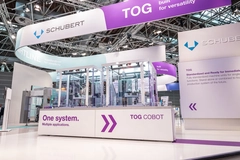
Gerhard Schubert will showcase its TOG AI-enabled pick-and-place cobots, as well as its TLM and LightLine product lines, at ISM Manufacturing 2027 in Cologne, Germany (Jan 31–Feb 2), formerly known as ProSweets Cologne.
“The TOG Cobot is a highly versatile pick-and-place robot with no product category restrictions,” Hannes Häusler, head of the Cobot Division at Schubert, tells Packaging Insights.
“Provided it has been trained with matching product data beforehand, it can handle a wide range of items, from muesli bars to technical products such as glue sticks or tubes. The cobot can fill boxes and trays or load chains and conveyor belts, which in turn feed cartoning, form-fill-seal, wrapping, and other machines.”

On the show floor, the German packaging machinery provider will use apple crisp pouches to provide a live demonstration of its TOG cobots’ packing capabilities. The first cobot picks up the pouch and places it in a box or on a conveyor belt. The second cobot then retrieves the box and places it into plastic crates.
“Thanks to its compact footprint of just 1.6 x 1.6 meters and its interfaces, the TOG Cobot can easily be integrated into existing packaging lines, even when floor space is limited. Like all technologies from the TOG range, it can also serve as a standalone solution,” Häusler adds.
AI vision
The TOG cobots’ “vision” is based on AI-supported image processing, allowing it to recognize items lying in a disordered state and to pick them up with precision, according to the company. It adds that robotics and vision systems are coordinated within a single integrated solution.
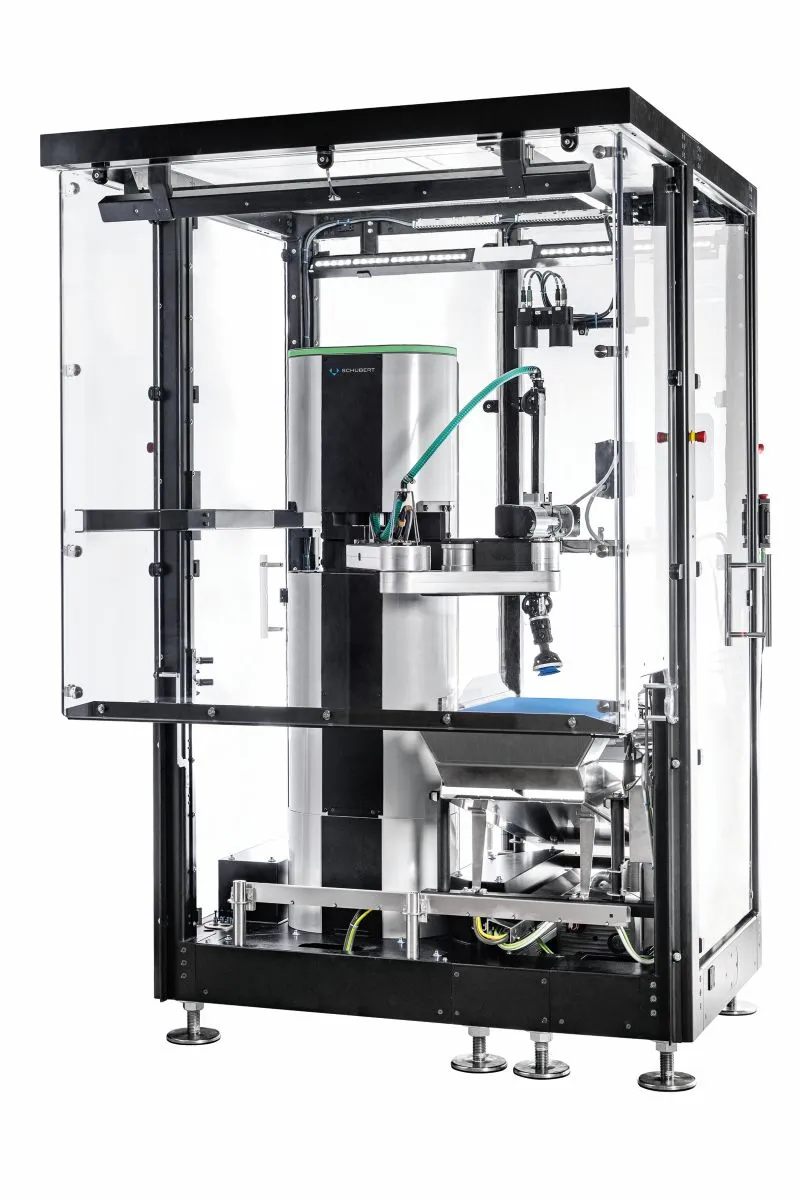 Schubert’s AI-powered TOG Cobot for packaging automation.Häusler explains: “AI-supported vision systems enable robots such as Schubert’s TOG Cobot to autonomously and efficiently pick and place various items, from technical components to baked goods and snacks, offering significant benefits to the entire production line.”
“Unlike traditional algorithms, which require a unique rule for each item, AI-based algorithms develop their own rules for picking and placing based on previously learned object categories. Therefore, they do not require time-consuming programming and can be used immediately following installation.”
Another benefit of the cobots, according to Häusler, is that they reduce the number of line components required, such as indexing and chain spacing. In a recent customer project, for example, Schubert’s TOG Cobot helped reduce the number of components needed to handle muesli bars because it is capable of doing so independently, he adds.
“The cobot ‘sees’ what is in front of it and makes independent decisions, requiring no additional assistance with product spacing or synchronized movement of products or packaging over a fixed distance. Instead, products can be processed continuously, ensuring further time savings.”
Bin picking functionality
Schubert notes that the packaging on the line does not need to be in a particular order for the cobots to operate properly, and boxes do not have to be guided by a conveyor chain or aligned in any other way.
“AI vision relies on cameras and neural networks, which act as a kind of robotic brain,” Häusler details. “These allow the robot to recognize items it has not seen before based on category information, such as bottles, pouches, and flow packs, with which the cobot has been trained. This even works with unsorted objects, as the neural network has been trained using exhaustive image data that includes items in different positions.”
“However, to realize its full potential, AI vision relies on dynamic, flexible robotics with a certain range of motion and adequate tools,” he continues.
When an AI-based robot “sees” an item belonging to a learned category, it can adjust the movement and position of its tool, as well as its speed, to handle the item securely, he explains further. “The so-called bin picking, which is picking from an unsorted pile, reduces the need for products to be separated and aligned first, contributing to more compact packaging lines.”
The cobots achieve up to 90 picks per minute within an area of two-by-two meters, “with a small footprint,” according to Schubert.
“The full potential of these technologies is best leveraged in combination with other process steps, as this enables highly flexible support,” Häusler shares. “For example, the TOG Cobot can act as a feeding solution for a flow-wrapping machine, while the TOG Erecting Unit can support cartoning operations once products have been reliably flow-wrapped.”
“In this way, the TOG range serves as a precision tool for automating individual process steps in a highly targeted, efficient, and time-saving manner.”
Robotized packing lines
Schubert will also discuss and provide information about its TLM and LightLine packing lines at next year’s ISM Manufacturing.
Its modular and “robot-based” TLM modules can be combined individually into an integrated packaging solution for tasks involving a “wide variety” of products and formats, the company highlights.
Meanwhile, its LightLine series targets manufacturers with less complex and “highly standardized” packaging tasks. Schubert explains that it has made this possible through the use of preconfigured machines that reduce planning and assembly effort while facilitating a quick production start.
The LightLine series also includes machines with pack and place capabilities, as well as flow wrappers, case packers, and cartooning machines. The series is compatible with TOG cells to create a tiered range for different requirements in terms of flexibility, performance, and investment budget.