

Vetropack moves lightweight Rezon glass bottle into industrial production

Key takeaways
- Vetropack has scaled its thermally strengthened Rezon lightweight glass bottle from pilot production to industrialmanufacturing at its Pöchlarn plant in Austria.
- The reusable bottle is described as up to 30% lighter than conventional alternatives, offering more use cycles and reducing life-cycle CO2 emissions compared with single-use bottles.
- Vetropack plans to open a second large-scale Rezon production plant in Pöchlarn in 2027, with further expansion to other Group sites planned in the medium term.
 (Image credit: Vetropack).
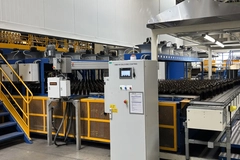
Rezon, a thermally strengthened lightweight glass bottle by Vetropack Group, has moved from its pilot phase into industrial series production at a large-scale plant in Pöchlarn, Austria.
Vetropack indicates that the factory ramp-up phase began this spring and included the training of around 30 employees and the production of more than 300,000 test bottles. Rezon bottles are now produced exclusively at the new large-scale plant, according to the company.
The Rezon producer says that its thermally strengthened bottles are up to 30% lighter than conventional reusable bottles while achieving up to 60% more use cycles. The glass producer explains that thermal strengthening technology can also improve resistance to scuffing, helping to ensure the bottles’ premium appearance in the long term.

“We have shown that we can produce Rezon reliably on an industrial scale in larger volumes and at a level of quality we had not achieved before,” says Guido Stebner, chief technology officer of Vetropack.
“This has been made possible by, among other things, optimized process steps, automation, and digitalization. All three are also key elements of our Strategy 2035.”
Carbon footprint and traceability
Rezon is said to combine lower-than-average weight and longer service life, supporting beverage producers in “significantly” reducing the total cost of ownership of a bottle over its life cycle.
Vetropack adds that the bottle’s shape and its crate’s geometry can improve transport logistics by increasing pallet capacity by up to 33%. Better pallet capacity can further contribute to a lower environmental footprint. The company states that Rezon reduces CO2 emissions by up to 70% over its life cycle, when compared with single-use bottles.
Rezon bottles can be fitted with a Data Matrix code that allows each bottle to be uniquely identified and traced. Earlier this year, Vetropack partnered with Coca-Cola and Myneral Labs to develop a digital traceability system that assigns reusable glass bottles with an engraved Data Matrix code.
Schubert’s AI-powered TOG Cobot for packaging.The glass packaging expert says that Rezon is one of the growth drivers of its corporate Strategy 2035 to expand solutions that “support customers beyond the packaging itself.”
Evan Williams, chief commercial officer of Vetropack, comments: “Our customers expect more from us than just high-quality glass packaging. Rezon shows how we create measurable added value: less weight, more use cycles, more efficient logistics, and a significantly better carbon footprint.”
“With industrial production, we can now increase the scope and scale of supply of Rezon. This investment demonstrates our commitment to the product and the technology and represents the next step in our leadership in reusable packaging.”
Rezon’s commercialization journey
Vetropack launched its thermal strengthening technology for glass bottles in 2019, describing it as the world’s first thermally strengthened glass bottle that is also durable and up to 30% lighter than conventional bottles. Since its launch, more than 35 million bottles have been sold, according to the manufacturer.
Austria’s brewing industry, including brands such as Gösser and Rieder, has had access to the 0.33 L reusable Rezon bottles since early 2024, helping meet the national reusability quota, the glass producer adds.
The technology has received industry recognition, such as the Circular Innovation Award Austria, two WorldStar Awards, the Austrian State Prize for Smart Packaging, and the Swiss Packaging Award.
In 2027, Vetropack is planning its next expansion step with a second large-scale plant for Rezon, which is also scheduled to go into operation in Pöchlarn.
Armelle Dupont, commercial and programme director at Vetropack, states: “We expect significant market growth over the next two years. Market momentum is clearly picking up.”
Vetropack says that in the medium term, it intends to extend Rezon production to other Group sites.
Earlier this year, Vetropack released a 0.75 L Rhinewine bottle weighing 350 g, lower than conventional wine bottles.