
UPM launches carbon-negative, NIR-detectable black pigment for recyclable packaging


Key takeaways
- UPM has introduced a bio-based, NIR-detectable black pigment made from renewable lignin.
- The carbon-negative pigment enables recycling of black packaging.
- Production will be scaled at UPM’s €1.3 billion (US$1.5 billion) Leuna biorefinery in Germany.

UPM has introduced a carbon-negative pigment for premium packaging. The UPM Circular Renewable Black is the “world’s first” bio-based, near-infrared (NIR) detectable, carbon-negative pigment.
Black packaging is challenging to recycle as conventional pigments are made from carbon black, which inhibits NIR detection, making the material “invisible” to sorting systems.
UPM’s new pigment is made from renewable lignin. It is also certified by third-party bodies, including FSCTM, PEFC, and ICSS Plus.
UPM highlights that the bio-based pigment ensures luxury appeal but is NIR detectable, meaning it can be sorted and recycled.
Robert Marx, vice president for commercial at UPM Biorefining, says: “With UPM Circular Renewable Black, we are redefining what’s possible in sustainable packaging. For years, black was seen as incompatible with circularity — but we’ve changed that.”

“This innovation combines deep black with full recycling detectability and a carbon-negative footprint, proving that sustainability and design excellence can go hand-in-hand. It’s a breakthrough that reflects UPM’s commitment to driving bold, science-based solutions for brand success and a truly sustainable circular economy.”
Carbon-negative solutions
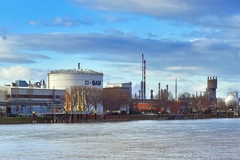
The solution is part of UPM’s portfolio of CO2-negative solutions that are set to be manufactured at its €1.3 billion (US$1.5 billion) biorefinery in Leuna, Germany. According to UPM, the facility is the largest industrial-scale investment in biochemicals in Europe.
The plant converts hardwood into next-generation biochemicals, enabling the transition from fossil-based to renewable materials across multiple industries.
Recently, UPM and Sappi signed a non-binding letter of intent to create a joint venture combining their regional graphic paper operations. The planned consolidation is expected to generate roughly €100 million (US$116.5 million) in annual synergies.
At Labelexpo Europe 2025, it launched a portfolio of new specialist label solutions designed to address emerging trends in logistics and consumer durables.
Meanwhile, UPM Adhesive Materials introduced a collection of premium performance label materials for wine and spirits packaging. The collection is part of a sample folder, available in European, North American, South American, and Asia-Pacific markets.