
Interpack 2026 review: Packaging industry innovates for resilience & regulatory readiness


Key takeaways
- Interpack 2026 showcased global packaging solutions addressing supply chain challenges and rising polymer costs.
- Companies highlighted resilience through global partnerships and material-agnostic approaches to meet PPWR and sustainability regulations.
- Innovation trends included recyclable, lightweight, and multi-functional packaging to reduce waste and extend shelf life.
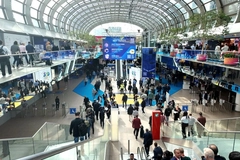
At Interpack 2026, 2,899 companies representing the entire packaging value chain showcased their latest solutions to 270,899 visitors from 169 countries, as industry players cope with the strain on global supply chains and increasingly strict packaging regulations.
The ongoing US-Iran war has affected the global packaging industry in major ways. At the same time, many of the packaging companies we spoke to at Interpack 2026 assured that they have not yet fully felt the burden of this crisis, with large players with diverse partners across the globe coming out as best prepared to weather the storm.
“Supply chain issues are not affecting KHS in such a big way,” Peter Brücker, head of the KHS packaging technology product center, told Packaging Insights. “This is because our global structure means we have a global manufacturing platform with different areas like in China, India, and the US. This means we can support out of these areas without blocking our performance.”
“We have huge partnerships all over the world, so we can act in Europe if we have problems in China or vice versa. If we run out of supply in China, we will supply out of Brazil or the US.”
Global partnerships for resilience
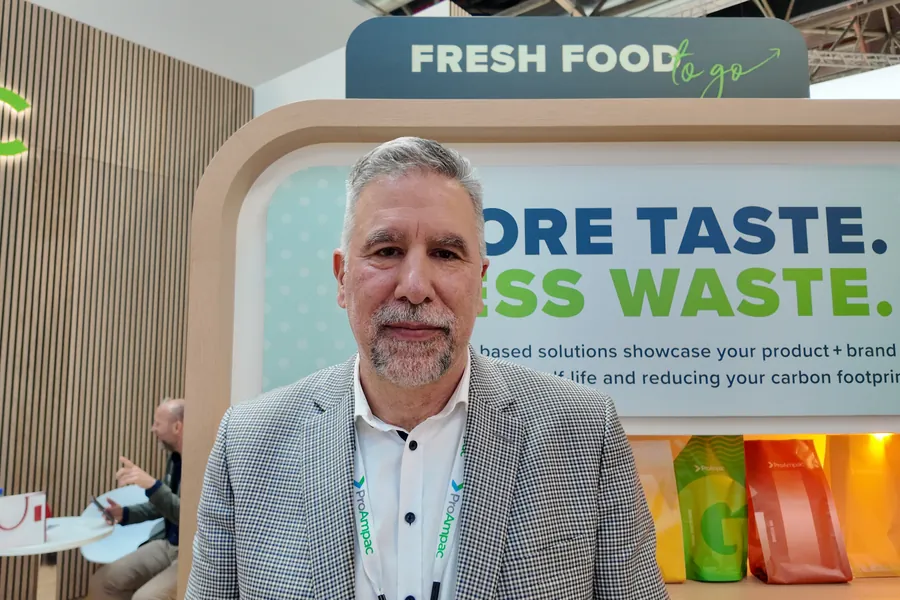 Sal Pellingra, VP of Global Package Design, Applications, and Business Development at ProAmpac.Sal Pellingra, VP of Global Package Design, Applications, and Business Development at ProAmpac, argued that, while supply chain disruptions are bad news for the industry overall, “with what’s happening in Iran and with raw materials,” global manufacturers like ProAmpac are at the top of the “food chain.”
“We have well-developed supply chains. Unfortunately, smaller manufacturers are going to have less access,” he added.
“We are feeling really good about supply, but more troubled for the entire industry. This is one of those storms we have to weather, and we’ve weathered them in the past, but fortunately, our broader, global manufacturing footprint is of huge help. We have very good relationships with our supplier base.”
“We just have to continue leveraging our size and work with our partners, so we can keep supplying without interruption.”
Flavio Froehli, VP of marketing and sales at Sappi, said that while the Middle East crisis has had a knock-on effect on costs in particular, as far as the supply chain is concerned, Sappi has managed to fare well.
Froehli’s sentiment was echoed by Cheryl Caudill, the VP of marketing and sustainability at Greif, and Peter Schubert, head of design engineering at Gerhard Schubert, who also emphasized the importance of the companies’ global reach.
Rising polymer prices
 Metpack’s VP for sales and NPD, Sühan Gürer.Metpack’s VP for sales and NPD, Sühan Gürer, said one of the major trends he saw at Interpack 2026 was the adoption of paper packaging that replaces plastic. “Of course, this is partially due to the supply crises we are having right now.”
At the trade show, Metpack, a global producer of certified home compostable paper and paperboard for food packaging based in Istanbul, Türkiye, launched two new solutions. These are its EzyCompost Flex, which is a recyclable, low-barrier flexible packaging for items such as spices, chocolate, and other food items, and the EzyCompost HighBarrier flexible packaging.
“We are also consuming polymers in certain Metpack products, and we’ve seen the polymer price changes affected by the ongoing war in Iran and the blockade of the Strait of Hormuz. This is changing the perception of the customers and the main reason is the critically short supply, which has led to prices more than doubling, depending on the type of polymer,” Gürer shared.
“We have to find alternatives to tackle the supply issues. We need plans A, B, and even C and D. We have to understand that some of the disruptions are here to stay for the long term, because some of the facilities have been hit. It’s not only the face value that we look at or the rise of the oil prices, but that’s only the short outlook. Of the facilities that have been hit, some might start working again in a year, and some in five years. That’s why we have to look carefully and foresee the effects.”
Material agnostic regulatory response
Evolving global packaging regulations, especially the EU’s Packaging and Packaging Waste Regulation (PPWR), were seen as a major driver of new packaging developments at Interpack 2026. Multiple industry players described themselves as “material agnostic” in their approach to responding to regulatory and sustainability pressures.
Thomas Schulz of Constantia Flexibles described the company in this way, saying its portfolio involves multiple material “evolutions,” tackling diverse sustainability and regulatory compliance goals.
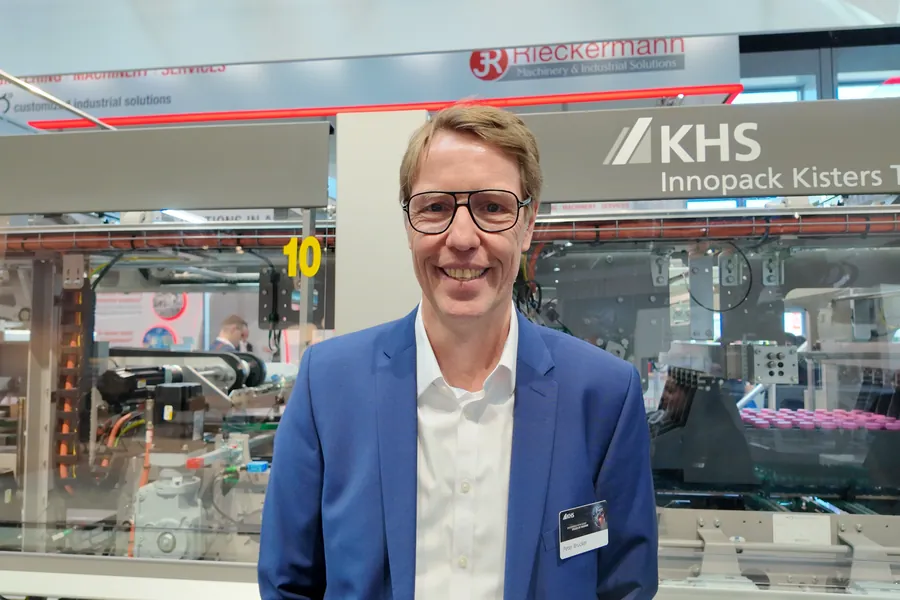 Peter Brücker, head of the KHS packaging technology product center.ProAmpac’s Pellingra explained that material agnostics use the least amount of material possible to ensure the longest shelf life and product protection that is possible.
“Food waste and product waste are much more of a problem for the environment than excess packaging waste, so we need the least amount of materials, whether it’s film or fiber, and the maximum amount of shelf life, and then making solutions circular, so they can be reused or recycled.”
Similarly, opting for combined functionality and lightweighting, Brücker said the PPWR has been an innovation catalyst for KHS. He highlighted the company’s fully recyclable beverage bottles and its cardboard-based, shrink-film-free solution for holding beverage bottles together. “In the future, regulations may ban the shrink film.”
“We also have our newest application, the Nature MultiPack, for which there is no packaging material necessary. Glue dots are used to band multipacks. This is in line with the PPWR,” he said.
Also on the show floor, Brückner Maschinenbau, Profol, Taghleef, Toppan, and the World Packaging Organization (WPO), told us that within the flexibles space, single-polymer structures capable of replacing multi-layer laminates are a standout solution for recyclability and PPWR compliance.
Nerida Kelton, the VP of sustainability and safe food at WPO, asserted that designing to ensure true packaging circularity for the real recycling infrastructure available is essential to preventing “wishcycling” claims by industry players.