




PGS Group targets scope 3 emissions with wooden pallet carbon tool
Key takeaways
- PGS Group has launched a Product Carbon Footprint tool covering all its newly produced wooden pallets.
- The methodology is aligned with the GHG Protocol Product Standard and ISO 14067 and independently verified by Vinçotte.
- Customers can use product-specific emissions data to support Scope 3 reporting and identify opportunities to reduce pallet-related emissions.

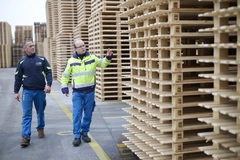 (All image credits: PGS Group).
PGS Group has launched a Product Carbon Footprint (PCF) tool for its wooden pallets, offering PCF assessments to its customers. The tool calculates the carbon footprint of all new wooden pallets produced by PGS, according to the French packaging manufacturer.
PGS says it developed its PCF service alongside Turn the Tide, an external carbon expert, while its methodology has been independently verified by Vinçotte.
“The tool works top-down,” a PGS spokesperson tells Packaging Insights. “It starts from the PGS corporate carbon footprint for fiscal year 2024 (1 October 2023 to– 30 September 2024), isolates the emissions linked to producing new wooden pallets across our sites.”
The spokesperson explains that the tool allocates emissions to ten building blocks, including nails and rivets, boards and beams, compressed wood blocks, metal blocks, and plastic blocks. The building blocks also include inbound transport, assembly, heat treatment, painting, and impregnation.

Each block has an emission factor per kg or per cubic meter, as PGS outlines. “The footprint of a pallet type is the sum of those factors multiplied by the bills of materials and its treatments.”
The activity data highlights PGS’s energy and fuel use, material purchases, transport records, waste, and production volumes.
“The result is from cradle-to-gate,” the spokesperson continues. “Raw material acquisition and pre-processing, transport to PGS, and production at PGS.”
“Transportation to the customer is calculated as a separate line. Biogenic emissions and the carbon stored in the wood are also reported as separate figures; stored carbon is not subtracted from the footprint.”
The method is aligned with the GHG Protocol Product Standard and ISO 1406, according to the provider.
Development challenges
Discussing the main challenges in developing a tool that provides product-specific carbon data rather than relying on industry averages, the PGS spokesperson notes that achieving consistency across sites was a hurdle.
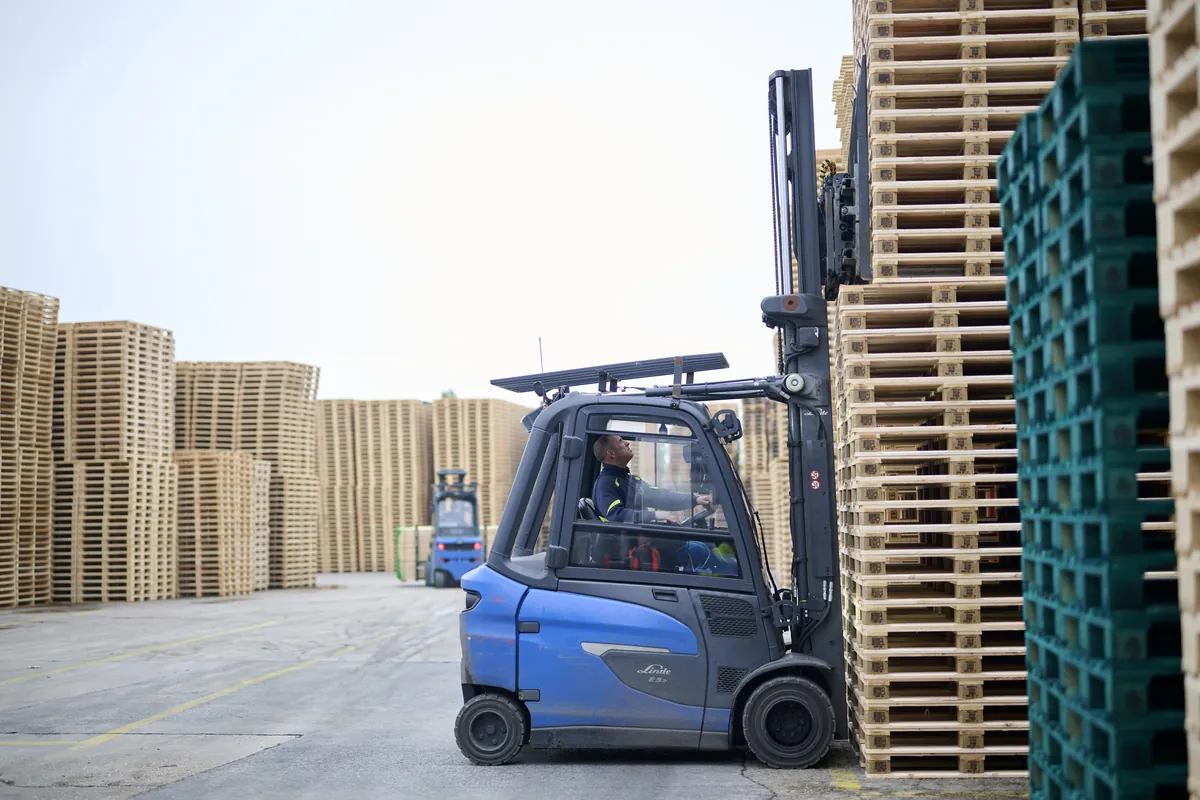 The PGS tool aims to gives customers an emission per pallet type for their own corporate carbon footprint.“Timber, nails, and pallets are produced at sites across the European countries where PGS operates, with different process routes. The method had to bring these into one calculation structure in which every figure remains traceable to the corporate inventory.”
The spokesperson also points to allocation as another hurdle that PGS had to address. “Emissions that serve several outputs have to be divided on a defensible basis, for example between sawn timber and co-products such as chips and sawdust at our sawmills, or between heat treatment with and without drying.”
“Such choices can change results substantially, and that is also a reason why we had the tool reviewed externally.”
Meanwhile, the company had to go from reporting on corporate carbon footprint to a product carbon footprint. “A corporate footprint does not capture every product-relevant flow at the level of detail a product calculation needs,” the spokesperson explains. “We added these, for example, external sawing and pre-drying of purchased timber and second-tier transport of purchased wood.”
Upstream data was another challenge, according to the company. “For our own operations we use measured activity data. For purchased materials, supplier-specific data are not yet available throughout, so database factors are used. The methodology states this as a limitation.”
Supporting scope 3 reporting
PGS argues that its customers can use PCF data to better understand and reduce packaging-related emissions within their Scope 3 reporting.
“Scope 3 estimates still rest largely on industry averages at sector-level, which do not reflect what an individual supplier or product emits,” the company spokesperson details.
“The tool gives customers an emission per pallet type for their own corporate carbon footprint. It replaces a generic estimate for purchased pallets with a figure based on PGS’s production data and the specification of the pallet bought.”
“Each data sheet splits the footprint into materials, inbound transport, and production, so the customer sees which stage dominates for their pallet.”
The tool also quantifies design levers, including the volume of wood and the weight of nails and other metal parts. “Steel carries far more emissions per kilogram than wood, so fasteners and metal blocks weigh more in the footprint than in the pallet.”
It also quantifies the block type, for example, solid wood, compressed wood, metal, or plastic. It also quantifies the treatment: ISPM 15 heat treatment alone or combined with drying, and whether the pallet is painted or impregnated.
Transport distances for materials brought to PGS and of pallets to the customer are also taken into consideration.
“The figure is cradle-to-gate and covers climate impact only. It says nothing about how many trips a pallet makes. Also: a lighter pallet that fails earlier is not an improvement, so design changes are assessed against the performance required.”
Annual usage
PGS explains that each dataset represents one fiscal year and is not a multi-year average, with current figures based on fiscal year 2024, and fiscal year 2025 data in planning.
 PGS says metal fasteners and blocks contribute disproportionately to a pallet’s carbon footprint compared with their weight.“The tool is rebuilt each year from the corporate carbon footprint, the same inventory we use to monitor progress on the reduction targets in our Climate Transition Plan,” the PGS spokesperson elaborates. “Changes in energy use and sources, materials, transport, production volumes, and sites therefore feed directly into the product figures, as do updated emission factors.”
“The priority for refinement is data specificity: supplier-specific data for purchased materials and site-specific data, where they replace database factors and proxy assumptions. These are the areas where better data adds most value.”
The methodology and calculations will be independently verified again with each annual update, according to the spokesperson.
A growing demand
PGS sees a growing demand for verified product-level carbon footprint data, adding that it may influence how customers select packaging and transport solutions.
“Customers’ own value-chain reporting is an important driver, whether it is required by regulation or follows from their own climate targets,” the spokesperson tells us.
“Purchased pallets typically sit in scope 3 category 1, purchased goods and services, so companies that report value-chain emissions need a figure for them.”
“For that category, the GHG Protocol’s guidance sets out four calculation methods and puts product-level cradle-to-gate data from the supplier first in order of specificity. That is the kind of figure our tool produces for each pallet.”
Such information needs to travel through the supply chain, the spokesperson adds. “Companies outside the scope of mandatory sustainability reporting may still receive requests from their own customers. Demand therefore comes both from companies preparing their own reports and from suppliers answering to customers further down the chain.”
PGS advises customers to understand and substantiate the figures they use. “Each PGS data sheet states the fiscal year covered, the calculation boundary, and the standard applied.”