


Sealed Air and Lenovo scale straw-based molded pulp packaging for laptops

Key takeaways
- Sealed Air and Lenovo have developed laptop packaging made from 50% straw pulp and 50% recycled paper pulp.
- The solution could replace 800 metric tons of PE plastic cushioning for every 10 million laptops shipped.
- The packaging enables the reuse of agricultural straw, reducing reliance on wood-based materials.
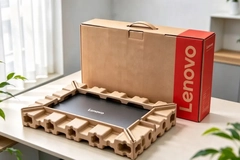 (Image credit: Sealed Air, AI enhanced by Sealed Air).
Sealed Air’s subsidiary, Fagerdala, is highlighting its collaboration with Lenovo to develop a plastic-free packaging solution for laptops made from 50% straw pulp and 50% recycled paper pulp.
Introduced to the Chinese market in 2025, the solution is designed to replace plastic cushioning materials while supporting the recovery and reuse of agricultural waste without compromising protective performance.
“Large volumes of agricultural straw are generated during the autumn harvest each year in China, creating disposal challenges associated with stockpiling, landfilling, or burning. Converting this agricultural waste into straw-based pulp packaging materials could offer a scalable alternative,” says Lenovo.
Adopting agricultural residue
Lenovo worked with Sealed Air to establish validation standards covering packaging structure compatibility, protective performance, user experience, and the feasibility of global implementation.

Sealed Air says that the development process involves converting agricultural straw into pulp. Following thorough processing and mixing, the materials form a pulp mixture suitable for molding.
The pulp then undergoes molding, drying, and hot-press forming processes to create a stable packaging structure. Finally, the packaging is trimmed and finished.
The companies share that for every 10 million laptops shipped, this transition can cut the use of PE plastic cushioning materials by approximately 800 metric tons. By incorporating straw pulp, the solution also reduces reliance on wood-based raw materials.
Sealed Air’s molded pulp packaging facility in Hefei, China, has established a comprehensive molded pulp production process, providing customers with integrated support spanning material development, structural design, and mass manufacturing.
Creating protective solution
Apart from eco-friendliness, the companies highlight that laptop packaging needs to meet various demands, including product protection, structural stability, dimensional compatibility, molding efficiency, and mass production capabilities.
Therefore, developing straw-based molded pulp packaging required multiple rounds of testing and optimization involving material properties, pulping parameters, molding processes, and hot-press forming.
Following successful trials, Lenovo’s new-generation laptops have now fully adopted molded fiber packaging.
The companies share that with the introduction of biodegradable straw-based molded pulp packaging, more than 650 metric tons of agricultural straw can be recovered and reused for every 10 million laptops packaged.
Earlier this year, Sealed Air unveiled the ProPad Mini, a protective packaging cushion that reduces operator movement in e-commerce products. The ProPad Mini is said to offer paper cushioning in small environments and provides flexible installation, including shelf, tabletop, swing-arm, and floor stand options.
This week, Packaging Insights spoke to Canopy Planet about how agricultural residues such as wheat straw and sugarcane bagasse could help paper packaging producers reduce exposure to volatile wood pulp prices. The organization highlighted that mills in China are best positioned to take advantage of agricultural residues to derive pulp.