


KHS and Rhodius scale resealable aluminum bottle production in Germany

Key takeaways
- KHS and Rhodius Mineralquellen have converted a canning line in Burgbrohl, Germany.
- The nine-month project introduced depalletizing, filling, labeling, inspection, and vacuum conveying technology while maintaining production during the conversion.
- Rhodius aims to grow the European market for resealable aluminum bottles, targeting RTD beverages.
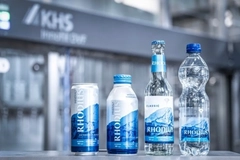
KHS has supported Rhodius Mineralquellen by integrating a resealable aluminum bottle line into the company’s production facility in Burgbrohl, Germany.
KHS adapted a canning line capable of processing up to 50,000 containers per hour. Rhodius then invested in depalletizing, filling, labeling, and inspection technology for the conversion. The companies share that they are working with an Innofill Glass DNRF glass bottler instead of using a classic can filler.
Gerd Bodenheimer, KHS project manager, says: “We ran through lots of different scenarios at the beginning of the project, integrating the new packaging into various lines in our minds. This allowed us to play out every conceivable setup with little effort, move existing lines around, and include potential new machines.”
Thomas Hüser, technical sales at KHS, adds: “We deliberately went for a long-tube filler. The long tube gently inserts the beverage just above the container base, forcing oxygen to the top and thus ensuring optimum oxygen values in the product.”
Advancing aluminum bottle production
The companies shared that the existing and new KHS Innopal AS 1 HZ were relocated to the facility’s basement. Two canners were decoupled, and the new array enables empty cans and aluminum bottles to be delivered to a single place for all lines.
To transport these empty containers to the filling line, KHS partnered with H. F. Meyer to implement a custom vacuum conveyor system.
Hannes Tack, managing partner at Rhodius, says: “KHS’s team understands what we want and need, and knows our premises inside out. This knowledge is valuable, especially when implementing highly complex projects.”
“Lots of brands are looking for high-quality alternatives that can be incorporated into existing closed-loop systems, which will help them stand out from their competitors at the point of sale. Our packaging system provides them with great opportunities, especially for trend beverages in the ready-to-drink segment such as functional beverages, flavored water, and energy drinks.”
Enhancing regional manufacturing
Rhodius purchases its pre-lacquered aluminum bottles with a screw cap from Japan. “Only a handful of suppliers worldwide have mastered the manufacturing technology for light, resealable aluminum bottles. Unfortunately, not a single one of them is operating in Europe,” says Tack.
With the new investment, the company aims to drive the development of the European market and promote regional production.
The revamped line has restored the initial maximum capacity output of 50,000 containers per hour, according to the companies.
“All processes ran smoothly from planning through installation to commissioning. A project of this size usually takes more than a year. We completed this conversion in nine months during ongoing operation,” shares Tack.
Initial runs feature Rhodius’ mineral water brand packaged in 400 mL aluminum bottles, as well as a limited Halloween edition for Bluna. Further product launches are planned for the end of the year.
Earlier this year, KHS unveiled the KHS Supreme PET bottle, a solution that utilizes the company’s Plasmax barrier technology and is designed to improve the protection of oxygen-sensitive beverages.
Next month, KHS is set to demonstrate its turnkey plant engineering from a single source — from the initial concept and system planning to flexible line concepts and consistent life cycle support — at BrauBeviale 2026 in Nürnberg, Germany (Nov 10–12).